Lowlights, glimmers of optimism from new St. Paul housing study


Last week, the Federal Reserve Bank of Minneapolis released a new report analyzing St. Paul’s housing trends and outcomes. It comes to the conclusion that the city’s policy landscape is a mixed bag. Attempts to reduce rent increases may have had unintended consequences, dampening new construction, whereas loosening restrictive zoning regulations seems to have helped.

My first reaction: I’m glad someone more accomplished than me is tracking housing trends in St. Paul. Back in 2021, as debate raged over the city’s referendum on strict rent control, it felt like I was the only one cobbling together housing statistics. For months, I’d spent hours on a spreadsheet tracking years worth of monthly Department of Housing and Urban Development data, hoping to understand how the city’s changing housing policies were impacting supply. 

Thankfully, a lot has changed. Two years ago, the city of St. Paul began publishing housing data on a dashboard, even breaking down housing construction by geography and subsidy status. The website is refreshingly complicated, showing how different data methodologies portray different trends. 

Then last week, the Minneapolis Fed team weighed in with its own St. Paul housing dashboard, alongside a slim-yet-punchy summary. The report lays out the city’s roller coaster policy landscape and its effects on construction and tax base, while offering comparisons with similar urban markets. The main takeaways are that St. Paul’s policies have had conflicting effects on its housing supply, its tax base is suffering, and despite increasing affordability problems, rents have stayed pretty much flat.

Countervailing forces on new construction

Those with longer memories will recall the 2021 rent control referendum, and how the public argument centered on the effect the new referendum might have on housing supply and affordability. As predicted, rent stabilization policies and politics in both St. Paul and Minneapolis have dramatically reduced new housing construction. 

Because of that impact, St. Paul officials amended the city’s rent stabilization policy more than once since the original strict approach was approved by voters in 2021. (See my articles on this: the first policy, the second policy and the in-place third policy.) 

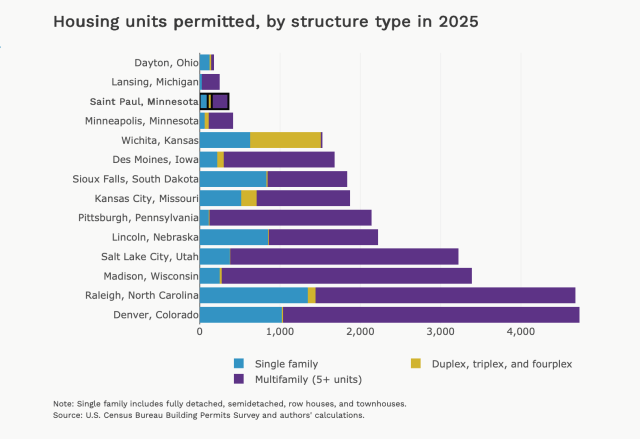
It turns out that, amid the chaos, St Paul’s housing production has dropped precipitously and, it’s worth noting, so has the Minneapolis trend line. As the Fed report points out, the numbers are so bad that St. Paul saw fewer apartments built last year than Lansing, Michigan, a city that’s been shrinking for a half-century.

Minneapolis Fed researchers compared Twin Cities housing production to comparable cities in the Midwest. Credit: Federal Reserve Bank of Minneapolis

Drawing on interviews, the Fed researchers point to the effects of rent stabilization politics on investment, specifically access to financing for housing developers. There’s no economic or geographic reason why Madison, Wisconsin; Wichita, Kansas; Lincoln, Nebraska; or Sioux Falls, South Dakota, should each be building twice as much housing as Minneapolis and St. Paul combined. The Twin Cities has a strong economy, at least when masked ICE agents aren’t on the streets.

Both Minneapolis and St. Paul have seen a decline in the number of residential housing units permitted, although the picture is slightly brighter in Minneapolis. Credit: Federal Reserve Bank of Minneapolis

At the same time, zoning reforms have made it easier to build new homes, providing a “carrot-and-stick” policy approach that’s hard to scrutinize. Developers will have to be creative about lining up financing for Twin Cities projects, as a percentage of investors will likely remain unwilling to finance local projects for a long time to come. (See this example of a new development under construction on Grand Avenue.)

Feedback on St. Paul implementation

Another key finding of the Fed report is that the evolving implementation of the rent stabilization law has not been as effective for landlords as policymakers would have liked. 

Here’s a key quote:

“Owners of rental housing expressed frustration about this process. One noted that their financial challenges ‘would need to be catastrophic before going to the rent control board’ because they don’t want to make their operating costs public. Another owner shared frustration about the city’s relative lack of capacity — both in number of staff and their real estate experience — in reviewing exemption requests.” 

Not wanting to reveal one’s expenses is certainly suspicious, and that complaint seems like a self-created problem for building owners. But it’s also a sign that the regulatory process does not seem to be working as designed. 

If landlords are overwhelmingly ignoring both the city’s vacancy decontrol and “reasonable return” provisions, avoiding any adjudicated process altogether, it seems like many apartment owners are simply raising rents 3% per year, to the extent that the market will bear it. That’s not a great outcome for renters.

Another side effect is a depression of apartment values, another mixed bag for the city. On one hand, if real estate values in St. Paul are low, rents will also be low. The study points out that rents are flat on average, even if this calculation blurs together different submarkets at the top and bottom of the income spectrum. For example, property in downtown St. Paul in particular is trading hands at steep discounts these days; relative to other central areas, renters can probably find some deals. In a way, it’s the opposite of what you might want to see: declining rents at the top of the market, and increasing rents at the bottom.

Meanwhile, low property values are not good for the city’s bottom line. The study cites the alarming statistic that tax receipts for St. Paul apartments have dropped 27% over the last five years.That amounts to a $40 million hole in sales taxes for the city and county, a sum that other property taxpayers (i.e. single-family homeowners) must make up to meet the overall levies.

The Minneapolis Fed study found that St Paul’s housing production has dropped precipitously. Credit: Federal Reserve Bank of Minneapolis

The report does end on an optimistic note, claiming that development in St. Paul has likely reached its nadir and has started to improve. That would be welcome news for the city budget and regional density goals. Urban infill remains one of the most effective solutions to climate change, and St. Paul has no shortage of vacant lots near transit lines. If investors begin financing development in St. Paul again, slowly but surely investment housing can begin growing.

In the meantime, thanks to city staff and the Minneapolis Fed, there are lots of analytics to pay attention to. Stay tuned.   


Source link

Leave a Reply

Subscribe to Our Newsletter

Get our latest articles delivered straight to your inbox. No spam, we promise.

Recent Reviews


You’ve built your small business from the ground up. It’s your pride and joy, your financial security, and a potential legacy for your family. But what happens to your business interests after you’re gone? Without proper estate planning, your small business could face a chaotic future, disrupting operations, hurting employees, and jeopardizing your loved ones’ inheritance.

Business estate planning is your secret weapon. It’s not just for the ultra-wealthy with complex trusts and wills. For small business owners, it’s a crucial tool to ensure business continuity and protect your business value. Here’s how you can craft a comprehensive estate plan:

Know Your Business Inside and Out

The first step in your estate planning process is taking a deep dive into your business affairs. Make a list of all your business assets: equipment, inventory, intellectual property, and real estate.

Furthermore, don’t forget your business debts like loans and outstanding payments. This comprehensive list helps you understand what needs protecting and planning for in your estate planning documents.

Chart Your Business’s Future Course

What do you envision for your business after you’re gone? Should it stay in the family? Be sold to a trusted partner? Wind down entirely? This is where business succession planning comes in. It’s about deciding the future of your business in a way that honors your legacy and sets your team up for success.

Here are some questions to consider:

  • Family Business? Do you have a family member who shares your passion and has the skills to lead?
  • Trusted Partner? Is there a key employee you see as the ideal successor?
  • Time for a Change? Are you open to selling the business to ensure a smooth transition?

There’s no right or wrong answer. The key is to have open conversations with your loved ones and key employees to understand their goals and aspirations. This will guide you in crafting a business succession plan that feels right for everyone involved.

Develop a Rock-Solid Business Succession Plan

This plan outlines who will take over your business and how. You might identify a family member, a key employee, or even an outside buyer. The business succession plan should detail the transfer process, including training and timeline.

Here’s how to craft a plan as strong as your business itself:

  • Identify Your Successor: It could be a family member you’ve been mentoring, a trusted key employee, or even an outside buyer.
  • Groom Your Successor: Start by involving them in key decisions to give them opportunities to learn the ropes.
  • Plan for the Unexpected: Have a backup plan in place. Identifying another potential leader or outline a buy-out option for remaining partners.

An experienced estate planning attorney like Keele & Parke can help you draft a legally sound plan that considers state law and tax implications.

Avoid Conflict with Ironclad Sell Agreements

If you have co-owners, a sell agreement is vital. This agreement dictates what happens to a deceased or incapacitated owner’s share of the business. It prevents conflict among remaining partners and ensures a smooth ownership transition in your overall estate plan.

Wills vs. Trusts: Choosing the Right Tool

A will can designate who inherits your business assets. But the problem is it can be a slow and public process through probate court.

Here’s where a revocable living trust comes in. Think of it as a private vault that holds your business assets during your lifetime. You can name yourself as trustee, so you’re still in control.

Another thing, you can designate a successor trustee to seamlessly take over managing the business if you become disabled or pass away. This avoids probate and keeps things running smoothly for your loved ones and your employees.

Wills are still important for your overall estate plan, especially for personal assets outside the trust. But for your business, a revocable living trust offers flexibility, privacy, and peace of mind.

Minimize Estate Taxes Through Strategic Planning

Nobody wants a big chunk of their hard-earned business value going to the government after they’re gone. That’s where estate taxes come in, and they can be a real burden for your family. But don’t worry, there are smart estate planning strategies you can use to minimize the impact of these taxes.

  • Smart Business Structure: The legal entity you choose for your business can impact your estate taxes. Talk to your estate planning attorney about structuring your business as a limited liability company (LLC) or another entity that might offer tax advantages.
  • Explore Powerful Trusts: There are special types of trusts, like grantor retained annuity trusts (GRATs), that can be used to transfer ownership of your business interests to your heirs while minimizing the taxable value of those assets.

The right strategy for you will depend on your specific situation and goals. That’s why it’s crucial to work with an experienced estate planning attorney and financial advisor. They can help you create a personalized plan that minimizes your estate taxes and protects your legacy.

Don’t Neglect Your Personal Estate Plan

Your business is just one piece of the puzzle. You also need a personal estate plan that includes a will, power of attorney, and healthcare directives. Without it, your loved ones could face a legal mess during tough times. Bills might go unpaid, important decisions could be delayed, and family heirlooms could end up in the wrong hands.

An estate plan ensures your wishes are followed. It names guardians for your minor children, designates beneficiaries for your personal assets (like your home and savings), and appoints someone you trust to make healthcare decisions if you’re unable to. This gives your family peace of mind knowing they’re taken care of, even in your absence.

Life Insurance: A Lifeline for Your Loved Ones

A life insurance policy provides your beneficiaries with a lump sum of cash upon your death. This can be crucial for surviving family members or business partners, especially if they need to buy out another owner’s share through a sell agreement or pay estate taxes.

Regularly Review and Update Your Plan

Life circumstances change, and so should your estate plan. Regularly review your plan, especially after major life events like marriage, children, or changes in your business structure.

Seek Professional Guidance for a Comprehensive Plan

Business estate planning involves complex legal and financial considerations. Don’t try to go it alone. Consult with an experienced estate planning attorney specializing in business succession planning and a financial advisor with experience in small business matters. Their expertise can ensure your estate plan is comprehensive, legally sound, and achieves your goals for business continuity and protecting your loved ones.

Final Thoughts

Safeguarding your business is like protecting your family’s future. Take control. Schedule a consultation with an experienced estate planning attorney today. They’ll guide you through the process and ensure your legacy lives on.


Source link