
Visa is handling AI-prompted transactions for OpenAI – but can you trust it?


gettyimages-2222592495-cropped

Guang Cao/Moment via Getty

Follow ZDNET: Add us as a preferred source on Google.


ZDNET’s key takeaways

  • Visa will secure agentic payments in OpenAI systems. 
  • AI-driven payments are a still-developing security landscape. 
  • Consumers and businesses alike face potential risks. 

Agentic commerce is a rapidly growing frontier of AI for consumers and businesses, reiterated by Google’s recent launch of Universal Cart at I/O in May. This week, Visa and OpenAI further solidified that infrastructure — but how reliable are AI agents when it comes to making purchases?

On Wednesday, the two companies announced a partnership to provide Visa-protected agentic transactions within OpenAI and effectively “bring agentic commerce into the mainstream,” as Visa said in its release. Visa’s Trusted Agent Protocol, among its other authorization and security layers, will integrate with OpenAI interfaces, like Atlas and ChatGPT Shopping, and allow developers and merchants to accept payments from agents. 

(Disclosure: Ziff Davis, ZDNET’s parent company, filed an April 2025 lawsuit against OpenAI, alleging it infringed Ziff Davis copyrights in training and operating its AI systems.)

“Transactions operate inside guardrails that the consumer or business sets: spending limits, required approval thresholds, and other permission layers that keep the buyer in command even when an agent is executing the work,” Visa explained. 

For consumers, this looks like letting agents do your shopping research (complete with pre-set personalizations) and make routine purchases you feel comfortable enough to automate. For merchants, the idea is still that a more seamless buying experience across more AI-powered surfaces, where consumers increasingly are, appeals to new buyers.

Also: How small businesses can survive AI shopping: 7 essential steps

Visa’s announcement also mentioned the partnership would apply to “OpenAI’s expanding suite of AI-powered products,” though it did not specify any involvement with the company’s forthcoming “superapp” when ZDNET asked. 

“The goal is to make agentic commerce more accessible, trusted, and secure for consumers and businesses worldwide,” the company continued, citing its Intelligent Commerce platform as the foundation for the partnership. 

A changing, risk-laden landscape 

Major financial players embracing agentic commerce isn’t new. OpenAI has been developing its agentic commerce arm in earnest since it launched Instant Checkout, which uses the company’s Agentic Commerce Protocol, developed with Stripe, to allow merchants to securely approve transactions through ChatGPT. 

At the time, ACP was joining Google’s Agent Payments Protocol (AP2) and other similar launches that tried to make agentic commerce appear more secure and appealing. Also on Wednesday, Mastercard launched Agent Pay for Machines, which aims to scale and speed up transactions between agents. 

Also: I let ChatGPT Atlas do my Walmart shopping for me – here’s how the AI browser agent did

Still, many users are understandably skeptical of handing over any part of a purchasing process to AI agents, which have been known to go rogue. 

ZDNET asked Visa what it would advise consumers who are nervous about handing payment controls over to an agent, even within Visa’s environment, and whether the company has a policy in place for if (or when) an agent bypasses safeguards or initiates an unauthorized transaction. 

“Visa’s approach to agentic commerce is built around user control, transparency and security,” the company said in response. “Transactions operate within user-defined permissions, including spending limits, merchant categories and approval requirements, and use tokenized credentials, real-time authorization and fraud monitoring.” 

But experts still have concerns. 

“Even with strong traditional security controls like tokenization and fraud monitoring, agentic payments introduce new risks that existing systems weren’t designed for — shifting the challenge from authenticating users to governing whether agents act within intent and policy,” Geoff Cairns, principal analyst at Forrester, said via email. “For consumers and businesses, the main concerns would be unauthorized or mistaken transactions, liability ambiguity, and fraud that scales faster than traditional dispute processes can respond.”

Visa said that for financial institutions and enterprise clients with strict security standards, tracking agent credentials across interactions helps keep them from taking unauthorized action, creating workflow efficiencies without increasing risk. 

Beyond that, the usual AI problems also plague agentic commerce. As the Guardian reported last week, AI shopping assistants can surface scam sites as legitimate retailers. Though the payment process itself isn’t at fault here, the larger environment of AI-assisted shopping is still grappling with trust holes before a buyer even gets to checkout.  

So are agentic payments worth it, at least at this stage? 

“The convenience benefits of agentic payments don’t inherently increase risk, but they shift authentication from explicit user interaction to continuous, risk-based validation, where delegated authorization and ‘on behalf of’ controls become central to trust,” Cairns explained. “This is a technical area that is still evolving.”




Source link

Leave a Reply

Subscribe to Our Newsletter

Get our latest articles delivered straight to your inbox. No spam, we promise.

Recent Reviews


2026 has shaped up to be a big year for Milwaukee, and the company shows no signs of slowing down as it expands its product line. For example, it has announced that some solid new Milwaukee hand tools and organizers will be arriving throughout the summer, but that’s not all. At the end of the day, you need somewhere to put all of this stuff, and while the Milwaukee Packout storage system is deep and varied as is, the company will expand the line in the summer months.

More methods for organizing your tools are on the way, too, with the Milwaukee Packout line set to introduce some new entries this summer. They vary in size, purpose, and price point, but they’re all compatible with the wider Packout line. That means they can connect to each other, making transportation easier. In some cases, they’ll be able to help keep tools and other items secure and organized while on the move. Additionally, all of these new Packout products are covered by Milwaukee’s Limited Lifetime Warranty.

So, what new products does Milwaukee have to offer from its Packout line this summer? Here are the drops you can look forward to throughout June and July 2026.

Milwaukee compact crate

Sometimes, a massive Packout crate isn’t a necessity, which is why the line has its share of smaller options. Yet another will be coming to the Milwaukee catalog in the form of the Milwaukee Packout compact crate, which is set for a June 2026 release and will cost $39.97. It has a 30-pound weight capacity, comes in at 8.75 inches tall, 9.5 inches wide, 15.5 inches long, and 3.75 pounds, and includes two removable dividers to create up to three sections within the crate. The dividers can also be customized by cutting them to size along the pre-made score lines.

This compact crate features a wide front opening for easy access to its contents while on the job, as well as a metal top handle to carry it around on its own. Should you want to add it to your current Packout stack, you can use the connection points at the top and bottom of the crate. Speaking of durability, Milwaukee notes that it has an impact-resistant body along with weep holes to prevent water collection. At the same time, there is some nuance regarding the waterproof nature of Milwaukee Packout products, so keep that in mind before letting this crate get soaked.

Milwaukee Packout low-profile crate

A shorter but equally mighty Milwaukee Packout container is also on its way to customers this summer. The Milwaukee Packout low-profile crate is the shortest of the new releases at just 6.625 inches tall, though it makes up for what it lacks in height with a 15-inch length and an 18.625-inch width. Even though it’s slightly heavier than the compact crate at 4.85 pounds, it wins out in weight capacity with a 50-pound limit. It will be released in June 2026 and will cost $44.97.

For added modularity, the low-profile crate includes three different divider types: eight short, two long, and one for the middle of the container. When combined, they form up to 12 individual sections for tool and accessory organization. In terms of connecting to other Packout containers, it can do so from the top and bottom. Alternatively, built-in side handles are integrated into the design to make it easier to carry the crate on its own. The crate has weep holes for water drainage and an impact-resistant body.

Milwaukee Packout XL crate

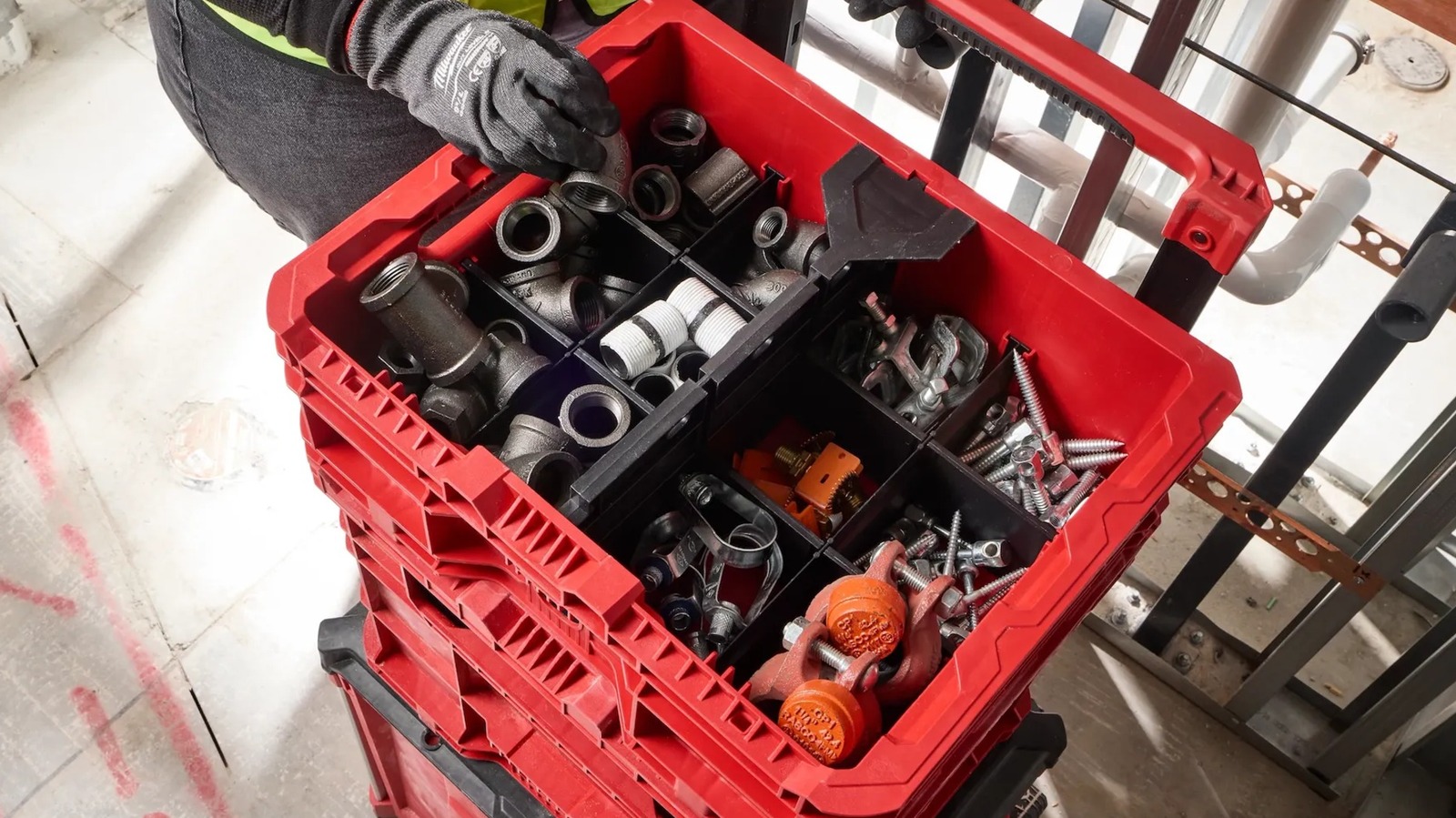
Moving on to one of the larger upcoming Milwaukee Packout releases — even if it ultimately lands somewhere in the middle of the smallest and largest Packout containers for sale — there’s the aptly-named Milwaukee Packout XL crate. This release will hit shelves in June 2026 and comes with a $69.97 price tag. The 8.03-pound crate can take on some serious tools with its 75-pound weight capacity. It measures 15 inches tall, 15.75 inches long, and 18.625 inches wide. Despite its size, it can be hung up on a wall like most other Packout containers.

While some may hang this crate in their workshop, many will use it as part of their mobile Packout stack. You can connect it to your existing setup via the top and bottom connection points. It can also be used with Milwaukee toolbox attachments to hold smaller tools and batteries with connection points on the sides. Alternatively, you can move the crate around using its built-in side handles. It’s advertised as having an impact-resistant body along with anti-water collection weep holes. Suffice to say, there’s more to this seemingly simple crate than initially meets the eye.

Milwaukee Packout Wire Pulling XL Crate

For the most part, the Milwaukee Packout line is so popular because of its versatility. While most entries can be used for just about anything, there are those that come with a specialized function. Case in point, the forthcoming Milwaukee Packout Wire Pulling XL crate, which is designed for dispensing wire. This involves inserting and locking in spools of the user’s needed material, threading the wire through the wire retention slots, and using the fold-down panel to keep the end of the wire from rolling back into the box.

Overall, this crate has the same dimensions and weight capacity as the previously covered Packout XL crate, though it is the heavier of the two at 9.85 pounds. It can accommodate up to six spools, can be stacked onto other Packout containers or hung up, and has an impact-resistant body. This is the most expensive of the new Packout releases at a hefty $119.97, and it’s set to release during July 2026. Alongside the best Milwaukee power tools for electrical work, this crate seems like a vital piece for any Milwaukee-enthusiast electrician’s kit.

New Milwaukee Packout inserts are coming, too

That’s it for the new Milwaukee Packout containers set to debut this summer, but there are more new releases yet to cover. To pair with some of these containers and improve their levels of organization and function, come two new insert sets. First is the divider for the Milwaukee Packout XL crate, which splits the container into two sections. It simply slides down the middle of the crate and fits snugly into place, while retaining its ability to connect with smaller Packout attachments. It will be released in July 2026 for $29.97.

Alongside the Packout XL crate divider is the set of Packout wire pulling inserts for the XL crate. You’ll need these if you end up buying an XL crate and later want to use it as a wire-pulling crate. These inserts allow you to convert it instead of having to buy a new designated wire pulling crate. They attach to two of the inner sides of the crate via T-25 screws and include wire puller guards as well. The Milwaukee product listing says these inserts are meant for 1/2-inch EMT conduit. This insert set also comes out in July and will cost $49.97. 


Source link


