
How Many Solar Panels Would It Take To Replace A Nuclear Reactor?


As opposed to coal power, nuclear and solar power are two high-tech ways to prove clean energy to homes around the world. It is, of course, a significant understatement to say that solar power is much easier to get your hands on than nuclear; you can buy a small solar panel for to charge your devices from places like Harbor Freight, or you can sign up for companies like Tesla to install solar panels on top of your roof. If you’re ever feeling curious, take a look around your neighborhood — it’s likely that more homes are getting some measure of power from the sun than you probably thought. 

Nuclear power, however, is tightly controlled and limited to military applications or large scale public works projects with heavy government subsidies. They’re operated by large energy companies and are often bolstered by any number of security measures including armed guards, drones, and other ways of preventing unauthorized nuclear material proliferation covered by all manners of international treaties and the U.S. Nuclear Regulatory Commission. 

But just for knowledge’s sake, what would it take for solar power to replace the output of a single nuclear reactor? How many solar panels capturing the energy of the sun can match the energy of splitting an atom? In short, it would take a very large solar farm of thousands (or millions) of commercial solar panels to replace just one reactor, depending on its output, but let’s break down the math.

Nuclear plants generate a massive amount of power

First, let’s take a look at output. The Peach Bottom Clean Energy Center, a nuclear power plant (one of many in the United States) in Delta, Pennsylvania (a short distance from where I live), serves roughly 2 million homes in the area through its two General Electric nuclear reactors. According to Constellation Energy, one of the contractors responsible for the plant, the pair of reactors has an output of 2,646 megawatts, which generated 21,944,000 MWh (megawatt-hours) of electricity in 2025.

Towards the solar energy side, a single solar panel from Tesla that sits right on top of your house generates up to 420 watts of electricity, or about enough to power a small refrigerator. 

One megawatt is 1 million watts. So, doing the math, it would take more than 2,380 Tesla solar panels to generate one megawatt of electricity. A single reactor at Peach Bottom makes 1,323 megwatts. That means it would take 3.15 million Tesla solar panels to cover the output of a single nuclear reactor. 

Sizes to consider when determining solar power generation

How much surface area would those 3.15 million solar panels take up? What size of solar panel array are we talking about at that scale? Each Tesla solar panel covers just over 22 square feet. An array of these panels that would cover the output of a single Peach Bottom reactor would be around 69.489 million square feet, or just about 2.49 square miles. Remember, Peach Bottom has two reactors, so to cover its output, you would need almost 5 square miles of real estate to make it work without even going into energy storage, distribution, and the myriad of other tasks that solar farms accomplish. For comparison, Peach Bottom’s nuclear facility itself sits on an area of “approximately 600 acres” according to Constellation. That’s only 0.93 square miles.

There are obvious reasons why you can’t have nuclear power replace solar power and vice-versa in every situation. Apart from pure power output calculations, a solar farm and a nuclear power facility have a lot of vastly different needs and maintenance requirements that are suited for different operating environments.


Source link

Leave a Reply

Subscribe to Our Newsletter

Get our latest articles delivered straight to your inbox. No spam, we promise.

Recent Reviews


There are certain engine configurations that are known even to those whose interest in engines is minimal. For instance, most people will know what makes a V-engine a V-engine, and even the differences between an in-line and flat engine

One engine design trait that’s perhaps less well-known is also related to the engine block, but not to with how the cylinders are arranged in the engine, rather with how they’re supported and cooled. When looking at this aspect of engine design, there are really three main types of engine block to look at. At the extremes are closed-deck and open-deck engine blocks, with some modern engines taking a halfway house approach with a semi-closed design. 

Let’s start by defining what an engine deck is. Essentially, the engine deck is that part of the block that the head gasket sits on, and the engine head attaches to. This means that an inline engine with a single line of cylinders will have one deck, whereas a V-configuration with two banks of cylinders will have two decks. 

Now that we understand that, we can begin to discuss the differences between closed-deck and open-deck engine blocks. In an open-deck engine, there is open space around the top of the cylinders that allows the coolant to circulate more freely. In a closed-deck design, in case you haven’t guessed it by now, the deck features extra material that offers less in the way of cooling, but it does support the cylinders more rigidly. Let’s pop the cylinder head off and have a closer look at these engine block types and why they matter more than you may think. 

Open-deck engines are cool, but flawed

For engine makers, there are definite advantages to open-deck designs — they cost less to manufacture when compared to closed-deck engines, and keep the engine cooler by exposing more of the surface area of the cylinder to the cooling liquid. 

However, all this open space around the cylinders is all very well and good when looking at cooling and manufacturing complexity — but cracks start to appear (sometimes literally) when we look at other aspects of closed-deck engine blocks. While it’s unfair to call open-deck engines unreliable and leave it at that, there are trade-offs in the design, and these become more noticeable in high-performance situations.

Essentially, the lack of material at the top of the engine deck means the engine is less structurally rigid right at the point where it meets some of the most extreme forces engines have to cope with — the combustion point at the top of the cylinder.

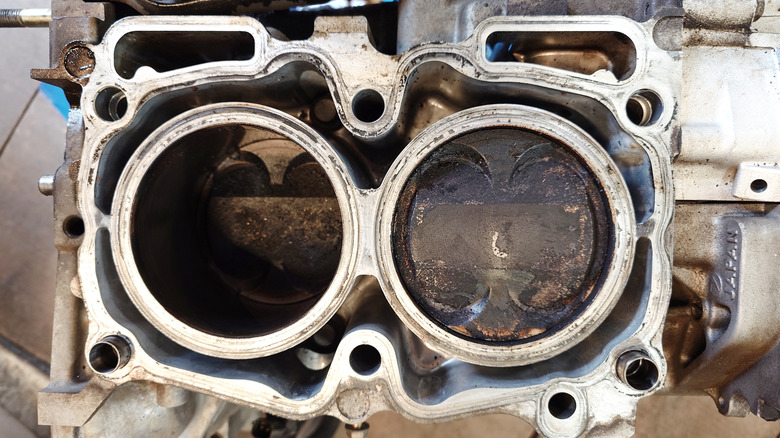
If you removed the head from an open-deck design and look down at the deck, this structural weakness is visible. From this viewpoint, the cylinders look separate from the rest of the engine block, with the gap between the two being used for coolant, as some open-deck designs have limited support at either end of the cylinder bank. While this gives more space for coolant to move freely, the downside is that it also does the same for the cylinder. Over time, even the limited movements of cylinders can weaken the head gasket and bring all the associated troubles that follow such a failure. 

Why some engines use closed- and semi-closed deck designs

Open-deck engine blocks are optimized for cooling and manufacturing efficiency. However, incorporate such a configuration in a high-revving, turbocharged brute of an engine and, well, it could end very badly. This is why such engines will usually use a closed-deck configuration. 

In a closed-deck engine, the open spaces around the cylinders of an open deck are filled with additional material. Obviously, the removal of such space and the flexibility it gives to the cylinders substantially strengthens the engine block. This is why some people fill engine blocks with concrete — it removes the flexibility afforded by the presence of cooling chambers. This is especially important for high-performance engines, but to call it overkill for the family runabout is not overstating the case. 

However, and the more observant among you will be there by now, filling an engine’s cooling cavities with material may add strength — but at the expense of cooling efficiency. This is why many modern turbocharged engines or higher-performance engines use a halfway house design in the form of semi-closed decks. 

Semi-closed decks are a compromise design that offers more rigidity to the cylinders by adding more support points. These supports are usually at the top of the cylinder. For instance, while there are pros and cons to Subaru’s EJ20 engine, the company released a version with a semi-closed deck with four additional support points, which should make it less prone to bore distortion. Ultimately, open-deck and closed-deck engine blocks represent design decisions based on the demands the engine is expected to handle. 


Source link