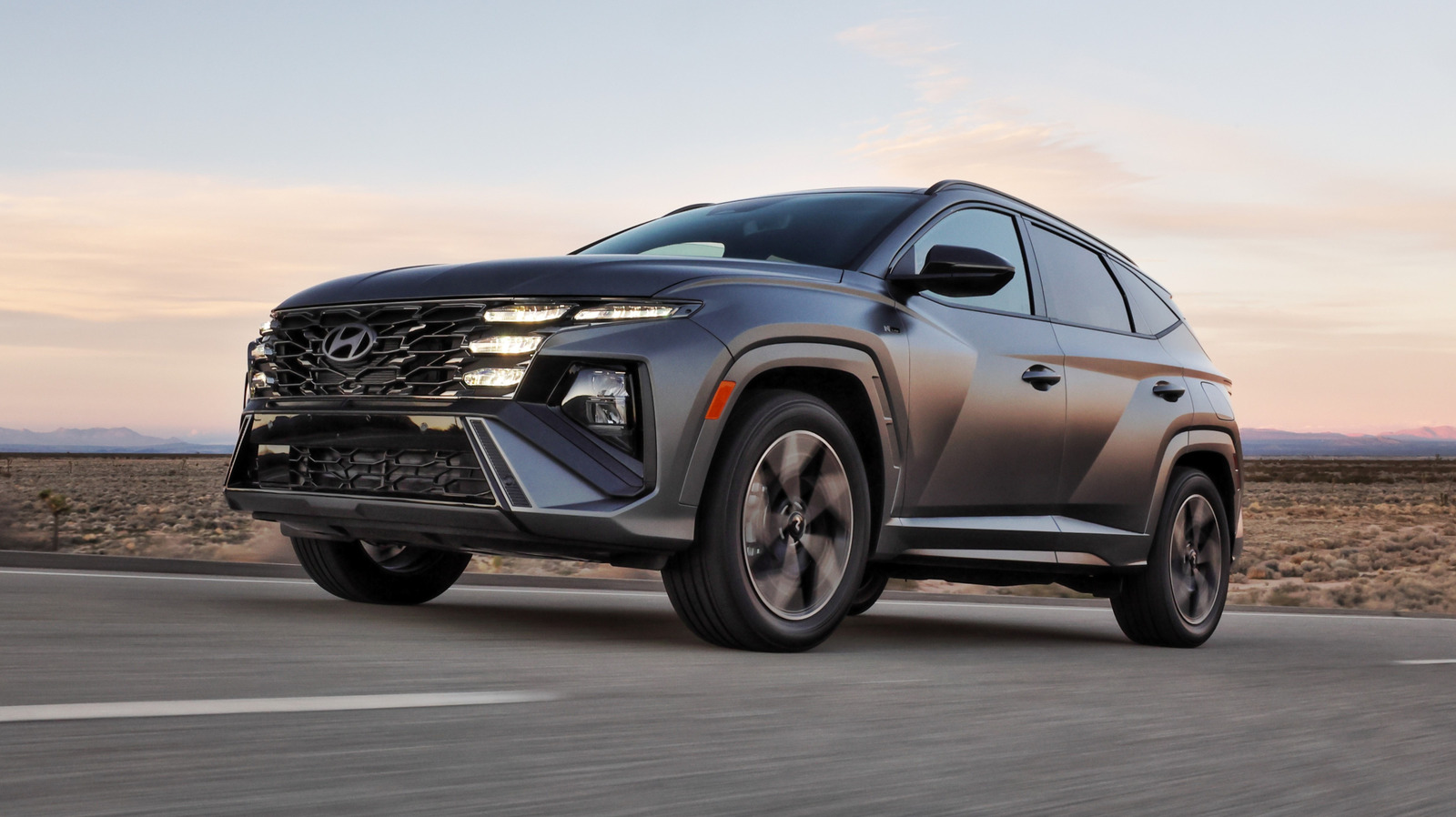

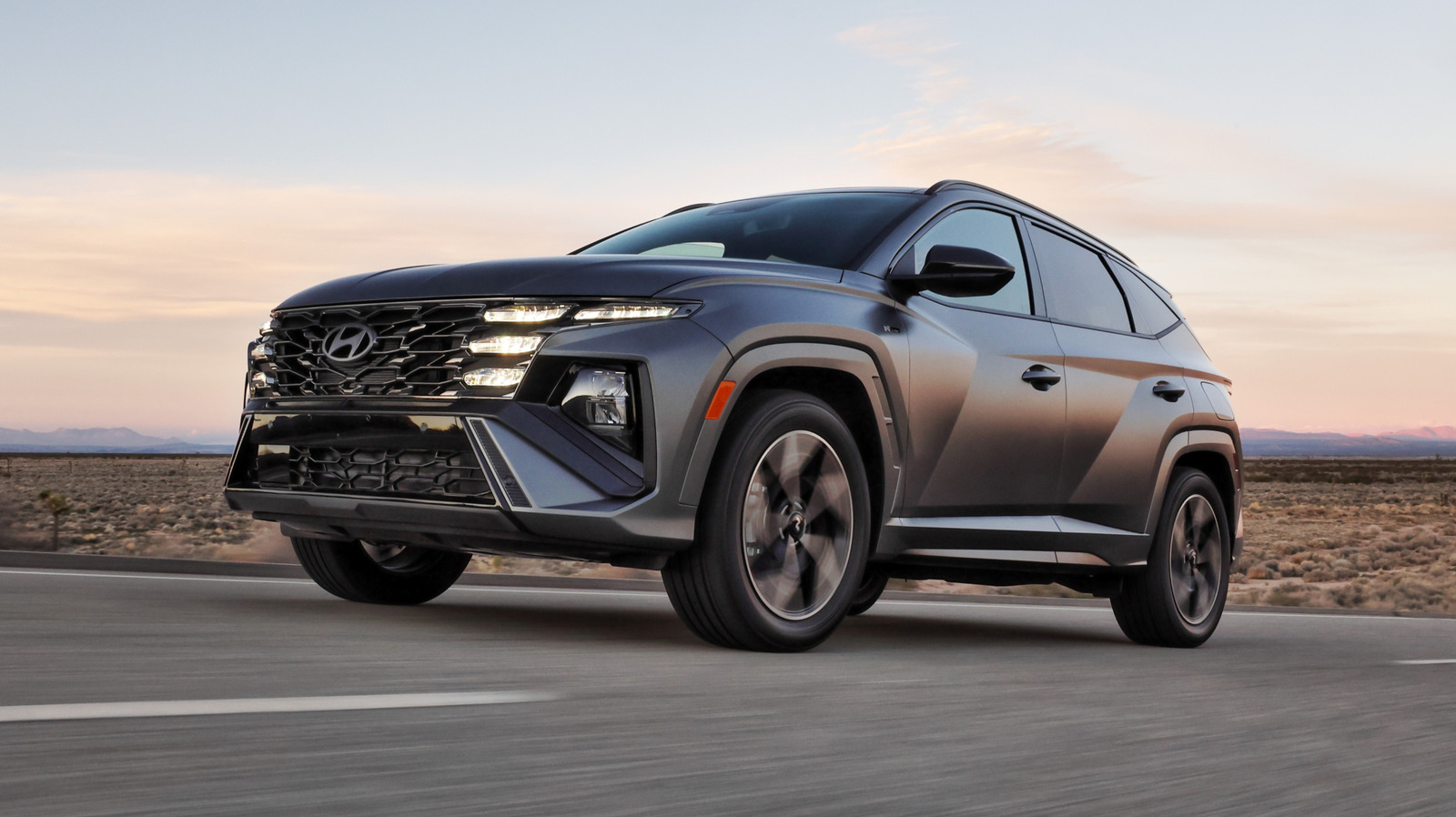
The compact SUV segment gets more and more competitive every year. Manufacturers are constantly bringing out new updates or complete redesigns for the buyer-favorite nameplates, making the decision for which one to buy a serious head-scratcher. One SUV that has managed to tick just about every box for a few years new is the Hyundai Tucson, coming off the back of one of these updates introduced for the 2025 model year. The SUV remained mechanically the same with the 187-horsepower inline-four staying underneath the hood, which isn’t a bad thing considering it’s solid 83 percent quality and reliability score from J.D. Power, falling into the outlet’s “great” category.
the latest Tucson isn’t likely to let you down compared to the average car. RepairPal’s four-out-of-five rating for dependability bolsters what J.D. Power says. However, if you want even more confidence in your SUV, there are still a handful of compact nameplates that manage to top the 2026 Tucson in this area. Whether it’s more affordable models that lose a bit of space behind the seats or more direct rivals that offer more power, here’s a closer look at five SUVs that have stronger reliability scores that the Hyundai Tucson.
2026 Subaru Crosstrek
Subaru has been finding itself at the top of reliability studies in recent years, constantly reaffirming its reputation among the industry’s best. In J.D. Power’s 2026 Dependability Study, Subaru came in sixth place, with its SUVs being the driving force in getting there. In particular, the outlet named the Crosstrek as the most dependable small SUV on sale at the moment. It gets a reliability score of 85 percent, two points better than the Tucson. Elsewhere, RepairPal also names the Crosstrek as the most reliable compact SUV, with a 4.5 out of five score.
The Crosstrek is a little smaller than the Tucson, competing more within the subcompact market rather than the standard compact segment. Measurements are pretty close between the two for passenger space, but the Tucson’s maximum 80.3 cubic feet of cargo space is notably more than the Crosstrek’s 54.7. But if you want more capability off-road and standard all-wheel drive, the Crosstrek is one of the best in the segment for this as standard. Power output is also quite close, with the Subaru producing 180 horsepower from its 2.5L engine. Despite being all-wheel drive, the Crosstrek manages to beat the Tucson’s combined fuel efficiency at 29 mpg combined. The Hybrid model increases that further to 36 mpg.
2026 Buick Encore GX
Out of all the American brands, none can beat Buick when it comes to reliability, at least according to J.D. Power’s data. In the latest Dependability Study, Buick was only beaten by Lexus overall, taking the lead for GM’s current brands. With only four nameplates in its lineup at the moment, there are fewer cars for things to go wrong with, but this shouldn’t take anything away from its achievement. The Encore GX is one of the main models for the brand, competing among the best in the compact segment. While it loses out in some areas, it boasts one of the best dependability scores in 2026.
As per J.D. Power, the latest 2026 Buick Encore GX comes in with a reliability score of 90 percent. The SUV was released in 2020, and while it’s had plenty of appearance and technology updates throughout the decade so far, the mechanical side of things has remained the same. A 1.3L turbocharged engine produces 155 horsepower and 174 pound-feet of torque, attached to a standard CVT transmission. If you’d like to save a little more money at the cost of the latest features, the lowest reported reliability score from J.D. Power is 83 percent for the 2021 model, with the ’22 and ’23 years both sitting at 87 percent.
2026 Chevrolet Trailblazer
The name Trailblazer might remind you of the mid-size SUV that Chevrolet had in production during the 2000s, but since 2021 it’s acted as one of the flagship models in the compact segment, next to the Trax and Equinox. Starting at just $23,300 (with a $1,795 destination charge), the Trailblazer is one of the cheapest new cars you can buy in 2026; luckily, it also appears to be one of the most dependable. Compared to the Tucson’s 83 reliability percent score from J.D. Power, the Trailblazer comes in with a score of 88 percent, helping it achieving its standout overall rating as well. While owner reviews on places such as Cars.com are still quite fresh, the Trailblazer doesn’t drop below four out of five stars on average when it comes to reliability.
While still technically a compact SUV, the Trailblazer falls into the same category as the Encore GX by being smaller and with less power as it shares the same 1.3L engine producing 155 horsepower. The main differences between the Encore GX and Trailblazer are the focus on affordability, with the Chevrolet sacrificing a lot of the luxury features found in the Buick. Still, if reliability is what you’re mainly looking for compared to the Tucson, the Trailblazer is another top choice, particularly if you don’t mind losing some space behind the seats.
2026 Nissan Rogue
Despite Nissan’s long-standing financial crisis deeply affecting the company, it still manages to stay right in the mix with some of the most competitive cars on the market such as the Tucson. Within the compact segment, the Rogue is the largest of the two nameplates keeping Nissan alive. Pricing comes in at $30,490 (with a $2,245 destination charge) for the 2026, which is only marginally more than the Tucson. In fact, the Rogue has managed to out-sell the Tucson so far in 2026 as of this writing. The reliability ratings are also very close, with RepairPal giving both models a score of four out of five. However, J.D. Power’s rating for the Rogue beats the Tucson’s, with the former sitting at 84 percent for the 2026 model.
Another key area where Nissan has the upper hand with the Rogue is performance. The turbocharged 1.5L three-cylinder produces 201 horsepower and 225 pound-feet of torque, which is used across all trim levels. In Car and Driver’s tests, the Rogue got to 60 mph in 8 seconds, 0.8 seconds faster than the Hyundai. Despite its slightly higher power output, the front-wheel drive base SV trim manages to achieve 32 mpg combined, which is four higher than the Tucson’s 28 mpg equivalent.
2026 Ford Bronco Sport
The Tucson, like many of its rivals, is built with road driving in mind. However, a handful of automakers target another area that SUVs can naturally excel in: off-roading. One of these nameplates that has been at the forefront of the off-roading scene is the Bronco, which in 2026 can be picked up in one of two guises. The base model competes in the mid-size segment, but if you’re looking for similar capabilities in a compact package, the Bronco Sport should be pretty appealing. To give you more confidence off-road, it comes with a reliability score of 88 percent from J.D. Power for the 2026 model. Based on owner data on Cars.com, the 2024 model is the only one of the current generation to drop below four stars.
For standard power, the Bronco Sport is a bit closer to the Tucson than some other SUVs on this list. The base 1.5L EcoBoost inline three-cylinder produces 180 horsepower and 200 pound-feet of torque, with the latter giving you a bit more instant motivation compared to the Hyundai. While it doesn’t have any hybrid options, the 2.0L inline-four gives the Bronco Sport a much more competitive 250 horsepower and 280 pound-feet of torque. You will have to go for the top-spec Badlands trim to get this engine, though, which starts at $38,260 (plus a $1,995 destination charge).
Methodology
To select the SUVs for this list, we looked at various sources, including J.D. Power, RepairPal, and Cars.com, to find those that have higher average reliability scores for the current 2026 Hyundai Tucson. Where there wasn’t any one-to-one comparison, we took data from recent model years that beat the corresponding year of the Korean SUV.

Stephan is the sports journalist for the Maple Grove Report.