
Compact SUVs are the largest market segment in America according to a 2025 study by S&P Global, and competition within the segment is fierce. Long-standing favorites from the likes of Toyota and Honda go head-to-head against upstart competitors, with the best of the bunch offering a winning mix of practicality, comfort, and affordability.
With so many small SUVs on the market to pick between, buyers can afford to be choosy. There are many different factors that influence a buyer’s final decision, with depreciation being a particularly important factor for many. Most buyers would strongly prefer that their shiny new SUV doesn’t plummet in value during their ownership, although some do exactly that.
Using data from two trusted sources, we’ve compared depreciation rates from a wide range of small SUVs to pick out the models that lose value at the fastest and slowest rates. There are some common themes between models at each end of the spectrum: For example, the highest depreciating models tend to hail from luxury brands, feature electric powertrains, or both. At the other end, the models with the best value retention are offered by mass-market brands with good reputations for long-term reliability. If you’re in the market for a new budget-friendly small SUV and want to know which models to stay away from, you’ll find the answers here.
Loses value: Lexus RZ
EV technology is rapidly evolving, and as a result, the spec sheets of cars that are just a few years old are already starting to look a little dated. A good example is the Lexus RZ, which arrived in 2023. Even at launch, its 220-mile range was far from exemplary, but today, it’s even further behind its rivals. To its credit, Lexus has managed to boost the RZ’s range slightly in the intervening years, and a 2026 RZ now achieves between 264 and 301 miles, depending on trim. However, that’s still low by today’s standards: For context, a base-spec 2026 Nissan Leaf offers 303 miles between charges.
Add in the effects of battery degradation and a used RZ will offer a range that’s simply too small to be appealing to most buyers. It depreciates heavily as a result, with CarEdge estimating that RZ owners can expect to lose 60% of their initial investment after a period of five years. Meanwhile, KBB is even less positive about the RZ’s future resale value, predicting a 66% drop in value over the same period of time.
Holds value: Honda CR-V
Honda unveiled the CR-V TrailSport Hybrid trim for the 2026 model year, but even without the added dose of all-terrain capability, it’s easy to see the appeal of the popular SUV. The CR-V is affordable to buy, starting from $32,370 (including a $1,450 destination charge) for 2026, but buyers with larger budgets can spring for the top-spec Sport Touring Hybrid. The latter offers a premium audio system, a 204 horsepower hybrid powertrain, and a long list of other additional features.
As well as being more powerful than base trims, the hybrid CR-V is also more efficient. The all-wheel drive hybrid CR-V hits an EPA-estimated 37 mph combined, while the front-wheel drive version achieves 40 mpg. Add in the durable materials in the cabin, the intuitive infotainment, and Honda’s strong reputation for reliability, and the result is a car that’s a sensible choice for a huge range of buyers. That wide-ranging appeal helps keep used values high, with CarEdge estimating that a new CR-V will depreciate just 29% after five years and KBB predicting a 46% reduction compared to the original sticker price.
Loses value: Chevrolet Blazer EV
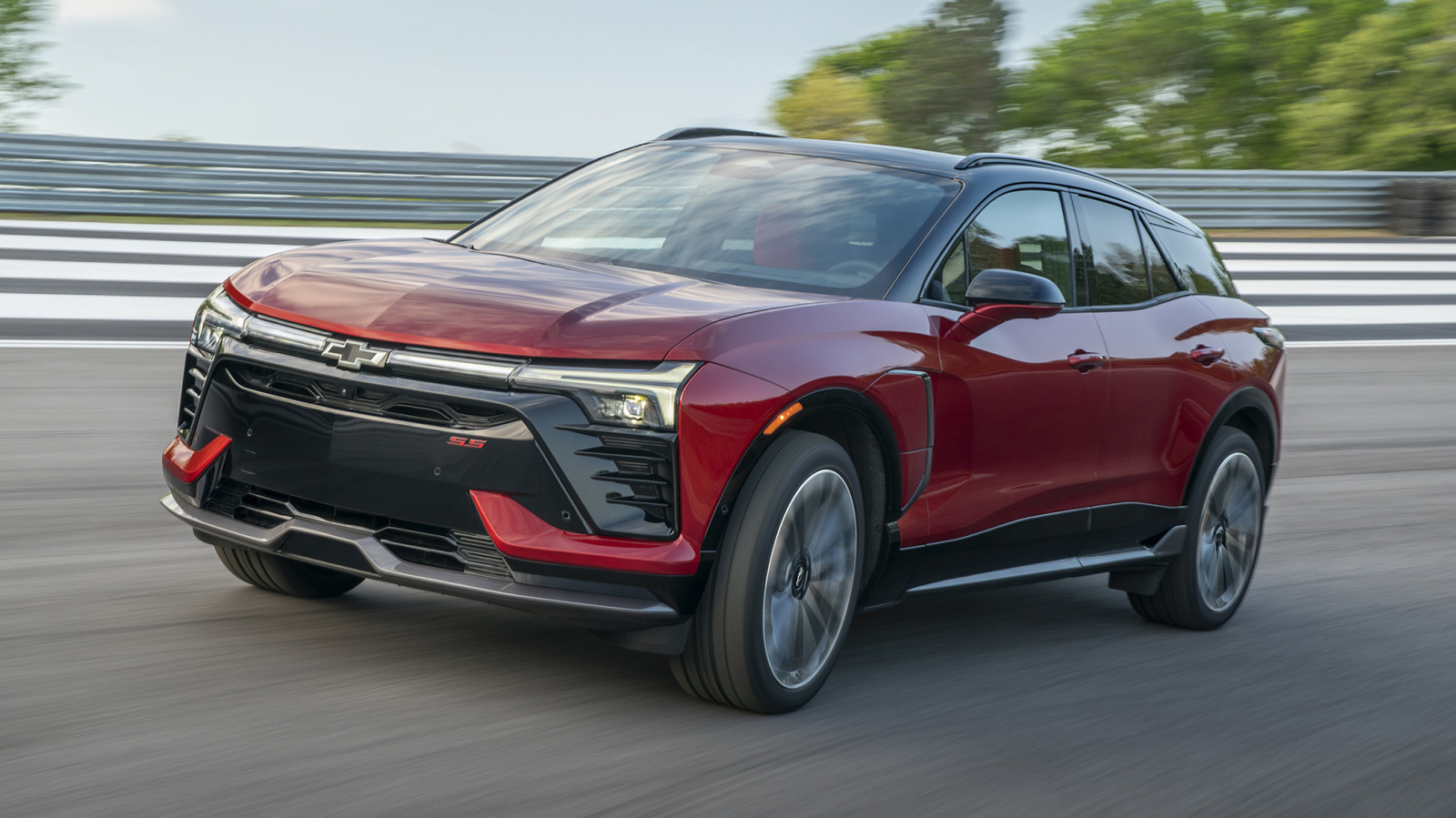
It isn’t just luxury EVs that lose value fast. The Chevrolet Blazer EV might wear a humble bowtie logo on its hood, but current data suggests that owners can still expect to lose money at the kind of rate that you’d usually see from a premium or luxury car. CarEdge puts the Blazer EV’s depreciation rate at 60% over five years, while KBB estimates that the car will be worth 67% less than it was when it was new.
The Blazer EV has proven to be unpopular with buyers from the get-go, taking the unenviable title of Chevy’s least-sold SUV in America. Even its electric sibling, the Equinox EV, has proved to be significantly more popular. That’s despite the 2026 Blazer EV featuring a range of up to 312 miles and starting from $46,495 (including a $1,795 destination fee), which is a few thousand dollars less than the price of the average new car. If you move up the trim range, things quickly get pricier, with the all-wheel drive SS trim costing north of $60,000.
Holds value: Subaru Crosstrek
The latest Subaru Crosstrek is far from perfect, but it’s an appealing option, especially in hybrid form. Its combination of affordability and all-conditions capability make it a great alternative to rivals from the likes of Honda and Toyota, and the Subaru offers similarly strong value retention to small SUVs from those brands.
Estimates for exactly how much owners can expect to receive for their 5-year-old Crosstrek vary between sources, with CarEdge suggesting the car will only depreciate 34% over that time. Meanwhile, KBB predicts a 48% depreciation after half a decade. Either way, that puts the Crosstrek towards the front of the pack for holding its value, and given its sub-$30,000 starting price, buyers will be losing very little in dollar terms.
Unlike many of its rivals, the Crosstrek is also made in America at Subaru’s Indiana assembly plant. It’s not the brand’s only American-made model either, with the Outback and Ascent SUVs also being built in the same facility.
Loses value: Land Rover Range Rover Evoque
It’s made by a luxury brand with a poor reputation for long-term reliability and it’s far from cheap when it’s new, so it’s natural that the Range Rover Evoque depreciates fast. Accelerating that value loss is the fact that it’s also not very efficient, and despite its rapid depreciation, it isn’t all that rapid on the road either. The typical owner of a new Range Rover won’t mind any of those things, but for many used buyers, an aging Evoque isn’t going to be an easy sell.
Despite its somewhat limited appeal, a 5-year-old Evoque won’t have lost quite as much value in percentage terms as some of its rivals. Still, with predicted depreciation rates of 52% and 63% from CarEdge and KBB respectively, it’s among the poorest performers for value retention. Buyers who do decide to roll the dice on a used Evoque can at least enjoy one of the nicest cabins in the segment and a top-tier sound system, even if the threat of wallet-bruising repair bills might loom large.
Holds value: Toyota RAV4
Toyota redesigned the RAV4 for the 2026 model year, but it follows the same core formula as before. Efficiency is still one of its key selling points — in fact, it’s even more of a focus with the latest generation, which is only available as either a hybrid or plug-in hybrid. A range of trims are also available to cater to a wide spectrum of buyers, with the base trim starting from $33,495 (including a $1,595 destination fee).
Further up the trim range, the Woodland trim beefs up the RAV4’s appearance with Rigid Industries fog lights, roof rails, and all-weather floor mats. At the very top, the Limited trim offers the most comfortable, premium experience. A 2026 RAV4 Limited costs at least $44,895 before optional extras are factored in.
Buyers of all trims will be able to take comfort in the fact that the RAV4’s perennial popularity has helped earn it strong value retention rates. CarEdge and KBB are notably split on exactly how far ahead of its rivals the RAV4’s value retention falls, with the former predicting only a 28% drop in value after 5 years but the latter saying that the car will lose 51% of its sticker price. Regardless of which estimate proves more accurate in the long run, the RAV4 remains among the best SUVs in its class for holding its value.
Loses value: Jaguar F-Pace
By now, most enthusiasts will already be well aware of Jaguar’s impending all-electric relaunch. The brand’s upcoming EV has not yet hit the road at time of writing, but Jaguar dealers are still busy selling off the last of their old stock. The F-Pace SUV can still be found at dealers, with the cheapest 2026 trim starting just under $60,000 and the SVR 575 Final Edition trim costing close to six figures.
The gas engine in the base trim is slightly underwhelming given its asking price, offering 246 horsepower and a 6.9 second 0-60 mph time. The mild hybrid variant bumps those numbers up to a more respectable 395 horsepower and 5.1 seconds, but both lag far behind the Final Edition. It might be significantly more expensive, but the top-spec trim does receive a supercharged 5.0-liter V8 engine making 567 horsepower and propelling the car from 0-60 mph in just 3.8 seconds.
No matter whether they pick a base example or a top-spec Final Edition, buyers of the 2026 F-Pace can expect to lose most of their investment after 5 years of ownership. CarEdge predicts that the SUV will depreciate 65% after half a decade on the road, and KBB forecasts a very similar 66% depreciation rate.
Holds value: Toyota Corolla Cross
Slotting below the RAV4 in Toyota’s SUV lineup, the 2026 Corolla Cross is an entry-level crossover for buyers who want the style and practicality of an SUV but don’t want to spend a fortune. It’s equipped with a competitive amount of standard tech and offers cargo space and legroom that’s on par with most of its rivals.
It’s efficient too, with the EPA estimating that the Corolla Cross Hybrid should be capable of hitting 42 mpg on a combined cycle. In the real world, our testing saw the car average slightly less than that claimed figure, averaging around 39 mpg over the course of the test period. Prices for the non-hybrid variant start at $26,830 (including a $1,595 destination fee), while the hybrid costs around $30,000.
The Corolla Cross doesn’t win any points for driver engagement, but as a sensible, wallet-friendly runaround, it ticks all the right boxes. That sensibility appeals as much to used car buyers as it does to new car buyers, and as a result, the small SUV holds its value well. Estimates for exactly how well a new example will hold value differ, with CarEdge predicting a 30% drop in value over 5 years but KBB suggesting a 50% drop is more likely.
Loses value: Land Rover Discovery Sport
Compared to the Range Rover and Defender lines, the Discovery is the forgotten child of the Land Rover stable. Bosses have been on record discussing how the next generation of the Discovery and its smaller relative, the Discovery Sport, need to be better differentiated from the Defender. For now though, the current generation soldiers on. The 2026 model year has seen the launch of some new trims and additional options, but fundamentally it’s still the same SUV that’s been in Land Rover’s lineup for years now.
Until its relaunch, both the Discovery and Discovery Sport are stuck with high depreciation rates that reflect the fact that they’re overlooked by many buyers. Land Rover’s reliability record is also patchy at best, which doesn’t help matters. The Discovery Sport is the smaller of the two Discovery SUV models, and it’s expected to depreciate 59% after 5 years according to CarEdge and 65% over the same time according to KBB.
Holds value: Hyundai Venue
Compact SUVs don’t get much smaller than the Hyundai Venue. It’s one of the cheapest new cars you can buy in 2026, with a starting price that only just surpasses the $20,000 mark. Depreciation estimates for the car differ in their assessment of how much of its value it’s likely to retain 5 years after it leaves the lot, with CarEdge being more positive about its value retention than KBB. The first says buyers can expect to lose only 36% of their original investment, while the second predicts a 54% depreciation rate.
In dollar terms, the Venue’s depreciation is among the lowest of any small SUV even if KBB’s less optimistic depreciation rate is assumed to be true. Owners won’t spend a lot at the fuel pump either, with the EPA estimating that the SUV should hit 31 mpg combined. That translates to a fuel savings of $1,000 compared to the average new vehicle over the course of 5 years.
Loses value: Cadillac Optiq
As previously mentioned, luxury cars tend to depreciate fast, as do electric vehicles. The Cadillac Optiq is both a luxury SUV and an electric vehicle, and so it’s no surprise that it sheds value pretty rapidly. It’s still a relatively new model, but estimates generally agree on how much it can be expected to lose over five years. CarEdge predicts a 57% drop in value, while KBB forecasts a slightly larger loss, at 61%. That’s not shockingly bad for an EV, but it’s still more than most other small SUVs.
We tested the Optiq shortly after it was launched and found it to be a typical Cadillac in all the ways that matter: It was quiet, comfortable, and well appointed inside, without much of the over-the-top gadgetry that some of its rivals offer. Like virtually all new cars, it still has a prominent infotainment screen, but we found it generally straightforward to operate and not too intrusive. Aside from the odd omission, like the Optiq’s lack of Apple CarPlay compatibility, we didn’t find much to dislike about the smallest Cadillac EV.
Holds value: Honda HR-V
The HR-V is Honda’s SUV equivalent of the Civic, with shared underpinnings and a similarly affordable price tag. We spent time with the car at the launch of the current generation and liked its interior and standard equipment levels, although we found the sound of its CVT to be grating when the SUV was driven on the highway. Noisy transmission aside, the HR-V is a good entry point into Honda’s SUV lineup, and as a bonus, it looks less cheap than its price tag would suggest.
Buyers can expect the HR-V to hold its value well over its first 5 years on the road, but like many of the top performing small SUVs here, estimates differ on just how much it will be worth. According to CarEdge, the HR-V will lose 31% of its sticker price over that time, while KBB suggests that a deprecation rate of 48% is the more likely scenario. Individual factors like mileage and condition can also play a significant part in resale value, but overall, the HR-V remains towards the top of its class.
How we selected these small SUVs
Every platform uses a slightly different methodology and different datasets to predict how fast a new vehicle will lose value, so to gain a balanced overview of predicted depreciation rates, we averaged data from two trusted sources. We based our picks for this list on the mean average of predicted depreciation rates from CarEdge and KBB, with each of our fast depreciating picks losing 55% or more of their initial value over their first five years on the road. Our top picks for value retention are each forecast to depreciate an average of 45% or less, putting them towards the very top of their segment.

Stephan is the sports journalist for the Maple Grove Report.