Why Do Utah State Highway Signs Have A Beehive?


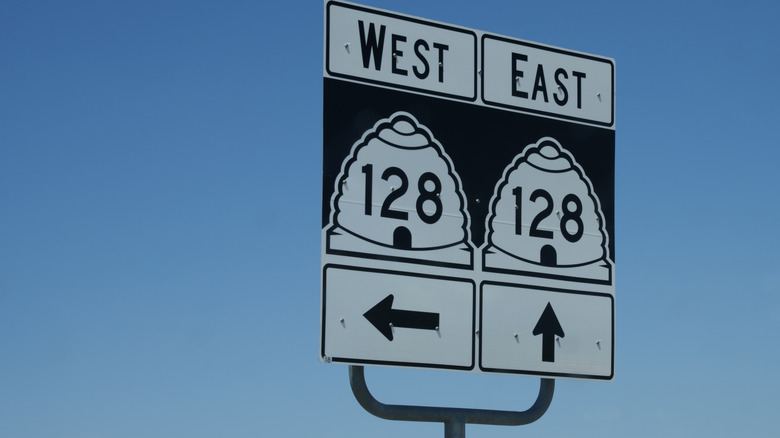
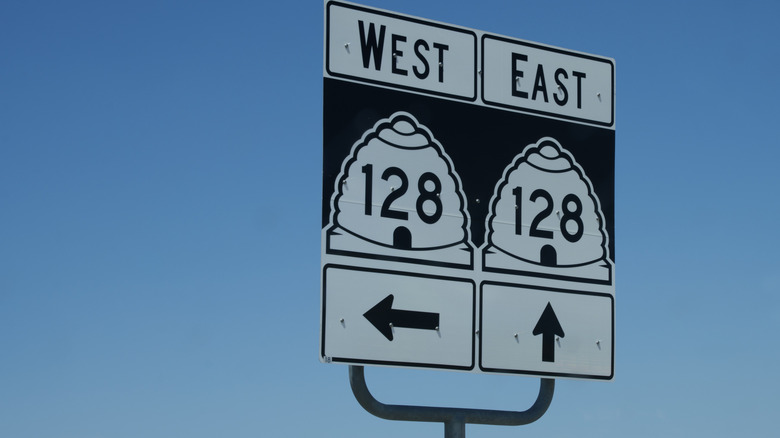
If you’ve ever driven through Utah, you probably noticed something a little unusual on the state highway signs: an image of a beehive where the usual shield or state silhouette might be. As it turns out, the beehive is one of Utah’s most cherished symbols, almost like a visual shorthand for the state’s entire identity. It goes all the way back to the earliest Mormon settlers who arrived in the Salt Lake Valley in 1847. Those settlers called their new state “Deseret,” which is a word from the Book of Mormon that means “honey bee.” It reflected how they saw themselves and what they were doing: taking a harsh landscape and attempting to build a successful society out of it.

The first governor of the Utah Territory and president of The Church of Jesus Christ of Latter-day Saints, Brigham Young, further embraced the beehive emblem, incorporating it throughout early Mormon architecture and public life. Beehive motifs could be seen on church buildings, homes, decorative features, and even Young’s own Beehive House. The beehive remained a central feature when Utah joined the Union in 1896, appearing on both the state seal and state flag. It became the official state symbol in 1959, which helps explain why Utah started using it on state highway signs. 

The beehive is central to the state’s identity
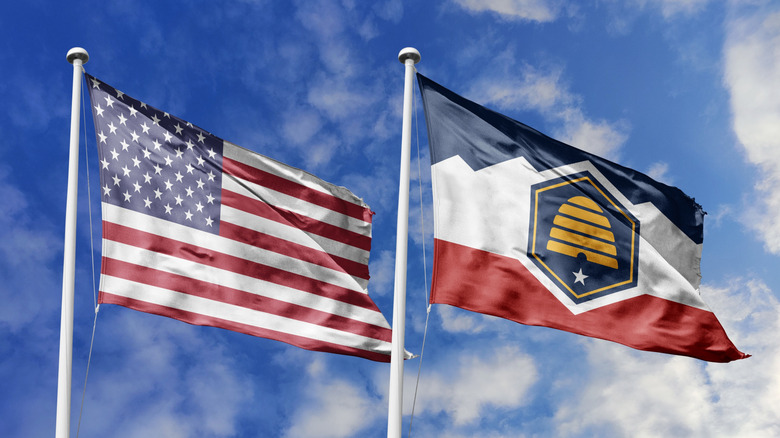
Over time, the beehive has become less about religious identity and more about Utah as a whole. Even as Utah’s population diversified, the emblem has continued to represent the state’s belief in community-minded cooperation. So it’s not surprising that when state leaders redesigned Utah’s flag in 2024, the beehive remained the dominant visual element. Today, the beehive can still be found on state highway distance signs, route markers, and beyond. It also shows up on government buildings, public infrastructure, business names, and even educational institutions throughout the state.

While most states use either a shield emblem or a silhouette of the state itself on their highway signs, Utah follows in the footsteps of other western states that buck the trend. For example, New Mexico uses a sacred Zia sun symbol to honor the Indigenous Zia Pueblo community. California uses a spade-shaped sign as a tribute to the Gold Rush. Further up the winding Pacific Coast Highway, Washington (fittingly) uses a silhouette of George Washington’s profile. Looking at the big picture, Utah’s just having some fun with its signs like the rest of the region.


Source link

Leave a Reply

Subscribe to Our Newsletter

Get our latest articles delivered straight to your inbox. No spam, we promise.

Recent Reviews


Soundcore, which you may have heard does both audio and video now, has launched another pair of headphones in the Liberty 5 Pro and Liberty 5 Pro Max.

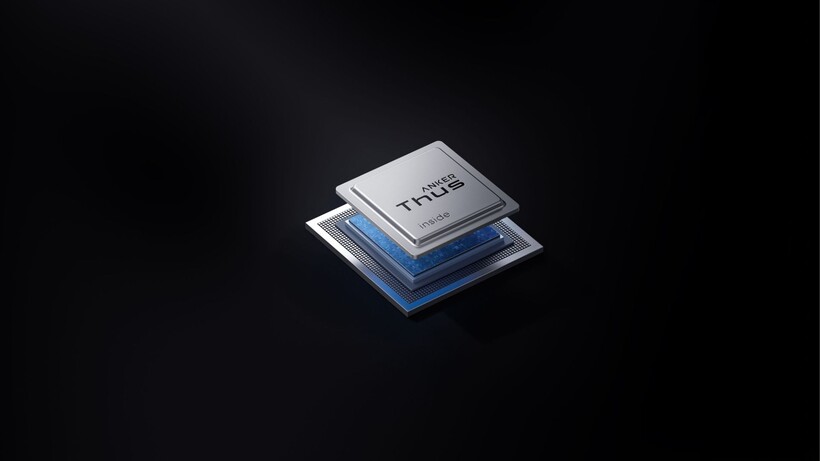
Another pair of true wireless earbuds, you might think what’s interesting about that? Well, in a first for Soundcore, this true wireless pair are the first two products to features Anker’s co-developed Thus AI chip, which it claims can offer “Whisper Clear” calls.

How so? By utilising a 10-sensor matrix that can separated the speaker’s voice from background noise, combined with eight microphones to capture ambient noise and two bone conduction sensors that can detect skull vibrations, the Thus AI chip is said to ensure “clear voice pickup even in noisy environments.” Interesting.


Of course there have been improvements in other areas for both the Liberty 5 Pro and Max efforts, with ANC improved up to two times over previous generations, while the Liberty 5 Pro Max also features AI Note-Taker for recording meetings without having to reach for your phone.

Anker Thus AI chip
Image Credit (Anker)

Advertisement

As you can see, Anker/Soundcore is delving deeply into AI for its latest products, with it involved in seemingly every aspect of the two earbuds that have just been announced.

Another area where AI is used is with voice interaction, with 20 built-in commands that allow users to adjust volume, answer or hang up phone calls, skip tracks and change ANC modes.

Soundcore Liberty 5 Pro Max product
Image Credit (Anker Soundcore)

Speaking of ANC, there’s a transparency mode for paying attention to your surroundings, and what Soundcore is dubbing its Easy Chat feature, where audio is paused when the headphones sense you’re speaking.

Both earbuds offer up to 6.5 hours of playback with noise cancelling on, and 28 hours in total with the charging case. Bluetooth 6.1 is supported, as is Google Fast Pair, Apple’s Find My (in case you lose the earbuds somewhere), and Bluetooth multipoint for connecting to not just two devices but three. What’s the main difference between the two? The Liberty 5 Pro Max’s charging case has a touch screen.

Advertisement

The Liberty 5 Pro is available now, priced at $169.99 / £149.99 / €179.99, putting within the midrange area of the market. Colours include blue, white, black and pink.

The flagship Liberty 5 Pro Max is the more expensive at $229.99 / £199.99 / €249.99. Colours are a choice of Titanium-Gold and black.

Look out for our review of both headphones in the coming weeks.


Source link