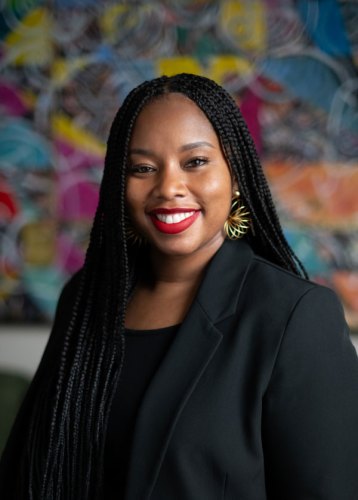
Staff Note Q&A with Adora Land
Adora Land is a grantmaking director at the Bush Foundation who leads the Bush Fellowship program, supporting community leaders across our region. We asked Adora for her insights about the selection process and what makes the Fellowship unique.
What are some of the guiding principles that shape the Bush Fellowship selection process?
We’re looking for leaders who have a strong record of impact, who saw a gap in their community and stepped in to fill it. These are problem solvers with deep roots in the communities they serve, working alongside those communities to create change. They also have big visions and are ready to take the next step in their leadership to create large-scale impact. And they’re good at collaborating with others, because they understand that they can’t do this work alone. It’s not just about having a unique idea; what often makes the difference is who is doing it, how it’s being done and who is involved.
How does the Bush Foundation make sure the application process delivers value even to those who aren’t selected?

We’ve intentionally designed the process so that the experience itself — not just the outcome — is meaningful. The application and interview process creates space for people to really sit with their leadership and develop a plan they might not otherwise have taken the time to create. I’ve even met people who applied, didn’t receive the Fellowship, and then looked back at their application 20 years later to find they had accomplished everything in it. That speaks to how intentional the process is.
Throughout the interview stages, applicants are also connecting with other leaders from across the region who challenge them to think even deeper about what they need to thrive. It’s an opportunity to build networks and dream bigger, in community with others who are also dreaming big. We also offer all finalists a $3,000 grant for executive coaching for one year as an investment in their continued growth.
What are the plans that Fellows are required to develop, and why do they matter?
Fellowship grants are specifically for the Fellow’s personal leadership development — not to fund a project or reward them for what they’ve already accomplished. We’re saying: you still have more to do, more to share, more to learn. Fellows are asked to self-design their own learning plan — experiential learning, academic or credential programs, skill-building, cultural experiences — whatever will best strengthen them as a leader. We operate under the belief that learning doesn’t only happen in a classroom, and that people also need networks and experiences to grow.
What are some of the visions this year’s Fellows are working toward?
The 2026 Bush Fellows reflect the breadth and depth of our region. One Fellow is working to build North Dakota into a model for coordinated, equitable crisis response through the 988 Suicide and Crisis Lifeline. Another is a teacher pursuing her Ph.D. to advance Lakota language revitalization and increase the number of fluent speakers. And one Fellow is linking small businesses, media outlets and corporate partners to close gaps in access to capital and visibility for Latino businesses in Minnesota.
What has leading this program helped you understand about your own leadership?
Leadership today requires real mental fortitude and courage. Over the years I’ve talked often with Fellows about what it looks like to sustain yourself as a leader, and I’ve had to reckon with the fact that I don’t always honor that in myself. My leadership doesn’t just extend to this work; community is much larger than that. I need to show up for the people in my life too. The practices I encourage others to build, I have to build in myself, and that’s become something I take more seriously.

Thanks to contributing writer, Mo Perry, who developed this Q&A with Adora Land.
Applications for the 2027 Bush Fellowship will open in September 2026. Stay connected by subscribing to our newsletter.
Related