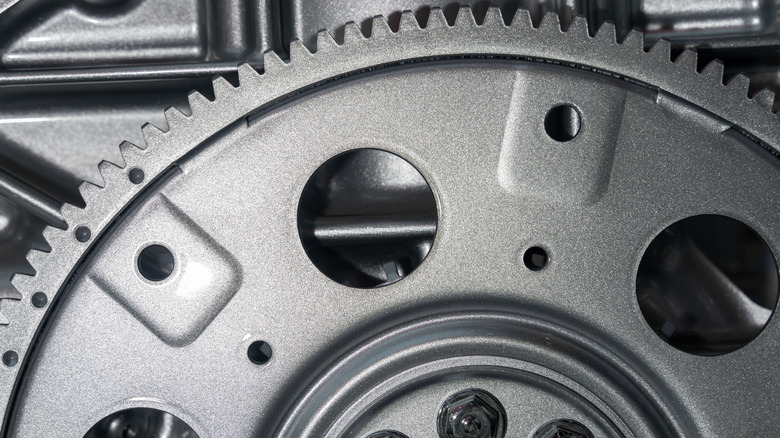

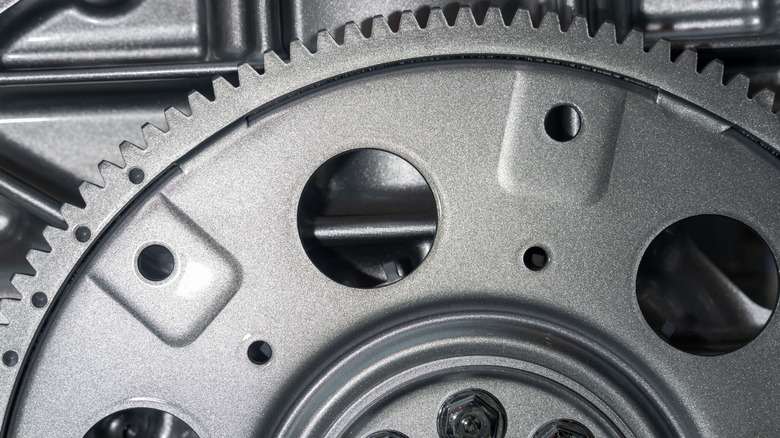
If you take a look at diagrams of typical automatic and manual transmissions, you’ll see a lot of noticeable differences — how they’re built, how the gears are meshed, how torque is transferred, what fluids they accept, and so on. However, both transmission types will have some sort of large disc that sits on the engine’s crankshaft. One might assume, at a glance, that both of these elements are identical. They look relatively similar; they’re about the size of dinner plates and lined with gear teeth. And they’re in the same place in your car — yet they’re two different parts, depending on your transmission type. Why?
There’s a long answer and a short answer, so let’s get the latter out of the way first. Automatic transmissions have thin, lightweight flex plates because they don’t need the smoothing effect of a flywheel’s mass; but they still need something to connect the engine and transmission, as well as engage the starter motor. They flex to help accept all the weight of the torque converter doing its thing behind them.
Still complicated? Okay, fair enough, let’s shift gears and answer one important question. What exactly does a flywheel do? Think of how an engine works. Internal combustion is nothing more than a series of controlled explosions. It’s not a smooth, linear motion. Rather, it pulsates with each power stroke. A manual transmission’s flywheel acts as an energy storage device, using its weight to smooth out those pulses. An automatic’s torque converter does the same thing, just with a lot of heavy fluid instead of a thin clutch. That’s why flywheels are so much heavier than flex plates, but it doesn’t explain why flex plates, well, flex. For that, we’ll have to dig a bit deeper.
The importance of storing energy
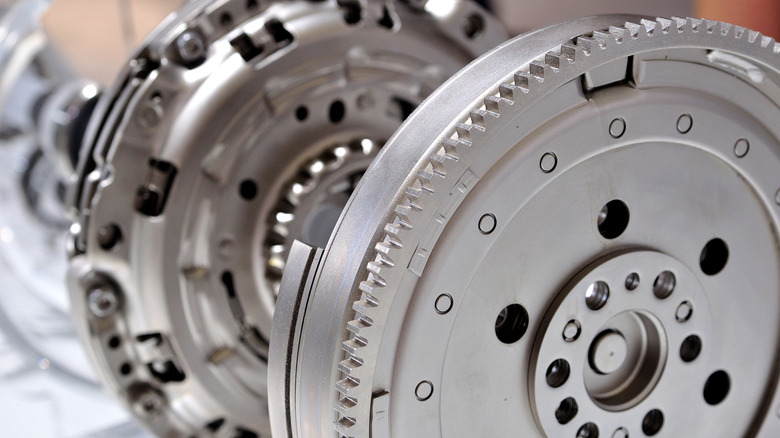
Before we discuss flex plates, it’s important to understand the basis for why these devices exist at all. Automobile engines are incredibly violent devices, and despite how smooth they run, the way they function is actually quite the opposite. A typical car’s four-stroke engine only produces power during the third stroke — the power stroke. That’s where all of the torque is concentrated; imagine a line that goes nothing, nothing, everything all at once, then back to nothing, nothing… and so on. This manifests in a series of pulses, which you can hear in your exhaust. That’s why, for instance, V6 exhaust sounds different from V8 exhaust.
The problem is, unlike your engine’s exhaust note, it’s not acceptable for those pulses to go through your transmission. That’s why your engine has either a flywheel bolted to it, or it has a torque converter. In the latter’s case, as the name implies, a torque converter accepts the engine’s torque, transferring it into a liquid medium instead of a solid one — transmission fluid.
It’s a fairly misunderstood device. Picture two fans facing one another; one fan is connected to the engine, and the other to your drivetrain. When the engine is running, that fan is spinning. All the fluid surrounding that fan is then also spun around, carrying the momentum of all that torque. This then imparts that torque onto the other fan — indeed, onto your transmission, and you have drive. Manual transmissions have a torque converter of sorts; it’s the flywheel and clutch assembly. That inertia the transmission fluid carries in a torque converter is accepted by the weight of the flywheel instead, that’s the main difference.
Why do flex plates exist?
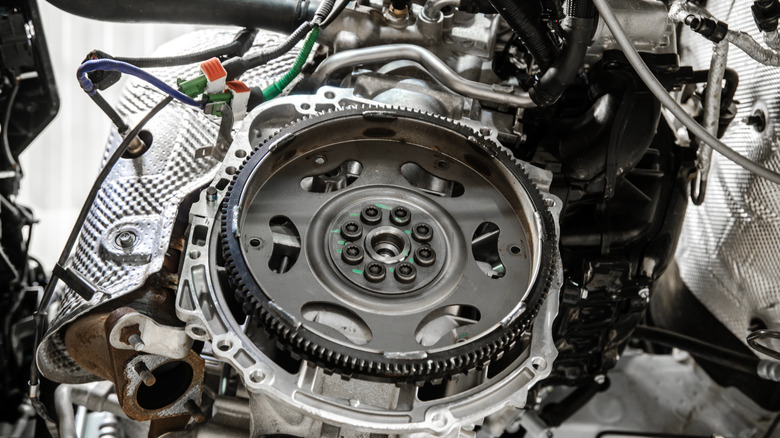
Ultimately, both the flywheel and flex plate serve similar functions in that they’re the junction point between the engine and transmission, at least in torque converter automatics — there are other types of automatic transmissions. That said, because most of the slack is picked up by the torque converter as far as smoothing the engine’s pulses is concerned, that eliminates the need for a flex plate to be as beefy as a flywheel.
Of course, if the torque converter does all the work of the flywheel, then it begs the question of why flex plates even exist in the first place. That’s because both flywheels and flex plates do more than carry momentum — for instance, those gear teeth on the edge of the flex plate engages with the starter motor, and is how your car starts up. But more than that, the flex plate must carry the torque from the engine to the torque converter, which it performs by, you guessed it, flexing.
These discs are thin enough to flex along their main axis, hence why they’re called flex plates. This motion is a key part of how these devices work; torque converters are heavy and filled with fluid. Likewise, the engine’s crankshaft is constantly having variable torque levels applied to it. Having a thin, flexible plate acting as the intermediary between these two elements acts as a buffer to smooth everything out, much like a flywheel in principle. This function requires flex plates to be noticeably thinner and lighter than flywheels, with flex plates typically being made out of thin stamped steel.

Stephan is the sports journalist for the Maple Grove Report.