
We may receive a commission on purchases made from links.
Most, if not all, professionals and DIYers have their personal favorites when it comes to power tool brands, though it’s hard to deny (even if they’re not your own preference) that Milwaukee and Makita are two of the best. When SlashGear ranked every major cordless power tool brand from worst to best, the red-M and blue-M brands both made the top three.
Milwaukee came in number one, in fact. Along with its innovation and premium quality, the brand is closely associated with raw power when it comes to its cordless tools, offering products that can easily replace the corded alternatives in your toolshed. However, there are still several Makita tools that outperform Milwaukee’s equivalent options. Makita is also known for its superior quality and reliability, so a Makita tool that’s also stronger and/or faster is icing on the cake for its users. Milwaukee may have more oomph than Makita for most kinds of devices, but Makita competes closely in multiple categories, including yard tools, cutting tools, and drivers and wrenches.
When it comes to cutting thick pieces of lumber, Makita even sells options where Milwaukee doesn’t even come close. Based on manufacturer specs and the findings of expert testers, here are five Makita power tools that are more powerful than their Milwaukee alternatives.
18V LXT 4‑Speed Mid‑Torque ½-Inch Drive Impact Wrench
According to Car and Driver, the Makita 18V LXT High-Torque ½-inch Impact Wrench (model XWT08Z) is one of the best cordless impact wrenches you can buy. Makita’s mid-torque model is no slouch either, though, and is more powerful than Milwaukee’s M18 Fuel ½-inch Mid-Torque Impact Wrench. The Milwaukee wrench, model 2962-20, has a breakaway torque of 650 ft-lbs. Makita’s 18V LXT 4‑Speed Mid‑Torque ½-Inch Drive Impact Wrench (model XWT17Z), on the other hand, tops out at 740 ft-lbs of loosening torque.
For what it’s worth, the M18 tool does slightly beat out Makita when it comes to fastening torque — 550 vs 520 ft-lbs — though that won’t be of much use if you’re dealing with a stuck, rusted lug nut. When Torque Test Channel put the two head-to-head, Makita’s tool proved to have a higher max torque than Milwaukee’s, though the latter had a higher working torque. The Makita 18V LXT 4‑Speed Mid‑Torque ½-Inch Drive Impact Wrench includes three forward and three reverse modes with auto-stop. It also gives users the choice between four different speeds, so all that torque doesn’t need to be used if the job doesn’t call for it.
18V LXT Cordless Blower
One of the Makita tools you’ll need for yard in the fall is the 18V LXT Cordless Blower (model XBU03Z), unless you want to be manually raking your leaves. There are other leaf blowers on the market, of course, but the 18V LXT Cordless Blower generates a slightly higher volume of air than the Milwaukee M18 Fuel Blower (model 2724-20). It’s capable of up to 459 cubic feet per minute (CFM) of airflow, compared to Milwaukee’s 450 CFM. That means Makita’s blower moves more leaves at once, and a difference of 9 cu. ft. per minute can add up if you’ve got a large yard.
Milwaukee’s M18 Fuel Blower does have a higher maximum speed, though. As opposed to how much it can blow at once, speed measures how strong the airflow is. If you’re dealing with heavier, wet leaves, the M18 Fuel Blower has an edge over Makita since it can generate up to 120 mph, while the Makita XBU03Z tops out at 116 mph, which is practically a negligible difference.
The Makita 18V LXT Cordless Blower is equipped with a full-range variable speed trigger, allowing users to deliver the extra mph only when needed — that way battery life can be better managed. The tool also includes cruise control and speed lock, and its operational noise is rated at 60 dBa. The compact blower weighs 6.5 pounds without the battery and utilizes an in-line fan design for improved balance.
Makita 40V max XGT Hammer Driver-Drill
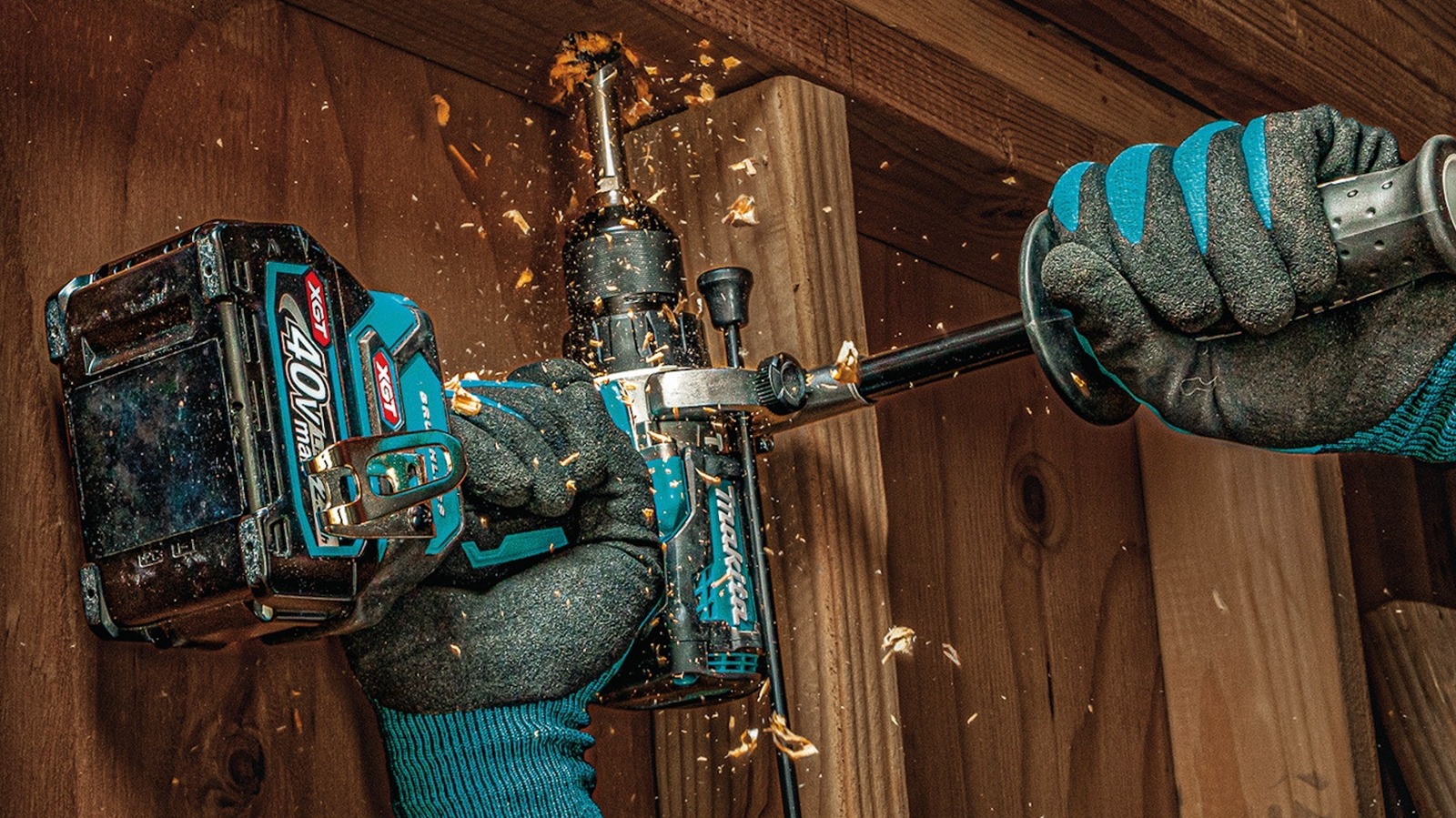
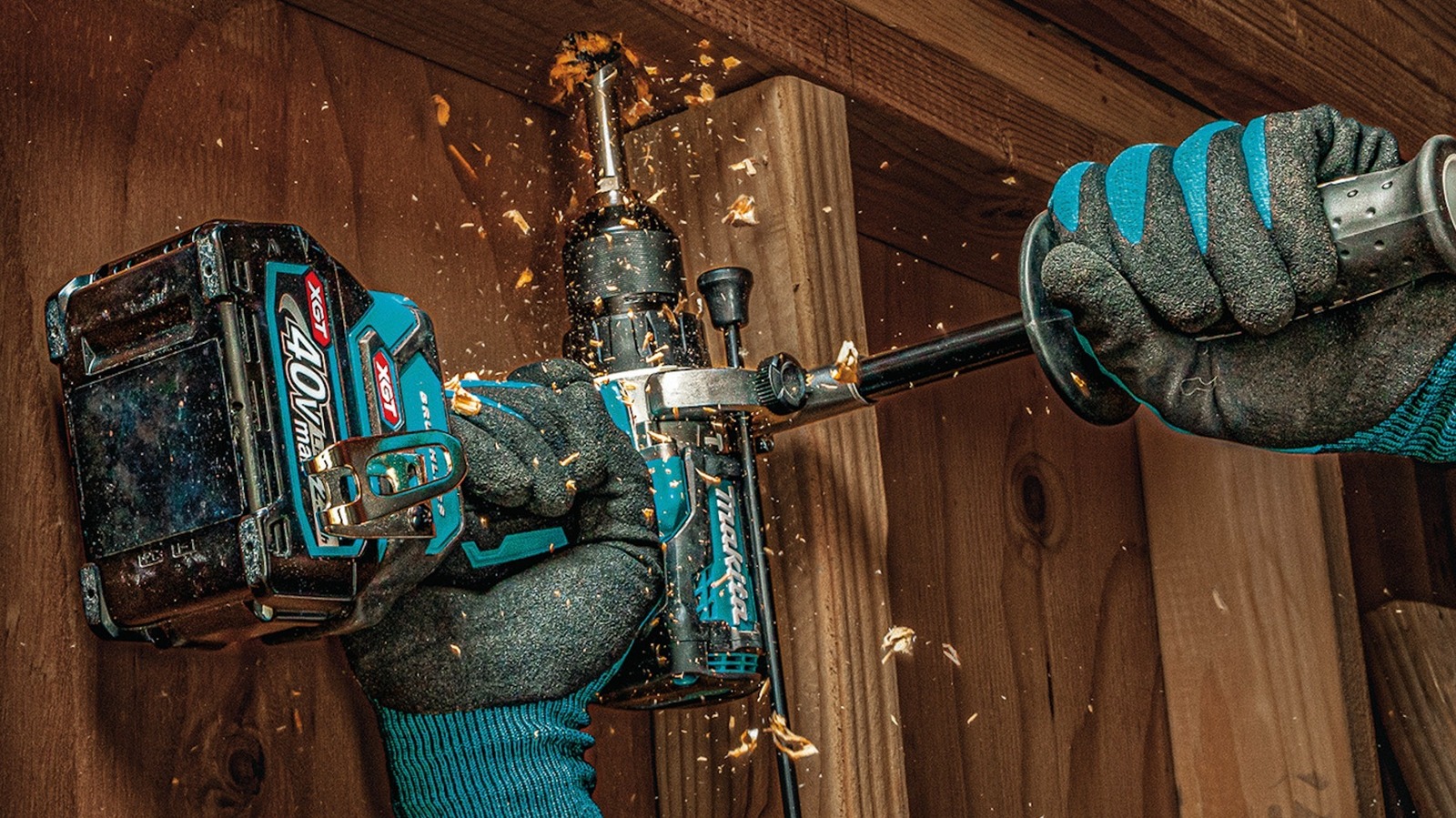
A hammer driver-drill is one of those tools that personifies power in just the way it operates. It’s meant to physically smash through stone and concrete, after all, and a weak hammer driver would be like using a dull knife for cutting — what’s the point? That’s why it’s one of the types of tools in Makita’s powerful 40V max XGT line of products, using big, beefy batteries to provide enough oomph for tools to do their jobs.
The 40V max XGT Hammer Driver-Drill (GPH01) is one of the Makita tools you can use on your next concrete and masonry project since it’s strong enough for hard materials. It comes with two different speed settings, with the high speed maxing out at 2,600 rpm. The Milwaukee M18 Fuel ½-inch Hammer Drill/Driver (model 2906-20) also works in two speeds, but both have lower ceilings, with 2,100 rpm being its maximum speed on paper. Additionally, Makita’s tool, which is both larger and heavier, is capable of up to 39,900 bpm versus Milwaukee’s 33,300 rpm.
Where Milwaukee’s hammer drill/driver beats Makita’s hammer driver-drill is torque — the former delivers 1,400 in-lbs of rotational force and the latter 1,250 in-lbs. These metrics are more or less confirmed in direct head-to-head tests conducted by Pro Tool Reviews. The testing averaged multiple runs with different bits, like concrete and spader, as well soft torque measurements. Milwaukee outperformed Makita when it came to torque, but in most tests Makita was able to drive bits into material faster.
18V LXT 24-inch Hedge Trimmer
On SlashGear’s list of the best and worst brands for cordless yard tools, both Makita and Milwaukee make the “good” list. But who has the more powerful hedge trimmer? Powered by a brushless motor, the Makita 18V LXT 24-inch Hedge Trimmer (model XHU07Z) generates up to 4,400 strokes per minute (SPM) to slice through your shrubs.
Milwaukee’s equivalent — the M18 Fuel 24-inch Hedge Trimmer (model 2726-20) — also features a brushless motor and same-sized bar. Milwaukee is known for its powerful cordless motors, yet the M18 Fuel trimmer delivers far fewer strokes per minute than Makita’s — just 3,400 SPM.
The Makita 18V LXT 24-inch Hedge Trimmer uses a double-sided shear blade, so users can really put that high speed to work. Plus, it includes a reverse function, which is useful when the blade gets jammed up with leafy debris. Its rear handle rotates between five different positions, which also makes the tool easier to use. Considering that the difference in speed between Makita’s and Milwaukee’s products is more wide than negligible, it’s not much of a surprise that the M18 Fuel 24-inch Hedge Trimmer is very difficult to find in stock these days. It’s almost as if, when it comes to cordless hedge trimmers at least, Milwaukee has ceded the battle.
Makita 40V max XGT 16‑5/16-inch Circular Saw
When it comes to cordless circular saws, almost nobody can even try to claim to be more powerful than Makita, as it’s one of the very few brands that offers a massive 16‑5/16-inch model. For comparison, the largest Milwaukee saw has been 7-¼-inch, which is less than half the size. As of mid-2026, Milwaukee finally has a 10-¼-inch saw, the M18 Fuel Rear-Handle 3026-20, but that’s just rolling out onto shelves at the time of this writing and isn’t widely available. It’s also not even close to the size of Makita’s 40V max XGT 16‑5/16-inch Circular Saw (model GSH06T1).
If you’re doing heavy carpentry or building timber framing, log cabins, decks, and other structures, Milwaukee’s smaller saws are no replacement for a beam saw or chainsaw. Makita’s 40V max XGT 16‑5/16-inch Circular Saw is, though, and would provide more precision than a chainsaw. The saw is designed to cut 6-by material at 90 degrees and 40-by material in a single pass.
One reason battery-powered circular saws of this size are so rare is that they require a lot of power, so it makes sense that most would be corded. However, Makita’s 40V max tool can make up to 75 cuts into 6×12 lumber per charge when powered by a 5 Ah battery. Makita also says it runs up to 30% faster than corded alternatives. Despite its size and power, the 40V max XGT 16‑5/16-inch Circular Saw only weighs about 24 pounds, so the cordless tool is still practical to use and take with you on the go. It’s also AWS capable, which is good because big saws kick up plenty of dust.

Stephan is the sports journalist for the Maple Grove Report.