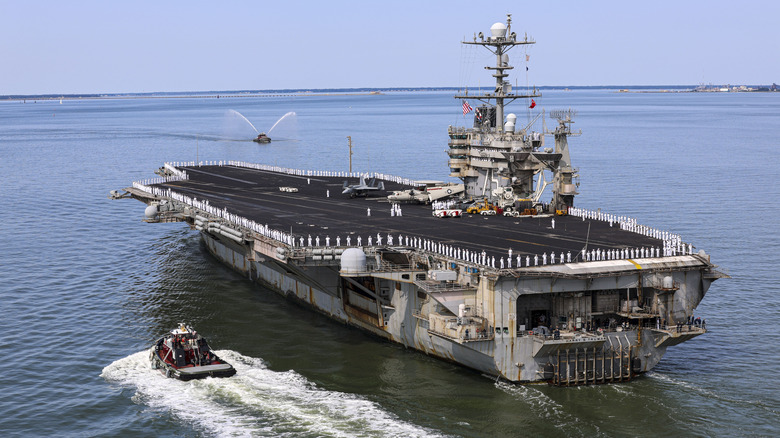
There’s A Good Reason Why US Navy Ships Use Onboard Calibration Labs


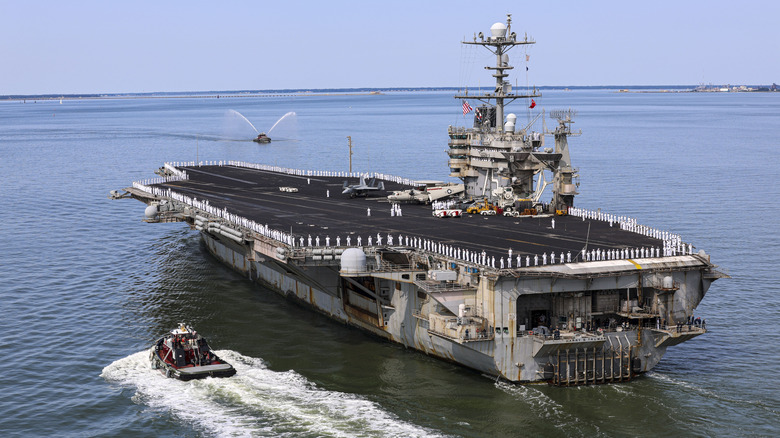
Modern United States Navy ships are among the most impressive vessels ever to sail the seas, but it’s not necessarily easy to appreciate the technology and capabilities of aircraft carriers like the USS Gerald R. Ford. Some features, be it a carrier’s nuclear power plant, catapult mechanism, or advanced weaponry, are obvious, but these vessels also have smaller, lesser-known features that can be equally important.

One of these areas is the onboard Metrology and Calibration Laboratory, more commonly known as METCAL. Why, exactly, would you need a laboratory on board a ship like an aircraft carrier, whose primary mission is launching warplanes? It’s because the METCAL performs the vital, yet under-appreciated task of keeping the ship’s equipment and associated instruments calibrated and accurate. 

Given the military’s overall emphasis on precision, correct calibration of equipment and instruments is critical for safety and fighting effectiveness. Many of these calibration jobs are quite involved, too. While some of this work can be done in traditional land-based laboratories, larger ships that spend extended periods at sea far from their home ports rely on their onboard METCAL centers and dedicated crews for these tasks. The METCAL’s smaller, yet consequential role in a carrier’s daily operations is just one more reason why these ships are often likened to floating cities.

The science of calibration
The Navy founded its METCAL program in the 1950s, after Navy employee Jerry Hayes discovered that incorrectly calibrated instruments were resulting in unreliable missile tests. The result was the establishment of the Navy Metrology Engineering Center. Note that while we’re focusing on the Navy, metrology and calibration labs can be found throughout the United States Military.

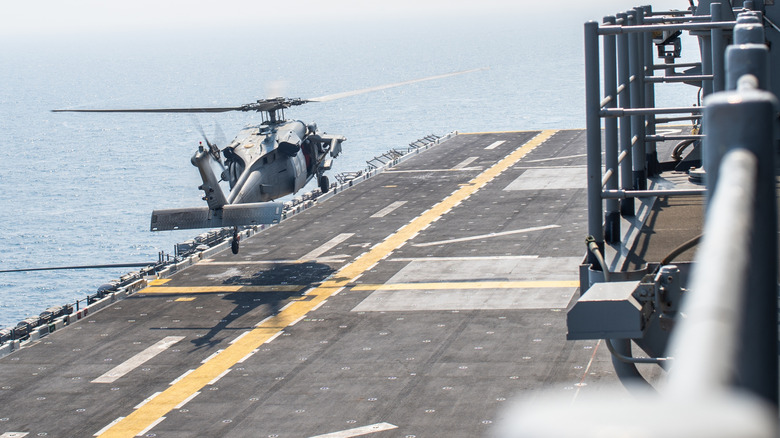
Metrology is broadly defined as the science of measurement, which plays a crucial role in many scientific fields. The Navy’s primary metrology department operates as part of the Naval Special Warfare Command (NSWC) Corona Division. Only certain Navy ships have their own METCAL department, usually larger ships like aircraft carriers and the Navy’s similarly impressive amphibious assault ships like the USS America

Smaller vessels can have their calibration handled by regional shore-based METCAL centers, but not the larger carriers and amphibious ships. Not only are these ships filled with equipment that needs calibrating, but they also operate aircraft that similarly require calibration. Additionally, the amount of time these larger vessels spend away from port means that having an onboard METCAL lab to handle calibration tasks is vital for self-sufficiency.

Floating precision
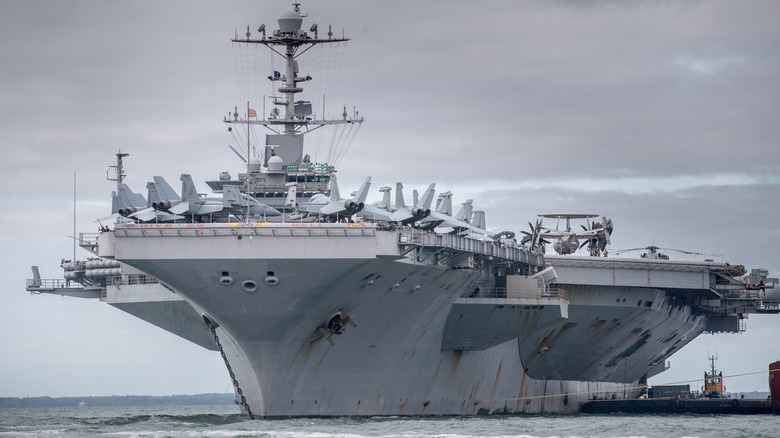
So how much work does a METCAL lab do? In 2007, the Navy METCAL was performing over 525,000 calibrations per year across its hundreds of land- and sea-based labs, and that number is likely higher today. There are also over 5,000 calibration procedures for the various types of equipment the Navy uses. 

On board the carrier USS Harry S. Truman, which was rated best in the Navy for its METCAL performance in 2021, there are about 12,000 pieces of equipment in need of regular calibration, with the ship’s lab handling around 550 calibration jobs per month. These include night vision goggles, with METCAL crew members tasked with ensuring Navy pilots’ goggles are set to the correct sensitivity.

Even while at port, a ship’s METCAL department can play a crucial role. In 2024, while the amphibious assault ship USS Essex was drydocked for repair and maintenance, the ship’s METCAL lab successfully calibrated and maintained the ship’s firefighting system, in a demanding job that would normally have been contracted out at great expense. For this achievement, Essex’s lab and its 13 technicians were recognized with a Navy Self-Sufficiency Award.


Source link

Leave a Reply

Subscribe to Our Newsletter

Get our latest articles delivered straight to your inbox. No spam, we promise.

Recent Reviews


It kind of makes no sense that literally every new car sold these days can go twice the regular speed limit in most countries. Even a Toyota Prius tops out at 115 mph, and reaching that speed in 99% of the world can easily land you in jail, or at least with a large dent in your bank account from a truly massive speeding ticket. Meanwhile, supercars can easily blow a Prius out of the water — for example, the Chevrolet Corvette ZR1 can hit speeds more than double that.

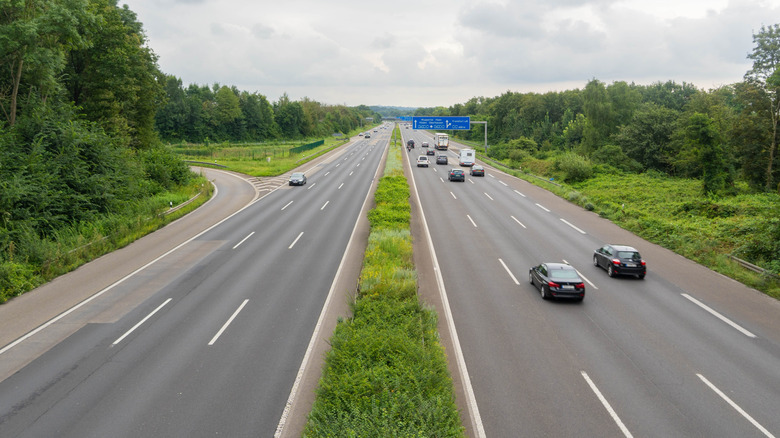
Either way, top speeds are merely hypothetical and completely off-limits for 99% of the world. Yet no matter if you own a ZR1 or a Prius and you want to test that top speed claim, there are public roads where you can try. The most obvious choice is the German Autobahn, which has certain sections with no speed limits. This means that, if it is safe to do so, you can theoretically chase that top speed.

Besides the German Autobahn, the roadways on the Isle of Man — known for the Isle of Man TT — also has sections with no speed limits. About a decade and a bit ago, you were also able to max out your car on certain locations of the Australian Northern Territory, specifically the Stuart Highway. However, speed limits were reinstated in the interest of public safety in 2016. Besides the Isle and the Autobahn, if you want to max out your car, public roads simply aren’t an option.

Limitations and dangers on no-speed-limit roads

Although reaching the top speed on the Autobahn is possible, it is not as simple as merging and hitting the gas. For example, the A9 near Bayreuth, A20 in Mecklenburg, and parts of A24 between Berlin and Hamburg are without speed limits in certain sections. In total, around 70% of German autobahns don’t have a capped speed limit. Even on those unrestricted sections, German law sets a recommended speed of 130 km/h called the Richtgeschwindigkeit.

Exceeding it is not a criminal offense, but if you are involved in an accident above that threshold, it can affect your legal liability for the incident. German law also prohibits driving at any speed where your stopping distance exceeds your line of sight, which effectively puts a practical ceiling on how fast you can legally go based on road conditions. The AutoTopNL YouTube channel serves as a good educational basis for how one ought to approach high speed driving on the autobahn.

If Germany is too far away and you want a more rural experience while driving at ten-tenths, the Isle of Man is your only other option. Outside of towns you can press on, but keep in mind that these roads are much narrower and less protected, leaving no room for error. The best example is likely the Isle of Man’s TT Race, which the BBC called “the world’s most dangerous road race.” The Isle of Man TT and the Manx Grand Prix, held on the same roads that you can max out your car on, are races so dangerous that they have taken a collective 270 lives since inception.

Where do automakers actually test top speed claims?

For decades past, we’ve seen automakers advertising hypercars going over 250 mph, but not many people know the places where these tests are commonly carried out. For example, the fastest street-legal car on record, the Bugatti Chiron Super Sport 300+, reached its top speed of more than 300 mph on the Volkswagen Ehra-Lessien test track in 2019. This facility has 60 miles of private roads with a single straight that is 5.4 miles long.

There is also the Papenburg test facility, which features a 7.6-mile-long oval track banked at 50 degrees. This is where the Yangwang U9 Xtreme set the all-time production car top speed record at 308 mph in 2025, and where in 2023 the Rimac Nevera drove 171 mph backwards — not something you can do on the German autobahn. Italy’s Nardò Ring is a 7.8-mile circular track built by Fiat in 1975 and now owned by Porsche. It is so large it is visible from space, and so well-banked that a car traveling at 149 mph in the outer lane doesn’t need to be steered and can simply be driven straight. This last test track is perhaps best known from the 2012 Top Gear episode where Jeremy Clarkson, Richard Hammond, and James May pushed a Lamborghini Aventador, a Noble M600, and a McLaren MP4-12C to their limits. 

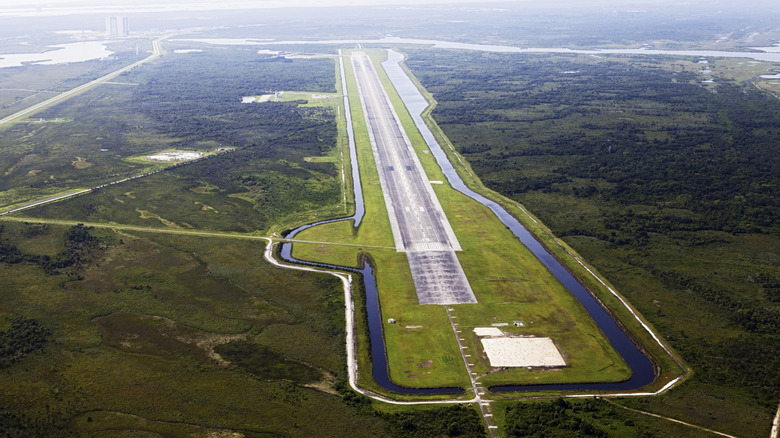
America’s equivalent is the former Space Shuttle Landing Facility at Kennedy Space Center, now operating as the Johnny Böhmer Proving Grounds. The 3.2-mile runway is where the SSC Tuatara hit 295 mph in 2022. Although these aren’t typically open for public joyriding, they are a few of a very limited number of places where top speeds are actually tested.


Source link