15 Makita DIY Products Users Recommend


We may receive a commission on purchases made from links.

Makita made its first electric power tools in 1958, but the company can trace its history back even further. It was originally founded in 1915 and made an assortment of electrical equipment including lighting and electric motors. Today, it’s one of the few major tool brands to remain independently owned, and its products are distributed across the globe.

Its range of corded and cordless power tools are trusted by professionals, but they’re also a great choice for serious DIYers. They’re built to be durable, powerful, and long-lasting, all of which helps justify their premium pricing.

Given that almost none of Makita’s tools could be called cheap, newcomers to the brand might be understandably cautious about dropping hundreds or even thousands of dollars on its products. Thankfully, many of the brand’s DIY-oriented tools have already been put through their paces by buyers, and these 15 have received scores of positive reviews, confirming that they’re worth the investment.

Makita 18V LXT 2-Piece Drill/Driver and Impact Driver Kit

DIYers who are new to Makita’s cordless tool line will want to make their investment in battery packs worthwhile. An easy way to do that is to opt for one of the brand’s multi-piece tool kits, such as the 18V LXT two-piece drill/driver and impact driver kit. It retails for $199 and includes all the key elements that newcomers will need to start using the brand’s 18V LXT tool line. Alongside both tools, the kit also includes a pair of 1.5Ah batteries, a charger, and a bag to carry everything in.

Both included tools are designed to be tough since they’re dust and water resistant, and both are lightweight. The tools, charger, and batteries are backed by Makita’s 3-year warranty, just like virtually all other products in the brand’s 18V cordless tool line. The included batteries are compatible with any Makita 18V LXT tool, although their modest capacity means that buyers wanting maximum tool runtime may want to purchase an additional high-capacity battery pack for their collection.

Makita 18V LXT 5.0Ah High Capacity Battery Pack

Retailing for $169, the Makita 18V LXT 5.0Ah high capacity battery pack is no small investment. However, users agree that it’s worthwhile for bigger jobs. Makita says that the battery pack can be fully recharged in 45 minutes, and has helpfully included LED indicator lights to let DIYers know its state of charge at a glance. It’s designed to withstand essentially all of the challenges that demanding users could throw at it, from high-vibration jobs to extreme cold weather. According to the brand, it will continue to perform well in temperatures as low as -4 degrees F.

The battery is designed to be used with Star Protection tools, which can be easily identified by the star symbol on their sides. This battery protection technology helps prevent overloading or overheating during the most intense jobs, which in turn helps keep the battery in top condition for longer. For additional reassurance, Makita provides the battery with a 3-year limited warranty.

Makita 18V LXT 4-½ Inch – 5 Inch Cut-Off/Angle Grinder

Although angle grinders can be nerve-racking to use, particularly if you don’t have much experience with one, they’re an important tool in the arsenal of many dedicated DIYers. Makita also sellscorded variants, but going cordless with the 18V LXT 4-½ inch to 5 inch angle grinder doesn’t mean you’re compromising on power. It’ll still be able to tackle all the same materials as a corded grinder, but with the added convenience of unlimited portability.

The tool retails in standalone form for $179, although it’s also available at Home Depot as part of a kit with a pair of 5.0Ah batteries and a charger. To give less confident users extra reassurance, or prevent seasoned pros from unfortunate accidents, the angle grinder features several safety features including anti-restart protection and active feedback-sensing technology. It can also automatically optimize its torque output in real time, which helps to boost its performance without sacrificing runtime.

Makita 1-¼ Inch Corded Compact Router

Many of Makita’s most popular DIY-friendly tools are cordless, but it still offers a broad range of corded tools too. Take, for example, the brand’s 1-¼ inch corded compact router, which retails for $159. We previously highlighted the router as one of the most essential woodworking power tools and specifically namechecked Makita as a solid choice in this category.

This router’s 1.25 horsepower motor spins up to a maximum speed of 30,000 rpm, although a variable speed dial can reduce output to as little as 10,000 rpm depending on the job. The motor is encased in an aluminum body that’s double-insulated and designed to be resistant to bumps and scratches. Makita covers the tool with a 1-year warranty, which is 2 years less than the brand’s cordless equivalent. However, the corded tool’s consistently strong reviews should be enough to allay any concerns about its durability.

Makita 18V LXT Reciprocating Saw

A capable reciprocating saw can be useful for many different DIY jobs, and cordless versions of the tool are even more versatile than their corded cousins. Makita’s 18V LXT reciprocating saw forms part of the brand’s sprawling cordless range, which it claims is the largest 18V cordless tool range on the market.

Whether or not that’s true is tricky to verify, since manufacturers are always tweaking their lineups to include new launches and discontinue older products. What is verifiably true is that Makita’s saw is consistently well-liked by reviewers, and it’s backed by a competitive 3 year warranty.

The saw retails as a standalone tool for $159, but like many of the brand’s most popular power tools, it’s also available at Home Depot as part of a kit with a battery and charger. The tool is compatible with all Makita 18V batteries that feature the star symbol on their side, signifying the brand’s Star Protection battery management technology.

Makita 18V LXT Variable Speed Oscillating Multi-Tool

When it comes to versatility, the Makita 18V LXT oscillating multi-tool is a top performer. It can be used to cut PVC, plaster, flooring, and many other materials you’ll be dealing with on home improvement projects, and it can also be fitted with accessory cutting blades to give it an even broader range of talents. The tool retails for $169 and comes with a cutting blade and adapters for accessories, but not with the battery or charger that will be needed to run it. Both of those will have to be bought separately if you’re new to Makita’s 18V cordless tool line.

With a compatible battery fitted, Makita says that the tool will weigh less than 5 pounds. That lightweight construction, combined with the inherent portability of cordless tools, make it an appealing pick even for DIYers who already have a corded oscillating multi-tool in their kit. Anyone who prefers to stick with corded tools still isn’t entirely out of luck, since Makita does offer such a version of its multi-tool, but it hasn’t racked up a high enough number of positive reviews to qualify for inclusion here.

Makita 18V LXT 6-½ Inch Circular Saw

Makita has been building electric motors of various kinds for more than a century, and so has had plenty of time to hone its expertise. That’s important for making power tools of many kinds, since a weak motor can render even the most feature-heavy tool useless. Makita’s 18V LXT 6-½ inch circular saw is light on additional features, but its brawny 3,700 rpm motor ensures it’ll still be a very useful addition to many DIYers’ toolboxes.

The saw retails in tool-only guise for $159, but Makita does include a general purpose blade with the price of purchase. The included 16-tooth blade has a 2-¼ inch cutting capacity, but anyone needing a more specialized blade will find plenty of compatible options at leading retailers like Home Depot. As standard, Makita provides a 3-year limited warranty for the tool, just like almost all of the rest of its 18V LXT range.

Makita 18V LXT 1/4 Inch Impact Driver

Choosing which Makita impact driver is best for you isn’t necessarily a straightforward decision. However, if you’re basing your pick mostly on reviews from existing users, the 18V LXT ¼ inch impact driver is a top candidate. The numbers on its spec sheet look impressive: It’s got a maximum motor speed of 3,400 rpm, 1,500 in-lbs of maximum torque, and a weight of just 3.3 pounds without a battery, all for a retail price of $159.

Of course, official specs only form part of the equation, but the consistently strong feedback from users is solid evidence that the tool can live up to its promises in real-world use. Just in case it doesn’t, Home Depot buyers are covered by the retailer’s standard 90 day returns policy, as well as Makita’s familiar 3-year 18V cordless tool warranty. That warranty covers any defects in either the workmanship or materials used within the tool’s construction.

Makita 18V LXT 7-1/4 Inch Circular Saw Kit

If you’re buying a more power-hungry cordless tool like a 7-¼ inch circular saw, you’ll need to make sure that the battery pack you’re pairing it with is up to the task. You could work out which size battery is the optimal match for the tool yourself, or you could let Makita do all the hard work for you and buy the 18V LXT 7-1/4 inch circular saw kit instead. If you pick the second option, you’ll save money too compared to buying everything individually. The kit retails for $449, but Home Depot notes that purchasing all the components on their own would total $770.

Alongside the saw itself, the kit includes two 5.0Ah batteries, a dual-port charger, and a handy carry bag. Makita’s testing saw the pair of batteries deliver 558 crosscuts in 2×4 wood before needing to be recharged. As well as being long lasting, the saw also delivers on cutting power, with its motor reaching up to 5,100 rpm. Primarily, the saw kit is aimed at tradespeople including roofers and framers, but it’s also worth considering if you’re a seasoned DIY enthusiast looking to take on a large home improvement project.

Makita 5 Inch Corded Random Orbit Sander

It’s safe to assume that most DIYers are going to need to use a sander at some point during a job, but exactly which sander is best will depend on what you’re doing. There are a few differences between an orbital sander and a random orbit sander, but if you’re looking for the latter, it’s worth considering Makita’s 5-inch corded version of the tool.

It’s available for $129, and because it doesn’t need batteries, it’s still just as appealing regardless of whether you buy it to add to an already extensive Makita tool collection or whether it’s your first tool from the brand. It’s aimed at professional users; as a result, it offers both power and precision, with a three amp motor that reaches a peak of 12,000 opm (oscillations per minute). When its full power isn’t needed, the variable control dial allows users to drop its speed to as little as 4,000 opm.

Makita 18V LXT Drywall Screwdriver

Having the right tools for big home improvement jobs cuts down on hassle and saves time, which makes the Makita 18V LXT drywall screwdriver worth a look. It’s another tool that Makita created with professionals in mind, allowing them to hang metal framing and sheetrock quickly and efficiently. It’s not going to be the most frequently used tool in a DIYer’s tool kit, but at $189, it might be worth the investment for a major project.

Buyers who do fork out for one are consistently impressed with its capabilities, and since it’s part of Makita’s 18V LXT tool line, it’s compatible with the same battery packs as the other 18V cordless tools here. Since it’s less than 10 inches long, it won’t take up much space in your tool box when it’s not in use either. It’s one of many professional-oriented Makita tools that features the brand’s Extreme Protection Technology (XPT), which it says provides enhanced protection against water and dust ingress.

Makita 18V LXT Rapid Optimum Battery Charger

Even the best cordless tools will be rendered useless if you don’t have a charged battery pack to power them. The Makita 18V LXT rapid optimum battery charger is designed to reduce downtime compared to the brand’s standard charger, so those tools won’t remain useless for long. It features a unique fan design that cools batteries while they’re charging and two-way communication between the battery and charger to ensure maximum charging speed.

Makita claims that the unit can fully recharge a 5.0Ah battery in 45 minutes, while a 3.0Ah battery takes just half an hour. At those speeds, you can pop the battery in the charger, and by the time you’ve run to the store to pick up your caffeinated beverage of choice, you’ll be able to get straight back to work when you return. At the time of writing, the rapid battery charger is available for $145.99 at Home Depot.

Makita 18V LXT Blower

There are very few DIY jobs that won’t generate at least some level of mess, and cleaning up that mess can be a pain. A compact blower like the Makita 18V LXT blower can make tidying up a bit easier, and it runs on the same battery packs as the brand’s other DIY-friendly cordless power tools.

It’s small in size but big on power, with a peak air velocity of 219 mph. The tool’s variable speed switch can tone that power down for lighter cleaning jobs. Its maker claims a runtime of up to 17 minutes on a fully-charged 6.0Ah battery, but given that most Makita kits come with smaller capacity batteries, it’s worth adjusting your expectations accordingly if you’re not planning on buying a 6.0Ah battery pack separately.

The blower retails for $159 as a standalone tool. Just like the brand’s cordless DIY essentials, it’s backed by a 3-year warranty, but its high average review score suggests that buyers are unlikely to need it anyway.

Makita 18V LXT Compact Router

We’ve already covered Makita’s corded compact router, but anyone who prefers their tools to run on batteries might want to consider the 18V LXT compact router instead. It’s similarly capable, but it runs using the brand’s 18V battery packs. The additional portability does come at a cost though: the cordless router retails for $219, which is $60 more than the corded tool.

Just like its outlet-tethered counterpart, the 18V LXT compact router has a variable speed control dial that can be adjusted from 10,000 rpm all the way up to 30,000 rpm. It also features the same tough aluminum housing.

There are a few differences between the two tools, with the cordless router featuring an LED work light to aid users’ vision in dimly lit workspaces. The cordless tool is also covered by a 3-year warranty while the corded version only gets a single year of coverage as standard. Whether those differences are worth the price premium comes down to personal choice, but users recommend both models.

Makita 7-1/4 Inch Corded Circular Saw

Another corded tool with a similarly highly rated cordless counterpart is the Makita 7-¼ inch corded circular saw, which retails for $219. For that price, buyers of the corded saw also get a 24-tooth carbide blade and a hard-shell carry case thrown in. According to Makita, that carbide saw blade should last up to twice as long as a standard one.

The tool offers the kind of power that demanding users have come to expect from the brand, with its 15 amp motor able to hit a peak of 5,800 rpm. Despite its power, it isn’t particularly heavy, clocking in at a little over 10 lbs.

Makita helpfully included a dust blower within the saw as well as a pair of LED lights, both of which help to keep the cut line easy to see. If you’re not fussed about the added portability that comes with cordless tools, it’s hard to go wrong with Makita’s corded circular saw, a fact that’s reflected by its consistently strong user reviews.

How we picked these top-rated Makita tools

Makita is a trusted brand among professionals and DIYers alike, but inevitably some of its tools don’t meet the high standard set by the rest of its range. To ensure that each of our picks lived up to buyers’ expectations, we only included tools and accessories that had received a minimum of 500 reviews at Home Depot with an average rating of at least 4.5 stars. As an additional measure, we then checked reviews on rival retailers like Acme Tools and Ace Hardware to ensure that each had received a similarly positive reception.


Source link

Leave a Reply

Subscribe to Our Newsletter

Get our latest articles delivered straight to your inbox. No spam, we promise.

Recent Reviews


Struggling with infertility can be emotionally draining. It can leave you feeling isolated and alone. Many avoid talking about their struggles and may even avoid conversations with their physicians because of the stigma surrounding infertility. However, according to the World Health Organization (World Health Organization, 2023), infertility affects approximately 17.5% of the world’s population.

You are not alone – Arizona Gynecology Consultants is here to help you understand the impacts of infertility and share resources to help navigate the emotional and physical difficulties associated with it.

What Is Infertility?

Infertility is generally described as struggles with becoming pregnant within a year of beginning active efforts to conceive (i.e., vaginal sex without withdrawal, barrier, or medication-based birth control). With this definition, it’s easy to see how many individuals suffer from infertility, especially as they age. A woman’s fertility, for example, declines after age 35, and many women seek treatment for infertility if they have not become pregnant after six months of unprotected sex, according to the Centers for Disease Control (CDC, 2024).

Many other factors can contribute to infertility, including medical conditions, medications, new or existing trouble ovulating, differing reproductive organ structure, hormonal changes, and even lifestyle factors like weight, smoking and/or alcohol use, and stress. It’s also important to note that infertility does not just apply to women, but to men as well.

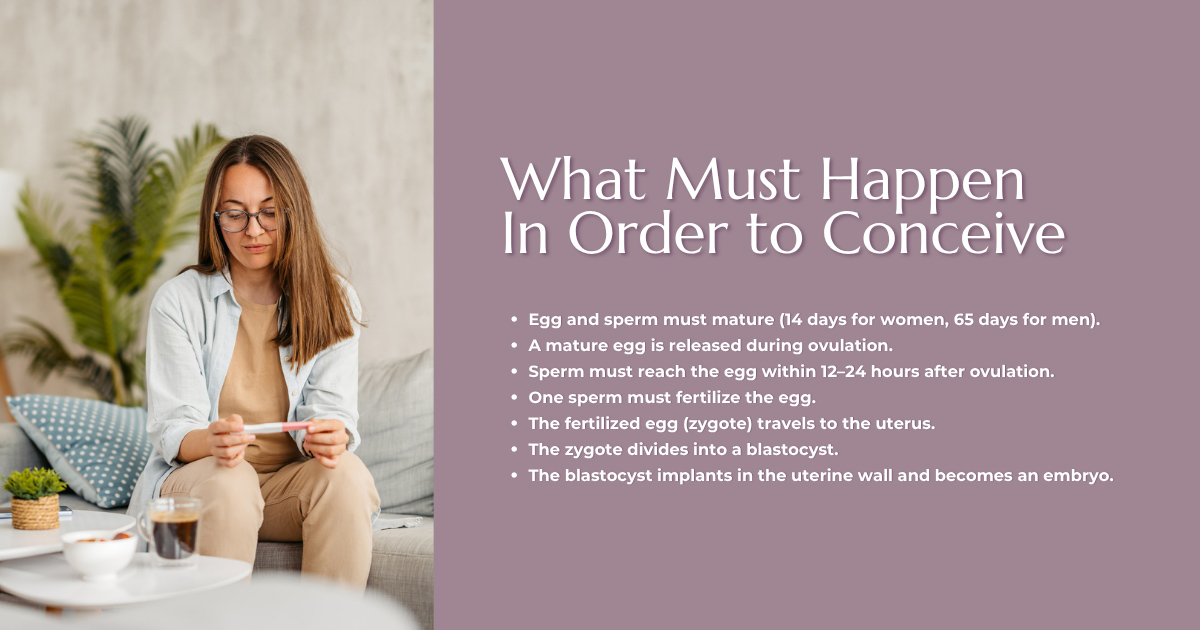
What Must Happen In Order to Conceive

What Must Happen In Order to Conceive

Many women are able to become pregnant without any medical assistance, even those who have previously experienced infertility. However, it’s important to note that many events must occur under ideal conditions to make conception possible. When you’re amidst an ongoing struggle to conceive, though, it can seem like pregnancy happens quickly and easily for everyone else.

For a woman to become pregnant, several things must occur:

  • First, both egg and sperm must develop and mature, a process that begins at birth and takes about 14 days to complete for women and about 65 days for men.
  • A mature egg must be released from one of the woman’s ovaries, a process called ovulation.
  • Sperm must be released into the vaginal canal within 12-24 hours after ovulation and enter the fallopian tube; otherwise, the egg will be reabsorbed by the woman’s body.
  • At least one sperm must join with the egg to fertilize it.
  • The fertilized egg, now known as a zygote, must then travel through the fallopian tube and into the uterus.
  • The zygote must undergo cell division multiple times to become a blastocyst.
  • The blastocyst must implant itself within the uterine wall, where it will remain as an embryo as it begins to undergo more cell divisions.

From a medical standpoint, pregnancy officially begins at implantation, where the quickly dividing cells implant within the uterine wall and begin receiving nourishment.

Medical conditions, medications, organ structure differences, hormonal changes, and the other issues described earlier can affect the completion of one or more of these events. Even timing can impede pregnancy in many women. But, when these steps are interrupted repeatedly, regardless of the reason, despite active efforts to conceive for a year or more, a physician may diagnose infertility.

It’s important to note that in some cases, a woman may be able to get pregnant but may not be able to carry to term. When a woman miscarries multiple times, she may also be diagnosed with infertility.

What Are Common Reasons for Women to Experience Infertility?

As you can see, conditions must be ideal for both women and men in order for conception to occur. For women, any factors or medical conditions that impact the ovaries, uterus, or fallopian tubes can result in infertility.

Here are some common reasons women experience infertility:

Polycystic Ovary Syndrome

Polycystic Ovary Syndrome (PCOS) is a hormonal issue that impacts the ovaries, causing irregular periods as well as the development of cysts within the ovaries. Irregular periods make it difficult for women to track when they are ovulating, leading to difficulty conceiving. Other women with PCOS may not ovulate at all. PCOS is a permanent condition that makes it difficult to become pregnant, although women can manage symptoms with medications.

Endometriosis

Endometriosis is a condition that occurs when tissue similar to the uterus’ lining grows outside of the uterus. When this happens, scar tissue forms, which causes inflammation, hormonal changes, and pain. Pain during sexual intercourse can inhibit a couple’s efforts to conceive. Meanwhile, scar tissue can physically prevent fertilization or implantation, while both hormonal changes and inflammation can affect all stages of the conception process.

Fibroids

Uterine fibroids are benign tumors that form in or around the uterine wall. They consist of muscle cells or other kinds of tissues that may grow to various sizes. Typically, cysts do not cause pain, but can prevent fertilization and implantation, cause ongoing issues with the development of the fetus, or even result in pregnancy loss.

Other Ovulation and Structural Issues

Aside from the major causes of infertility listed above, women may experience other conditions that can inhibit conception, including:

  • Other hormonal imbalances that hamper ovulation, like thyroid disorders
  • Other delayed or inconsistent ovulation, often due to unknown causes
  • Fallopian tube damage caused by surgery or untreated sexually transmitted infections (STIs)
  • Genetic or chromosomal conditions that impact ovulation or reproductive organ structure
  • Certain autoimmune disorders, including lupus and rheumatoid arthritis

Lifestyle Factors

While lifestyle factors are often not the only causes of infertility, they can decrease the likelihood that a woman will become pregnant under otherwise normal circumstances. Substance use, including smoking, alcohol, and drug use, may reduce a woman’s chances of conception. Similarly, being significantly underweight or overweight can impact ovulation, fertilization, and conditions within the uterus.

What Are Common Reasons for Men to Experience Infertility?

Reasons Men Experience Infertility

It’s important to recognize that, although women frequently blame themselves for difficulty conceiving, infertility is not solely a woman’s issue. Conditions that impact a man’s testicular or ejaculatory function can also inhibit conception.

These conditions include:

  • Severe injury, birth defects, or genetic conditions that block the testicles or the tubes that carry sperm
  • Various conditions that raise the temperature of the testicles, inhibiting sperm production
  • Low sperm count due to hormonal imbalances or genetic factors
  • Abnormal sperm that cannot fertilize an egg, which can result from genetic or environmental factors
  • Sperm with poor motility that cannot reach the egg, also due to genetic or environmental factors
  • Chromosomal or genetic abnormalities that affect sperm quality or sperm production
  • Medications or medical conditions (like STIs) that cause issues with sperm production
  • Autoimmune disorders that can affect sperm production
  • Lifestyle and environmental factors that reduce or eliminate sperm production, such as smoking, heavy alcohol use, environmental toxins, and even weight problems

These conditions represent the most common, but certainly do not represent all the causes for infertility in men. It is vital for any individual experiencing infertility to examine the potential causes in both partners.

When to See A Doctor

While it can be frustrating to experience difficulty conceiving, due to the number of things that must go precisely right and in the correct order, it isn’t unusual to experience a wait of several months before conception occurs. Most couples wait to consult a fertility specialist until they’ve marked one year of trying to conceive.

Here are some groups of women who may want to consult with a physician for infertility as soon as – or even before – a year elapses:

Women Who Are Older

Women aged 35 and older should consult with a specialist after six months of trying to get pregnant. Fertility rates decline as women age, especially in the late 30s and into the 40s. Addressing fertility issues as soon as possible can help older women maximize their fertility before natural age-related changes further hamper conception.

Women Who Struggle with Reproductive Health Conditions

Women with diagnosed endometriosis, PCOS, and other conditions that affect the reproductive system can benefit from consulting with a physician when they decide to have children. Providers can give professional insight into the condition, help address factors that prevent pregnancy, and even provide potential techniques that can increase the chances of conception.

Women with Irregular Periods

Women with inconsistent or absent menstrual cycles often have inconsistent ovulation, as well. Learning more about the reasons behind this irregularity can help women address potential infertility issues. In addition, a physician may be able to help women reach a solution for timing and tracking ovulation for the best chances at conceiving.

Women with a History of STIs, Painful Periods, or Miscarriage

STIs and pelvic inflammatory disease can negatively impact fertility, and painful periods can be indicative of endometriosis or another condition that can cause infertility. Similarly, multiple miscarriages may be a symptom of a condition that has caused infertility. Women with these circumstances should consult with a physician once they decide to try to conceive.

Fortunately, advances in medical science have allowed for more treatment options to help couples conceive. Some of these options include intrauterine insemination (IUI) or in vitro fertilization (IVF). Although Arizona Gynecology Consultants does not provide fertility treatments like IUI or IVF, we play a critical role in diagnosing and treating issues that may affect fertility.

The Testing Process for Infertility

If a couple has had trouble conceiving or has experienced multiple miscarriages, a physician can conduct several tests to determine why they are experiencing infertility.

Tests for Men

Providers typically run a series of tests with the male partner first, as male infertility causes are usually easier to identify. When a man struggles with infertility, the problem is typically due to the production of sperm. This is why fertility tests for men involve an analysis of the semen to evaluate sperm count as well as sperm quality, shape, and motility.

Tests for Women

If men’s tests do not reveal any cause of infertility, the female partner will then undergo several tests. Physicians first determine whether the woman is ovulating and, if so, if she is ovulating regularly.

Testing for women often involves X-rays and ultrasounds. Physicians may also elect to conduct a hysterosalpingography, where dye is injected into the vagina and allowed to spread to other parts of the reproductive system. With these kinds of tests, any blood clots, blockages, or other issues can be identified.

In certain cases, women may need additional tests such as a laparoscopic inspection. This procedure involves a doctor using a laparoscopic tool that is placed through a small incision in the abdomen. From this perspective, the doctor can gain a better understanding of the woman’s reproductive system and any issues preventing conception.

Lifestyle Tips for Fertility Health

Lifestyle Tips for Fertility Health

Whether you are exploring the root cause of ongoing infertility or simply want to ensure you are giving yourself the best chance at conceiving, it’s wise to address your lifestyle at the same time. Implementing a few healthier choices into your life can make a significant difference in your reproductive health.

Get Plenty of  Omega-3 Fatty Acids

An article published in the Oxford University Press (Stanhiser et. al., 2020) states the importance of eating omega-3 fatty acids to boost fertility. Omega-3 can be found in various foods, including fatty fish, walnuts, chia seeds, and flax seeds.

Get Enough Fiber in Your Diet

Fiber intake can also impact fertility health, according to research published in The American Journal of Clinical Nutrition (Willis et al., 2020). Eating foods that are high in fiber but low in added sugars can help increase the chances of a woman becoming pregnant. Some examples of high fiber foods include beans, fruits, vegetables, and whole grains.

Take Prenatal Vitamins

Taking prenatal vitamins may also help you create ideal conditions for conception and fetal growth. The most crucial ingredients in prenatal vitamins are folic acid and B vitamins, but they are also a good source of vitamins A, C, D, and E, as well as calcium, iodine, and zinc. Before choosing a prenatal, consult with a medical professional to determine which prenatal may work best for you.

Maintain A Healthy Weight

Managing your weight is another crucial aspect of maintaining fertility health. Being overweight or underweight can affect your chances of getting pregnant. A 2020 study published by the Avicenna Research Institute (Bond et al., 2020) states that losing 5% of your body’s total weight, as well as lowering your body mass index (BMI), and maintaining healthy triglyceride levels, can help boost fertility.

Stay Away from Unhealthy Substances

Staying away from unhealthy habits, such as smoking or drinking too much alcohol, can also help increase a woman’s chances of becoming pregnant. One systematic review published in Scientific Reports (Fan et al., 2017) demonstrates that consuming alcohol can negatively impact fertility in women.

Evaluate Your Sexual Health

Past sexual activity can also play a part in infertility. STIs can cause a variety of issues to the reproductive system that may also cause problems with fertility. If you’re planning to try to get pregnant, you may want to undergo a screening to rule out lingering effects of STIs.

How Arizona Gynecology Consultants Supports Women Undergoing Fertility Treatments

Although Arizona Gynecology Consultants does not provide fertility treatments, we are still dedicated to helping you address the hormonal and physical issues that impact fertility. Our services are designed to support your health before conceiving, while you are undergoing fertility treatments, and after you give birth. We focus on many of the common issues associated with infertility.

Diagnoses

Diagnosing reproductive issues can help you answer many of the questions associated with infertility.

This includes health issues such as:

  • Tubal disorders, including fallopian tube blockages
  • Uterine disorders, such as endometriosis or uterine fibroids
  • Disorders that impact the ovaries, including PCOS
  • Disorders that affect the endocrine system, resulting in a hormonal imbalance

Preconception Care

We promote menstrual health, ensuring consistency so that you can track your cycle and identify when you are ovulating. Evaluating any potential medical issues, such as diabetes or high blood pressure, alongside reproductive health, can help you prepare for pregnancy. Arizona Gynecology Consultants can work with you to develop a plan to manage these conditions before they create infertility struggles or become a health risk to you or your child.

Other preconception care includes assistance with implementing healthy habits, such as exercising regularly, eating well, keeping stress levels down, and eliminating alcohol, drugs, or tobacco.

Hormone Management

Managing hormonal imbalances is another important part of treating infertility. When your hormones are not balanced, you may experience uncomfortable side effects as well as difficulty conceiving. Depending on your hormone levels, you may require medication, Hormone Replacement Therapy (HRT), or surgery.

Helping You Find Solutions

When needed, we will provide referrals to fertility specialists to support you on your infertility journey. This is why we partner with a large network of trusted medical providers who possess the necessary medical expertise to treat a wide range of infertility-related issues. If you’ve undergone testing, we can help you analyze your lab results, giving you a better understanding of your situation. We can then provide you with options and guide you through the next steps in your infertility journey.

Find Support for Infertility with Arizona Gynecology Consultants

Support for Infertility with Arizona Gynecology Consultants

If you’re struggling to conceive, Arizona Gynecology Consultants offers compassionate and comprehensive care to help identify the underlying issues and guide your next steps.

For more information, please contact us to arrange a consultation and begin accessing our comprehensive services for women.

*Editor’s Note: This article was originally published July 9, 2017 and has been updated with additional information, and republished on August 7, 2025.


Sources:

  1. World Health Organization. (2023, April 4). 1 in 6 people globally affected by infertilityhttps://www.who.int/news/item/04-04-2023-1-in-6-people-globally-affected-by-infertility
  2. Centers for Disease Control and Prevention. (2023, October 26). Infertility FAQshttps://www.cdc.gov/reproductive-health/infertility-faq/index.html
  3. Inhorn, M. C., Patrizio, P., & Serour, G. I. (2022). Third-party reproductive assistance around the Mediterranean: Comparing Sunni Muslim, Roman Catholic and Jewish perspectives. Reproductive Biomedicine & Society Online, 14, 1–11. https://doi.org/10.1016/j.rbms.2021.12.001
    [PMC article: https://pmc.ncbi.nlm.nih.gov/articles/PMC9308390/]
  4. Mascarenhas, M. N., Cheung, H., Mathers, C. D., & Stevens, G. A. (2012). Measuring infertility in populations: Constructing a standard definition for use with demographic and reproductive health surveys. American Journal of Obstetrics and Gynecology, 206(5), 351.e1–351.e10. https://doi.org/10.1016/j.ajog.2012.01.036
    [ScienceDirect: https://www.sciencedirect.com/science/article/pii/S0002916522007663?via%3Dihub]
  5. Vander Borght, M., & Wyns, C. (2018). Fertility and infertility: Definition and epidemiology. Clinical Biochemistry, 62, 2–10. https://doi.org/10.1016/j.clinbiochem.2018.03.012
    [PMC article: https://pmc.ncbi.nlm.nih.gov/articles/PMC7048694/]

The post Understanding Infertility: Causes, Testing, and When to Seek Help appeared first on AZGyn.


Source link