15 Ryobi DIY Products Users Recommend


We may receive a commission on purchases made from links.

DIYers across the spectrum of proficiency and expertise levels often reach for Ryobi equipment. The tool brand is well suited to home improvers and other consumer-level tool users. The Japanese toolmaker has an in-store brand deal with Home Depot (which is why you won’t find Ryobi tools at Lowe’s), making the lime green tools a visible staple on the home improvement store’s shelves. Users frequently tout the combination of low prices and included features that make the budget-friendly equipment feel like professional-grade gear.

Users often praise many pieces of Ryobi equipment, with a wide cross section of the catalog garnering great review scores from buyers. Also, some of its most valuable tools and accessories run the gamut from outdoor power tools to intuitive measurement and layout solutions. These 15 products are some of Ryobi’s most highly rated items that DIYers often say they can’t live without. Each one delivers on key areas that DIYers rely on, including favorable price tags and ease-of-use features like comfortable grips and the ability to serve multiple roles during a renovation.

Link Speed Bench Mobile Workstation

The Link Speed Bench Mobile Workstation is a versatile force multiplier for DIYers. The tool is available direct from Ryobi for $219 and features 72 reviews with a 4.6-star average rating. Buyers can also find it at Home Depot ($240 with 444 reviews and a 4.5 rating). It works as a cart that can support up to 300 pounds of material or equipment. The tool moves on 10-inch, all-terrain wheels with a steel frame. It also features a quick setup that allows it to fold out into a pop-up workbench, supporting up to 400 pounds.

The solid wood work surface measures 42 inches by 22 inches and is entirely replaceable, giving users peace of mind, especially when handling heavy-duty work or demanding tasks that can result in damage to the surface. It allows for four-sided edge clamping, with miter saw mounting capabilities as well. The fast pop-up action makes it capable of moving your gear into position ahead of a job and then transforming into your primary workbench in seconds, making the whole task far less complicated.

ONE+ 18V/40V Dual Platform Charger

The ONE+ 18V/40V Dual Platform Charger is one of Ryobi’s new tools, existing alongside a range of high-profile additions to the Ryobi catalog in 2026. The charger offers a 12-amp charge rate for 18V ONE+ batteries and a 6-amp output in the 40V port. Both elements are contained in a compact unit that can be mounted on the wall for efficiency. Ryobi tool users who rely on a range of different equipment can get significant support from a dual-use charger like this. Specifically, it’s an ideal choice to keep both your outdoor power tools and standard 18V renovation-focused gear powered up without having to invest in numerous charging devices. 

It’s available from Ryobi for $99 and has 13 reviews with a 4.7-star average rating. It can also be found at Amazon for $75 (at the time of writing) and Home Depot for $99, where it enjoys a 4.7-star rating from 48 buyers. The charger delivers extremely quick charge times for batteries across two of Ryobi’s most prominent tool platforms. Ryobi calls it the “fastest 18V ONE+ charger” available, offering a 15-minute charge time for a 4Ah EDGE battery, while it takes just an hour to recharge a 6Ah 40V battery.

Link Wall Storage Kit (15-Piece)

Ryobi’s Link Wall Storage Kit is a key element in optimizing your workspace, creating better organization that extends into every job you tackle as a DIYer. Most professionals will have developed a system for organizing and storing their equipment through years of practical experience, while home improvers looking to tackle jobs on the weekend or in the evenings don’t have that same muscle memory. As such, it’s perhaps even more important for prosumers to prioritize organizational equipment to keep frustrations to a minimum.

Ryobi’s Link organizational equipment is fairly inexpensive, making it a natural focal point for anyone thinking about revamping their organizational capabilities. The 15-piece kit is available from Ryobi for $129. It includes five 33-inch wall rails (and a range of hooks) that can each hold up to 75 pounds per foot. The set is also available from Home Depot for the same price, where it has amassed a 4.5-star average rating across 649 reviews. The price tag is the primary selling point. Other solutions in this realm often retail for significantly more. However, many users offer strong praise for the storage tool, too. They note that it’s a quality option for those with limited space, as well as DIYers who may be seeking a large, modular installation.

18V ONE+ HP Airstrike 18-Gauge Brad Nailer Kit

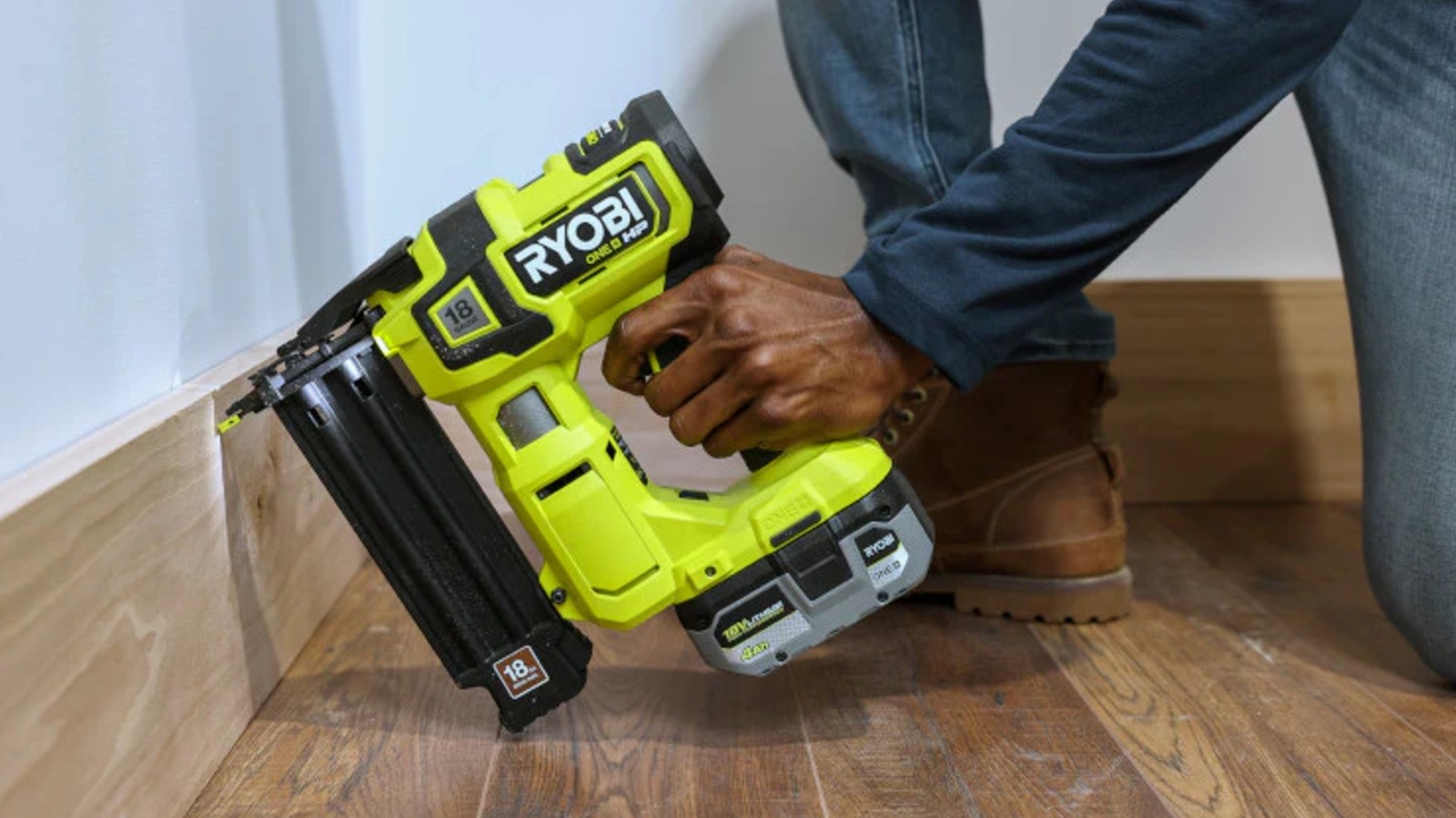
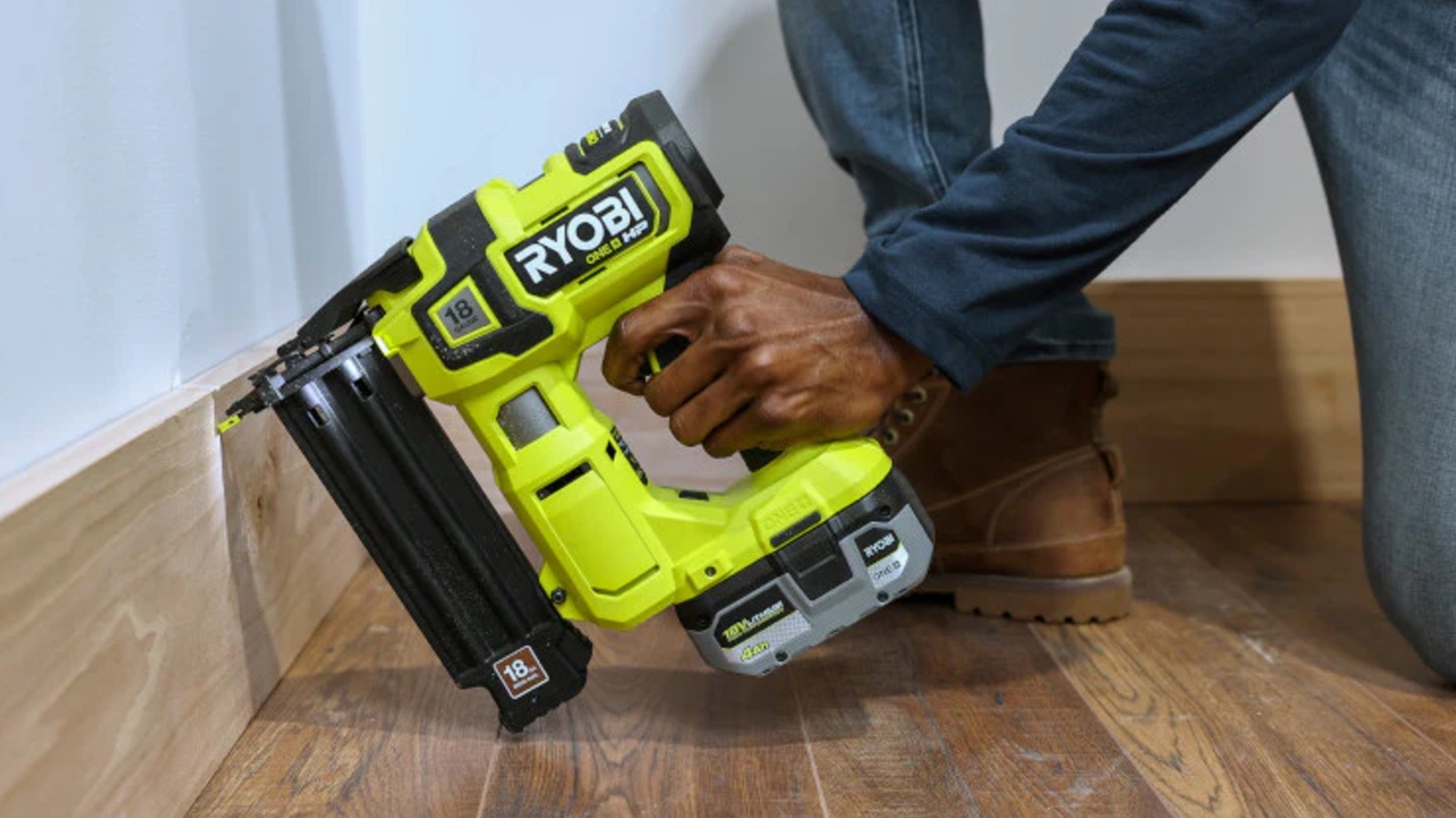
The 18V ONE+ HP Airstrike 18 Gauge Brad Nailer is available from Ryobi in either a bare tool ($179; 4.8-star average rating with 1,018 reviews) or as a kit featuring a 4Ah battery and charger ($259; 4.9-star average from 143 buyers). Home Depot buyers also give it a 4.8-star average from around 2,000 reviews for each option. The tool features Ryobi’s ONE+ HP technology that promises to deliver “60% more nail driving power” with the capacity to sink up to 2,250 nails per charge. The tool’s Air Strike technology underpins its cordless performance, delivering a truly mobile fastening tool that offers speed, precision, and versatility in one solution.

The tool is a brad nailer, among Ryobi’s wider range of nail guns, making it a general-purpose fastener that can deliver 2-1/8-inch nails into workpieces, including hardwoods. The AccuDrive nose improves your line of sight while operating the tool, making the whole process more efficient. It also features an LED work light. The unit is ideal for securing trim work and handling a variety of other light- to moderate-duty installation tasks.

18V ONE+ HP 4-1/2-Inch Angle Grinder

An angle grinder is a tool that easily finds a home in just about any DIY toolkit. It’s a solution that can handle a wide range of tasks. The angle grinder’s power comes from its ability to handle virtually any job that requires a spinning tool accessory. Ryobi’s 18V ONE+ HP 4-1/2-Inch Angle Grinder is a solid option at a great price. Buyers note the tool’s strong power output and appear to frequently move to this option as a replacement for an older, corded model in their collections. Many note this change specifically, while others highlight the cordless nature of the tool independently.

For the kit, Ryobi has it listed for $209, and 149 buyers have given it a 4.8-star average rating. For those who don’t require additional power elements, the bare tool has a 4.7-star average rating from 44 buyers with a $129 price tag. The tool can deliver up to 210 cuts per charge with the equivalent performance of an 11-amp corded grinder. The tool introduces an upgraded foot angle that makes flush cutting easier, and it utilizes a three-position side handle and a paddle switch to improve your grip on the unit.

USB Lithium Multi-Head Screwdriver Kit

Light-duty tools are equally valuable for both professional and consumer requirements. Not every tool needs to be a mauler, and the USB Lithium Multi-Head Screwdriver Kit showcases this well. The tool exists within Ryobi’s USB Lithium category, delivering great power at a small scale. The tool is available from Home Depot for just $50, and it features 500 reviews with a 4.6-star average rating. It comes with an organizational case and a 10-piece bit set, along with three interchangeable heads, including right-angle and offset driving solutions.

The tool’s batteries are USB rechargeable, and they can also be used as power packs to charge your phone or consumer electronics in a pinch. It offers up to 200 RPM speeds while operating with a small tool body. The attachments can be swapped between different fixed orientations, allowing you to utilize the accessory heads in a range of setups.

Whole Stud Detector

Finding studs in the wall doesn’t have to be a challenge. Ryobi’s Whole Stud Detector is an easy-to-use option that features multiple LEDs along the top line. As a result, both ends of the stud can be found as you move the tool across a wall’s surface. This allows users to find the entire width of the stud rather than just its center or an edge. The tool is available from Ryobi for $35 and features a 4.7-star average rating with 608 reviews.

Stud detectors help renovators make faster decisions about where to secure decorations and mounting brackets on the wall. Identifying their location is critical to creating a secure hold that won’t waver with time. Alternatives do exist, but securing new components to studs remains the best option for long-lasting and rock-solid staying power. This stud detector offers one-handed operation and can identify the thickness of the wall in question up to 1-½ inches to identify both wood and metal studs. It also features an integrated stud marker.

300-Piece Drill and Drive Kit

Your drill is a key solution in many renovation tasks, but it’s useless without the correct accessory attached to its chuck. This is where a product like the 300-Piece Drill and Drive Kit comes into play. This kit is available at Home Depot for $69 and features 4,809 reviews with a 4.6-star average rating. The kit includes just about every drilling and driving accessory you might require across a broad spectrum of tasks, including driving bits, hole saws, and spade bits. All of these play a pivotal role in a DIYer’s ability to handle most tasks they encounter. Drilling and fastening are two cornerstone functions of any job, from hanging a new door to installing decking or shelves.

This collection also comes with titanium-coated bits and three drill stoppers for added precision. It’s also eligible for a $25 discount when opening a Home Depot Consumer Card, reducing the price to $44. For renovators with a particularly lengthy list of jobs on the docket, this offer might be worth considering.

1,800 PSI 1.2 GPM Electric Pressure Washer

Not all renovation jobs involve building or altering something. Often, you’ll run into the need to clean away dirt or grime. This is where a tool like the 1,800 PSI 1.2 GPM Electric Pressure Washer can deliver serious functionality. Rather than investing in a full-size unit that’s not always easy to manage, the mobile Ryobi pressure washer offers solid performance in a compact package. 

The tool produces a high-pressure output that’s more than capable of blasting away buildup on your driveway, cleaning windows around the house, or spraying down cars. It comes with 15-degree and turbo nozzles, featuring ¼-inch quick-connect capability for fast changes to handle high-intensity spraying and lighter-duty work in quick succession. It’s available from Ryobi and Home Depot for $99, with a 4.4-star average rating from 1,225 reviewers at the latter. Owners note that it’s powerful enough to handle plenty of cleaning jobs and is easy to bring up a ladder, too, making tasks at height, like cleaning gutters, simpler to manage.

Link 17-Inch Tool Bag

The Link 17-Inch Tool Bag is a versatile organizational solution that can make your job easier, regardless of what it might entail. The bag features 39 interior pockets and a range of external tool-holding options, combining for a total weight capacity of 60 pounds. Users also note that it’s built with a strong fabric material that feels sturdy, even when loaded up with tools. Others are pleased with the amount of storage space available within the bag, noting that the roominess surprised them.

The tool is available direct from Ryobi for $84. It can also be found at Home Depot for the same price, where it carries a 4.8-star rating from 74 reviewers. The adjustable internal dividers allow for extensive customization, and the bag itself makes for an ideal solution to fill with essential gear before leaving your shed or garage to handle a job without needing to run back and forth for more equipment.

18V ONE+ Brushless Belt Sander

Ryobi’s 18V ONE+ Brushless Belt Sander is an ideal tool for tackling large-scale sanding tasks. This can be the perfect accompaniment for preparing deck boards for the coming seasonal turnover, for example. It’s available at Ryobi for $166 and has 292 reviews with a 4.6-star average rating. As such, this is a relatively low-cost sander that can add a new dimension to your existing sanding equipment for more efficient work across the board. 

Buyers say it’s easy to control the tool while highlighting its power and the resulting speed at which it churns through a sanding job. Although users do recommend pairing it with a larger battery, as the constant-on state naturally drains your power packs’ charge. The tool is capable of speeds up to 850 FPM with a belt that measures 3 inches by 18 inches. The tool also features a pommel handle that rotates into five positions to support comfortable use across a range of requirements you might encounter.

Door Hinge Template

The Door Hinge Template is an accessory that makes this particular job far easier. Admittedly, it’s not something that renovators will need if they aren’t planning on installing new doors, but for tackling new trim work around transitions or door installation, the $35 price tag at Home Depot makes for a low-cost accessory that can significantly improve your workflow. Over 1,000 Home Depot buyers have given this product a 4.3-star average rating, and the accessory features a guide stop and a 15/32-inch router bit ideal for cutting out the groove for your hinge hardware. 

The tool features non-marring clamps to secure the unit to your door without the need to fasten it with screws or nails, keeping the door in pristine condition as you prepare to route out the groove for your hardware. This accessory unit makes tackling the precision work involved in getting the finishing touches correct much easier.

8,125-Watt Gasoline-Powered Portable Generator

Portable power is frequently essential for those operating in more demanding environments. Keeping your corded power tools running or delivering support for corded equipment in an inhospitable workspace requires a generator. The 8,125 Watt Gasoline Powered Portable Generator offers 6,500 running watts with an 8,125 starting watt output. It features CO sensors with an automatic shutoff function to improve safety while also utilizing an automatic voltage regulator that offers more reliable power. It’s available from Home Depot for $861 and has a 4.3-star average rating from 1,522 reviewers.

The generator can be a key solution for those tackling ambitious building projects around their home, or as a crucial element in repairing parts of your property after a natural disaster. It’s built with a robust wraparound hand truck frame and sits on 10-inch wheels to make mobility easier. The 6-gallon fuel tank delivers up to ten hours of runtime at a 50% load, and it supports four 120V outlets as well as a 120/240V 30-amp twist-lock output. There are also USB ports on the tool to allow for phone or other device charging.

15-Inch Compact Laser Level

A key asset in the arsenal of an industrious renovator, the 15-Inch Compact Laser Level is a tool that speeds up your progress when hanging pictures or tackling a host of other finishing touches around the house. The tool features a red laser output with a 15-foot range, and it utilizes integrated push pins that allow for temporary wall mounting. The rotating bubble vial allows you to leverage the tool precisely in either horizontal or vertical level orientations. It has a 4.6-star average rating from 881 buyers at Home Depot and retails for $25.

The tool is easily tossed in a tool bag, with a body that’s roughly the same size as a compact tape measure. Instead of marking lines on your wall and then worrying about touching up paint or other cleanup, utilizing this leveling solution delivers a simple option for finding the top line for hanging a picture or shelf.

ONE+ 18V Hybrid LED Tripod Stand Light

Lighting is everything on the jobsite. Regardless of the project, seeing what you’re doing is a basic essential. Attic insulation refits or crawlspace repairs frequently demand specific, additional lighting elements, but low-light workspaces aren’t the only areas that can benefit from this kind of tool. Painting often takes place in bright, airy rooms, but as the sun moves in the sky, your ability to perceive changes in hue diminishes. A work light allows you to cast uniform illumination onto the work surface, providing enhanced visibility to ensure you’ve met your goals.

The ONE+ 18V Hybrid LED Tripod Stand Light is a quality option in this regard, retailing at Home Depot for $139. It has a 4.8-star average rating from 759 buyers, and its versatility is a big reason for the high praise. The tool offers 2,700 lumens of light output that can deliver piercing illumination in a small area for detailed work or effectively light up a large workspace. The tool sits on an adjustable, 5-foot stand and has the ability to collapse down to a height of 22 inches. The tool operates on Ryobi’s ONE+ 18V battery system with added hybrid power flexibility, allowing for either 10 hours of runtime on a single battery charge or constant power when plugged into the wall. It also features two brightness settings and a 310-degree pivoting head for even greater flexibility.

Methodology

Each of these products has been reviewed by at least 50 buyers, with many having hundreds or even thousands of total ratings. They all have 4.3-star average ratings or better, with numerous products exhibiting near-perfect scores across all user feedback on their performance. They come from many different corners of the Ryobi catalog, offering something that can be beneficial for many different DIY projects and user requirements.


Source link

Leave a Reply

Subscribe to Our Newsletter

Get our latest articles delivered straight to your inbox. No spam, we promise.

Recent Reviews


In May 2024, we released Part I of this series, in which we discussed agentic AI as an emerging technology enabling a new generation of AI-based hardware devices and software tools that can take actions on behalf of users. It turned out we were early – very early – to the discussion, with several months elapsing before agentic AI became as widely known and discussed as it is today. In this Part II, we return to the topic to explore legal issues concerning user liability for agentic AI-assisted transactions and open questions about existing legal frameworks’ applicability to the new generation of AI-assisted transactions.

Background: Snapshot of the Current State of “Agents”[1]

“Intelligent” electronic assistants are not new—the original generation, such as Amazon’s Alexa, have been offering narrow capabilities for specific tasks for more than a decade. However, as OpenAI’s CEO Sam Altman commented in May 2024, an advanced AI assistant or “super-competent colleague” could be the killer app of the future. Later, Altman noted during a Reddit AMA session: “We will have better and better models. But I think the thing that will feel like the next giant breakthrough will be agents.” A McKinsey report on AI agents echoes this sentiment: “The technology is moving from thought to action.” Agentic AI represents not only a technological evolution, but also a potential means to further spread (and monetize) AI technology beyond its current uses by consumers and businesses. Major AI developers and others have already embraced this shift, announcing initiatives in the agentic AI space. For example:  

  • Anthropic announced an updated frontier AI model in public beta capable of interacting with and using computers like human users;
  • Google unveiled Gemini 2.0, its new AI model for the agentic era, alongside Project Mariner, a prototype leveraging Gemini 2.0 to perform tasks via an experimental Chrome browser extension (while keeping a “human in the loop”);
  • OpenAI launched a “research preview” of Operator, an AI tool that can interface with computers on users’ behalf, and launched beta feature “Tasks” in ChatGPT to facilitate ongoing or future task management beyond merely responding to real time prompts;
  • LexisNexis announced the availability of “Protégé,” a personalized AI assistant with agentic AI capabilities;
  • Perplexity recently rolled out “Shop Like a Pro,” an AI-powered shopping recommendation and buying feature that allows Perplexity Pro users to research products and, for those merchants whose sites are integrated with the tool, purchase items directly on Perplexity; and
  • Amazon announced Alexa+, a new generation of Alexa that has agentic capabilities, including enabling Alexa to navigate the internet and execute tasks, as well as Amazon Nova Act, an AI model designed to perform actions within a web browser.

Beyond these examples, other startups and established tech companies are also developing AI “agents” in this country and overseas (including the invite-only release of Manus AI by Butterfly Effect, an AI developer in China). As a recent Microsoft piece speculates, the generative AI future may involve a “new ecosystem or marketplace of agents,” akin to the current smartphone app ecosystem.  Although early agentic AI device releases have received mixed reviews and seem to still have much unrealized potential, they demonstrate the capability of such devices to execute multistep actions in response to natural language instructions.

Like prior technological revolutions—personal computers in the 1980s, e-commerce in the 1990s and smartphones in the 2000s—the emergence of agentic AI technology challenges existing legal frameworks. Let’s take a look at some of those issues – starting with basic questions about contract law.

Note: This discussion addresses general legal issues with respect to hypothetical agentic AI devices or software tools/apps that have significant autonomy. The examples provided are illustrative and do not reflect any specific AI tool’s capabilities.

Automated Transactions and Electronic Agents

Electronic Signatures Statutory Law Overview

A foundational legal question is whether transactions initiated and executed by an AI tool on behalf of a user are enforceable.  Despite the newness of agentic AI, the legal underpinnings of electronic transactions are well-established. The Uniform Electronic Transactions Act (“UETA”), which has been adopted by every state and the District of Columbia (except New York, as noted below), the federal E-SIGN Act, and the Uniform Commercial Code (“UCC”), serve as the legal framework for the use of electronic signatures and records, ensuring their validity and enforceability in interstate commerce. The fundamental provisions of UETA are Sections 7(a)-(b), which provide: “(a) A record or signature may not be denied legal effect or enforceability solely because it is in electronic form; (b) A contract may not be denied legal effect or enforceability solely because an electronic record was used in its formation.” 

UETA is technology-neutral and “applies only to transactions between parties each of which has agreed to conduct transactions by electronic means” (allowing the parties to choose the technology they desire). In the typical e-commerce transaction, a human user selects products or services for purchase and proceeds to checkout, which culminates in the user clicking “I Agree” or “Purchase.”  This click—while not a “signature” in the traditional sense of the word—may be effective as an electronic signature, affirming the user’s agreement to the transaction and to any accompanying terms, assuming the requisite contractual principles of notice and assent have been met.

At the federal level, the E-SIGN Act (15 U.S.C. §§ 7001-7031) (“E-SIGN”) establishes the same basic tenets regarding electronic signatures in interstate commerce and contains a reverse preemption provision, generally allowing states that have passed UETA to have UETA take precedence over E-SIGN.  If a state does not adopt UETA but enacts another law regarding electronic signatures, its alternative law will preempt E-SIGN only if the alternative law specifies procedures or requirements consistent with E-SIGN, among other things.

However, while UETA has been adopted by 49 states and the District of Columbia, it has not been enacted in New York. Instead, New York has its own electronic signature law, the Electronic Signature Records Act (“ESRA”) (N.Y. State Tech. Law § 301 et seq.). ESRA generally provides that “An electronic record shall have the same force and effect as those records not produced by electronic means.” According to New York’s Office of Information Technology Services, which oversees ESRA, “the definition of ‘electronic signature’ in ESRA § 302(3) conforms to the definition found in the E-SIGN Act.” Thus, as one New York state appellate court stated, “E-SIGN’s requirement that an electronically memorialized and subscribed contract be given the same legal effect as a contract memorialized and subscribed on paper…is part of New York law, whether or not the transaction at issue is a matter ‘in or affecting interstate or foreign commerce.’”[2] 

Given US states’ wide adoption of UETA model statute, with minor variations, this post will principally rely on its provisions in analyzing certain contractual questions with respect to AI agents, particularly given that E-SIGN and UETA work toward similar aims in establishing the legal validity of electronic signatures and records and because E-SIGN expressly permits states to supersede the federal act by enacting UETA.  As for New York’s ESRA, courts have already noted that the New York legislature incorporated the substantive terms of E-SIGN into New York law, thus suggesting that ESRA is generally harmonious with the other laws’ purpose to ensure that electronic signatures and records have the same force and effect as traditional signatures.  

Electronic “Agents” under the Law

Beyond affirming the enforceability of electronic signatures and transactions where the parties have agreed to transact with one another electronically, Section 2(2) of UETA also contemplates “automated transactions,” defined as those “conducted or performed, in whole or in part, by electronic means or electronic records, in which the acts or records of one or both parties are not reviewed by an individual.” Central to such a transaction is an “electronic agent,” which Section 2(6) of UETA defines as “a computer program or an electronic or other automated means used independently to initiate an action or respond to electronic records or performances in whole or in part, without review or action by an individual.” Under UETA, in an automated transaction, a contract may be formed by the interaction of “electronic agents” of the parties or by an “electronic agent” and an individual. E-SIGN similarly contemplates “electronic agents,” and states: “A contract or other record relating to a transaction in or affecting interstate or foreign commerce may not be denied legal effect, validity, or enforceability solely because its formation, creation, or delivery involved the action of one or more electronic agents so long as the action of any such electronic agent is legally attributable to the person to be bound.”[3] Under both of these definitions, agentic AI tools—which are increasingly able to initiate actions and respond to records and performances on behalf of users—arguably qualify as “electronic agents” and thus can form enforceable contracts under existing law.[4]

AI Tools and E-Commerce Transactions

Given this existing body of statutory law enabling electronic signatures, from a practical perspective this may be the end of the analysis for most e-commerce transactions. If I tell an AI tool to buy me a certain product and it does so, then the product’s vendor, the tool’s provider and I might assume—with the support of UETA, E-SIGN, the UCC, and New York’s ESRA—that the vendor and I (via the tool) have formed a binding agreement for the sale and purchase of the good, and that will be the end of it unless a dispute arises about the good or the payment (e.g., the product is damaged or defective, or my credit card is declined), in which case the AI tool isn’t really relevant.

But what if the transaction does not go as planned for reasons related to the AI tool? Consider the following scenarios:

  • Misunderstood Prompts: The tool misinterprets a prompt that would be clear to a human but is confusing to its model (e.g., the user’s prompt states, “Buy two boxes of 101 Dalmatians Premium dog food,” and the AI tool orders 101 two-packs of dog food marketed for Dalmatians).
  • AI Hallucinations: The user asks for something the tool cannot provide or does not understand, triggering a hallucination in the model with unintended consequences (e.g., the user asks the model to buy stock in a company that is not public, so the model hallucinates a ticker symbol and buys stock in whatever real company that symbol corresponds to).
  • Violation of Limits: The tool exceeds a pre-determined budget or financial parameter set by the user (e.g., the user’s prompt states, “Buy a pair of running shoes under $100” and the AI tool purchases shoes from the UK for £250, exceeding the user’s limit).
  • Misinterpretation of User Preference: The tool misinterprets a prompt due to lack of context or misunderstanding of user preferences (e.g., the user’s prompt states, “Book a hotel room in New York City for my conference,” intending to stay near the event location in lower Manhattan, and the AI tool books a room in Queens because it prioritizes price over proximity without clarifying the user’s preference).

Disputes like these begin with a conflict between the user and a vendor—the AI tool may have been effective to create a contract between the user and the vendor, and the user may then have legal responsibility for that contract.  But the user may then seek indemnity or similar rights against the developer of the AI tool.

Of course, most developers will try to avoid these situations by requiring user approvals before purchases are finalized (i.e., “human in the loop”). But as desire for efficiency and speed increases (and AI tools become more autonomous and familiar with their users), these inbuilt protections could start to wither away, and users that grow accustomed to their tool might find themselves approving transactions without vetting them carefully. This could lead to scenarios like the above, where the user might seek to void a transaction or, if that fails, even try to avoid liability for it by seeking to shift his or her responsibility to the AI tool’s developer.[5] Could this ever work? Who is responsible for unintended liabilities related to transactions completed by an agentic AI tool?

Sources of Law Governing AI Transactions

AI Developer Terms of Service

As stated in UETA’s Prefatory Note, the purpose of UETA is “to remove barriers to electronic commerce by validating and effectuating electronic records and signatures.” Yet, the Note cautions, “It is NOT a general contracting statute – the substantive rules of contracts remain unaffected by UETA.”  E-SIGN contains a similar disclaimer in the statute, limiting its reach to statutes that require contracts or other records be written, signed, or in non-electronic form (15 U.S.C. §7001(b)(2)). In short, UETA, E-SIGN, and the similar UCC provisions do not provide contract law rules on how to form an agreement or the enforceability of the terms of any agreement that has been formed.

Thus, in the event of a dispute, terms of service governing agentic AI tools will likely be the primary source to which courts will look to assess how liability might be allocated. As we noted in Part I of this post, early-generation agentic AI hardware devices generally include terms that not only disclaim responsibility for the actions of their products or the accuracy of their outputs, but also seek indemnification against claims arising from their use. Thus, absent any express customer-favorable indemnities, warranties or other contractual provisions, users might generally bear the legal risk, barring specific legal doctrines or consumer protection laws prohibiting disclaimers or restrictions of certain claims.[6]

But what if the terms of service are nonexistent, don’t cover the scenario, or—more likely—are unenforceable? Unenforceable terms for online products and services are not uncommon, for reasons ranging from “browsewrap” being too hidden, to specific provisions being unconscionable. What legal doctrines would control during such a scenario?

The Backstop: User Liability under UETA and E-SIGN

Where would the parties stand without the developer’s terms? E-SIGN allows for the effectiveness of actions by “electronic agents” “so long as the action of any such electronic agent is legally attributable to the person to be bound.” This provision seems to bring the issue back to the terms of service governing a transaction or general principles of contract law. But again, what if the terms of service are nonexistent or don’t cover a particular scenario, such as those listed above. As it did with the threshold question of whether AI tools could form contracts in the first place, UETA appears to offer a position here that could be an attractive starting place for a court. Moreover, in the absence of express language under New York’s ESRA, a New York court might apply E-SIGN (which contains an “electronic agent” provision) or else find insight as well by looking at UETA and its commentary and body of precedent if the court isn’t able to find on-point binding authority, which wouldn’t be a surprise, considering that we are talking about technology-driven scenarios that haven’t been possible until very recently.

UETA generally attributes responsibility to users of “electronic agents”, with the prefatory note explicitly stating that the actions of electronic agents “programmed and used by people will bind the user of the machine.” Section 14 of UETA (titled “Automated Transaction”) reinforces this principle, noting that a contract can be formed through the interaction of “electronic agents” “even if no individual was aware of or reviewed the electronic agents’ actions or the resulting terms and agreements.” Accordingly, when automated tools such as agentic AI systems facilitate transactions between parties who knowingly consent to conduct business electronically, UETA seems to suggest that responsibility defaults to the users—the persons who most immediately directed or initiated their AI tool’s actions. This reasoning treats the AI as a user’s tool, consistent with the other UETA Comments (e.g., “contracts can be formed by machines functioning as electronic agents for parties to a transaction”).

However, different facts or technologies could lead to alternative interpretations, and ambiguities remain. For example, Comment 1 to UETA Section 14 asserts that the lack of human intent at the time of contract formation does not negate enforceability in contracts “formed by machines functioning as electronic agents for parties to a transaction” and that “when machines are involved, the requisite intention flows from the programming and use of the machine” (emphasis added).

This explanatory text has a couple of issues. First, it is unclear about what constitutes “programming” and seems to presume that the human intention at the programming step (whatever that may be) is more-or-less the same as the human intention at the use step[7], but this may not always be the case with AI tools. For example, it is conceivable that an AI tool could be programmed by its developer to put the developer’s interests above the users’, for example by making purchases from a particular preferred e-commerce partner even if that vendor’s offerings are not the best value for the end user. This concept may not be so far-fetched, as existing GenAI developers have entered into content licensing deals with online publishers to obtain the right for their chatbots to generate outputs or feature licensed content, with links to such sources. Of course, there is a difference between a chatbot offering links to relevant licensed news sources that are accurate (but not displaying appropriate content from other publishers) versus an agentic chatbot entering into unintended transactions or spending the user’s funds in unwanted ways. This discrepancy in intention alignment might not be enough to allow the user to shift liability for a transaction from a user to a programmer, but it is not hard to see how larger misalignments might lead to thornier questions, particularly in the event of litigation when a court might scrutinize the enforceability of an AI vendor’s terms (under the unconscionability doctrine, for example). 

Second, UETA does not contemplate the possibility that the AI tool might have enough autonomy and capability that some of its actions might be properly characterized as the result of its own intent. Looking at UETA’s definition of “electronic agent,” the commentary notes that “As a general rule, the employer of a tool is responsible for the results obtained by the use of that tool since the tool has no independent volition of its own.” But as we know, technology has advanced in the last few decades and depending on the tool, an autonomous AI tool might one day have much independent volition (and further UETA commentary admits the possibility of a future with more autonomous electronic agents). Indeed, modern AI researchers have been contemplating this possibility even before rapid technological progress began with ChatGPT.

Still, Section 10 of UETA may be relevant to some of the scenarios from our bulleted selection of AI tool mishaps listed above, including misunderstood prompts or AI hallucinations. UETA Section 10 (titled “Effect of Change or Error”) outlines the possible actions a party may take when discovering human or machine errors or when “a change or error in an electronic record occurs in a transmission between parties to a transaction.” The remedies outlined in UETA depend on the circumstances of the transaction and whether the parties have agreed to certain security procedures to catch errors (e.g., a “human in the loop” confirming an AI-completed transaction) or whether the transaction involves an individual and a machine.[8]  In this way, the guardrails integrated into a particular AI tool or by the parties themselves play a role in the liability calculus. The section concludes by stating that if none of UETA’s error provisions apply, then applicable law governs, which might include the terms of the parties’ contract and the law of mistake, unconscionability and good faith and fair dealing.

* * *

Thus, along an uncertain path we circle back to where we started: the terms of the transaction and general contract law principles and protections. However, not all roads lead to contract law. In our next installment in this series, we will explore the next logical source of potential guidance on AI tool liability questions: agency law.  Decades of established law may now be challenged by a new sort of “agent” in the form of agentic AI…and a new AI-related lawsuit foreshadows the issues to come.


[1] In keeping with common practice in the artificial intelligence industry, this article refers to AI tools that are capable of taking actions on behalf of users as “agents” (in contrast to more traditional AI tools that can produce content but not take actions). However, note that the use of this term is not intended to imply that these tools are “agents” under agency law.

[2] In addition, the UCC has provisions consistent with UETA and E-SIGN providing for the use of electronic records and electronic signatures for transactions subject to the UCC. The UCC does not require the agreement of the parties to use electronic records and electronic signatures, as UETA and E-SIGN do.

[3] Under E-SIGN, “electronic agent” means “a computer program or an electronic or other automated means used independently to initiate an action or respond to electronic records or performances in whole or in part without review or action by an individual at the time of the action or response.”

[4] It should be noted that New York’s ESRA does not expressly provide for the use of “electronic agents,” yet does not prohibit them either.  Reading through ESRA and the ESRA regulation, the spirit of the law could be construed as forward-looking and seems to suggest that it supports the use of automated systems and electronic means to create legally binding agreements between willing parties. Looking to New York precedent, one could also argue that E-SIGN, which contains provisions about the use of “electronic agents”, might also be applicable in certain circumstances to fill the “electronic agent” gap in ESRA. For example, the ESRA regulations (9 CRR-NY § 540.1) state: “New technologies are frequently being introduced. The intent of this Part is to be flexible enough to embrace future technologies that comply with ESRA and all other applicable statutes and regulations.”  On the other side, one could argue that certain issues surrounding “electronic agents” are perhaps more unsettled in New York.  Still, New York courts have found ESRA consistent with E-SIGN.  

[5] Since AI tools are not legal persons, they could not be liable themselves (unlike, for example, a rogue human agent could be in some situations). We will explore agency law questions in Part III.

[6] Once agentic AI technology matures, it is possible that certain user-friendly contractual standards might emerge as market participants compete in the space. For example, as we wrote about in a prior post, in 2023 major GenAI providers rolled out indemnifications to protect their users from third-party claims of intellectual property infringement arising from GenAI outputs, subject to certain carve-outs.

[7] The electronic “agents” in place at the time of UETA’s passage might have included basic e-commerce tools or EDI (Electronic Data Interchange), which is used by businesses to exchange standardized documents, such as purchase orders, electronically between trading partners, replacing traditional methods like paper, fax, mail or telephone. Electronic tools are generally designed to explicitly perform according to the user’s intentions (e.g., clicking on an icon will add this item to a website shopping cart or send this invoice to the customer) and UETA, Section 10, contains provisions governing when an inadvertent or electronic error occurs (as opposed to an abrogation of the user’s wishes).

[8] For example, UETA Section 10 states that if a change or error occurs in an electronic record during transmission between parties to a transaction, the party who followed an agreed-upon security procedure to detect such changes can avoid the effect of the error, if the other party who didn’t follow the procedure would have detected the change had they complied with the security measure; this essentially places responsibility on the party who failed to use the agreed-upon security protocol to verify the electronic record’s integrity.

Comments to UETA Section 10 further explain the context of this section: “The section covers both changes and errors. For example, if Buyer sends a message to Seller ordering 100 widgets, but Buyer’s information processing system changes the order to 1000 widgets, a “change” has occurred between what Buyer transmitted and what Seller received. If on the other hand, Buyer typed in 1000 intending to order only 100, but sent the message before noting the mistake, an error would have occurred which would also be covered by this section.”  In the situation where a human makes a mistake when dealing with an electronic agent, the commentary explains that “when an individual makes an error while dealing with the electronic agent of the other party, it may not be possible to correct the error before the other party has shipped or taken other action in reliance on the erroneous record.”


Source link