We may receive a commission on purchases made from links.
If you constantly need to lift a stroller in and out of your vehicle, switching to a lightweight stroller can make the experience much easier on your body. Compared with some of the most popular traditional strollers, lightweight strollers can weigh about 10 to 15 pounds less. This lower weight makes them ideal for frequent travel, whether you go to the airport every other weekend or simply have a lot of errands to run during the week.
Furthermore, most lightweight strollers can be folded with one hand, easily maneuvered through narrow spaces, and stashed in small areas like an entry closet, a compact car trunk, or an overhead compartment on an airplane. There’s not a ton of built-in storage, but most parents who need a lightweight stroller aren’t trying to weigh it down with a bunch of toys, snacks, and other tidbits. There’s plenty of room for the essentials, like a few must-have gadgets for traveling with small children, and that’s enough.
Consumer Reports has tested and reviewed a lot of different strollers over the years. Among hundreds of choices, three stand out as the best lightweight strollers, each weighing less than 17 pounds and earning multiple positive ratings online. Without further ado, here’s the first lightweight stroller option.
Nuna TRVL LX Stroller — 14.6 pounds
If you’re looking for a sub-15-pound stroller, look no further than the Nuna TRVL LX model. Without the canopy and armbar, which add an extra 2.4 pounds, the TRVL LX weighs just 14.6 pounds. When it’s unfolded, Nuna’s TRVL LX measures 32 x 21 x 45.5 inches. Folding it reduces the length and height by roughly half, giving it new dimensions of 14.25 x 21 x 27 inches. With those dimensions, it can certainly fit in most vehicle trunks, but it might not fit in an overhead bin on a plane.
This $600 lightweight stroller can be folded with one hand, stands on its own when folded, and comes with a carry bag to keep it clean while traveling. It also has a ton of practical features, like a water-repellent, UPF 50+-rated canopy that’s extendable and has mesh panels, front- and rear-wheel suspension tech, a self-guiding MagneTech magnetic buckle, durable airless tires that never go flat, and a shopping basket at the bottom to stash your essentials.
To accommodate kids of different sizes, parents can customize recline adjustments with one hand, extend or shorten the calf support, and rotate or completely remove the armbar. The Nuna TRVL LX is suitable for kids up to 50 pounds and for newborns using carriage mode, which features a near-flat recline. Or, parents can create a stronger travel system by attaching any of the brand’s PIPA series infant car seats.
Ergobaby Metro 3 Stroller — 16.7 pounds
The Ergobaby Metro 3 is one of the most affordable lightweight strollers you can snag. It’s $399 at full price, but if you don’t need the stroller right away, it often goes on sale for around $299. Without accessories and when unfolded, the Metro 3 weighs 16.7 pounds and measures 35 x 17.3 x 42.9 inches. Folded, the Metro 3 has compact dimensions of 9 x 17.3 x 22 inches, which means it can easily fit in most vehicle trunks and the overhead compartment on most planes, according to IATA guidelines. That said, it’s always smart to check your specific airline’s luggage requirements before flying.
By sliding a button, squeezing a handle, and pushing the handle toward the ground at the same time, the Metro 3 can be folded with one hand in seconds. It can be unfolded with one hand, too. Beyond its easy folding and excellent maneuverability, this lightweight stroller features no-puncture tires, an adjustable handlebar, an ergonomic cushioned seat, an all-wheel suspension system, a storage basket under the seat, a pocket behind the seat, and an extendable, water-resistant canopy with UV protection.
For newborns, the Metro 3 can be used in Newborn Nest mode, which transforms the seat into a near-flat recline, or with compatible car seats by Cybex, Nuna, Maxi-Cosi, Avionaut, Britax, and BeSafe, with an adapter (sold separately). For children up to 50 pounds, the stroller can be used in its traditional mode, with recline and footrest adjustments as needed.
UPPAbaby Minu V3 Stroller — 16.7 pounds
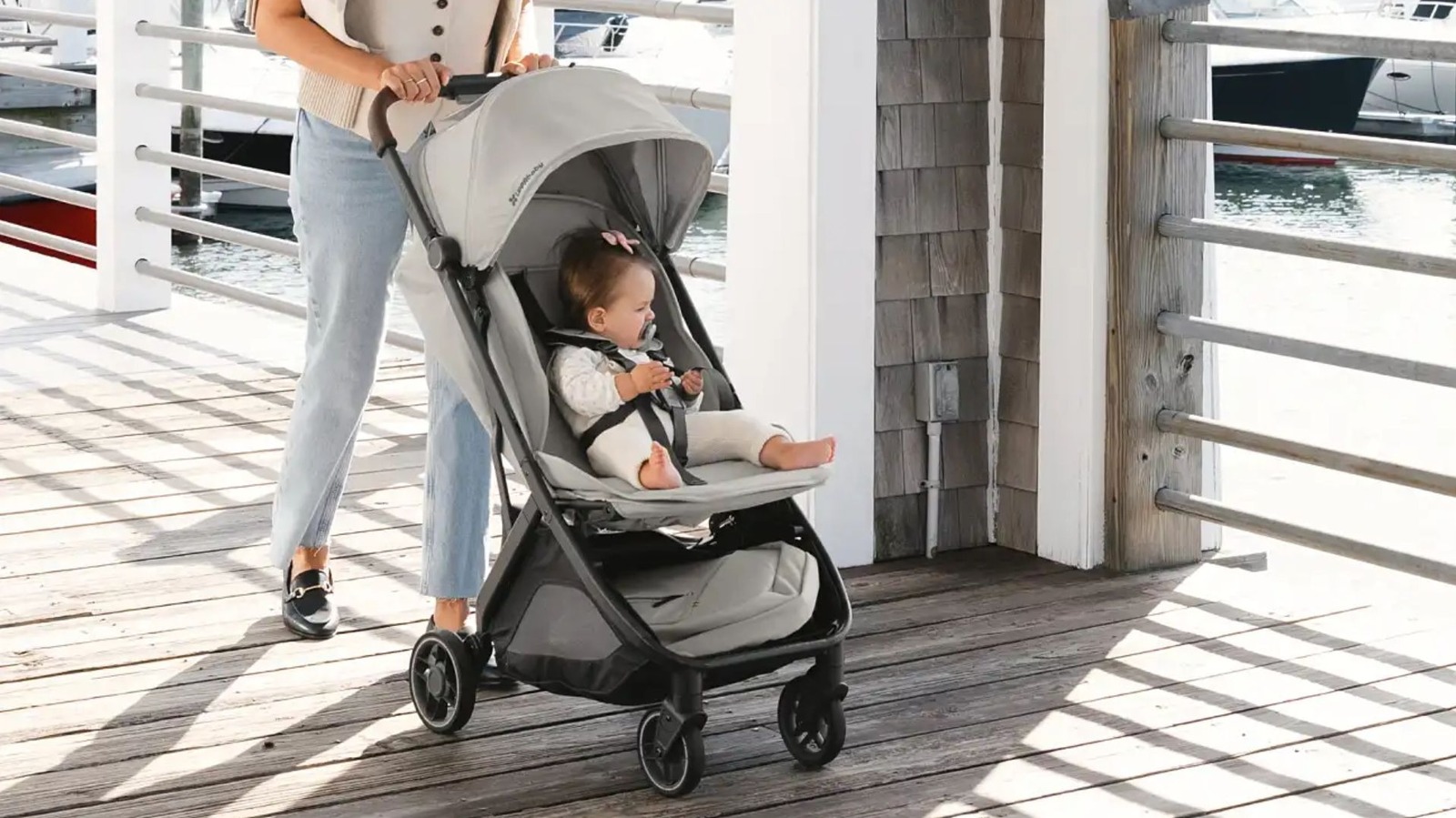
The $499 UPPAbaby Minu V3 stroller weighs 16.7 pounds, including only the frame and seat, and measures 34.5 x 18 x 41 inches when unfolded and fully set up. When folded, this stroller compresses to much more compact dimensions of 10 x 18 x 21.5 inches. It can be folded with one hand and is compliant with IATA guidelines for carry-on baggage sizes, which means it can fit in the overhead compartment for most airlines, but it’s still best to check the weight and dimension limits with your airline before flying.
Its lightweight design doesn’t prevent the Minu V3 from coming stocked with a slew of built-in features. It has all-wheel suspension to help make the ride smoother for your kid, a large basket at the bottom that’s easy to access and can hold up to 20 pounds, and a zip-out, extendable canopy that’s water-repellent, has a mesh peekaboo window, and offers UPF 50+ sun protection. It’s made with full-grain leather and aluminum, and currently comes in six color schemes with different fabric, leather, and frame options.
Your child can use the UPPAbaby Minu V3 from birth up to 50 pounds. For newborns, the brand recommends using the stroller in carriage mode or pairing it with an adapter and one of its infant car seats, like the Mesa or Aria, or select car seats made by Maxi-Cosi, Nuna, and Cybex.

Stephan is the sports journalist for the Maple Grove Report.