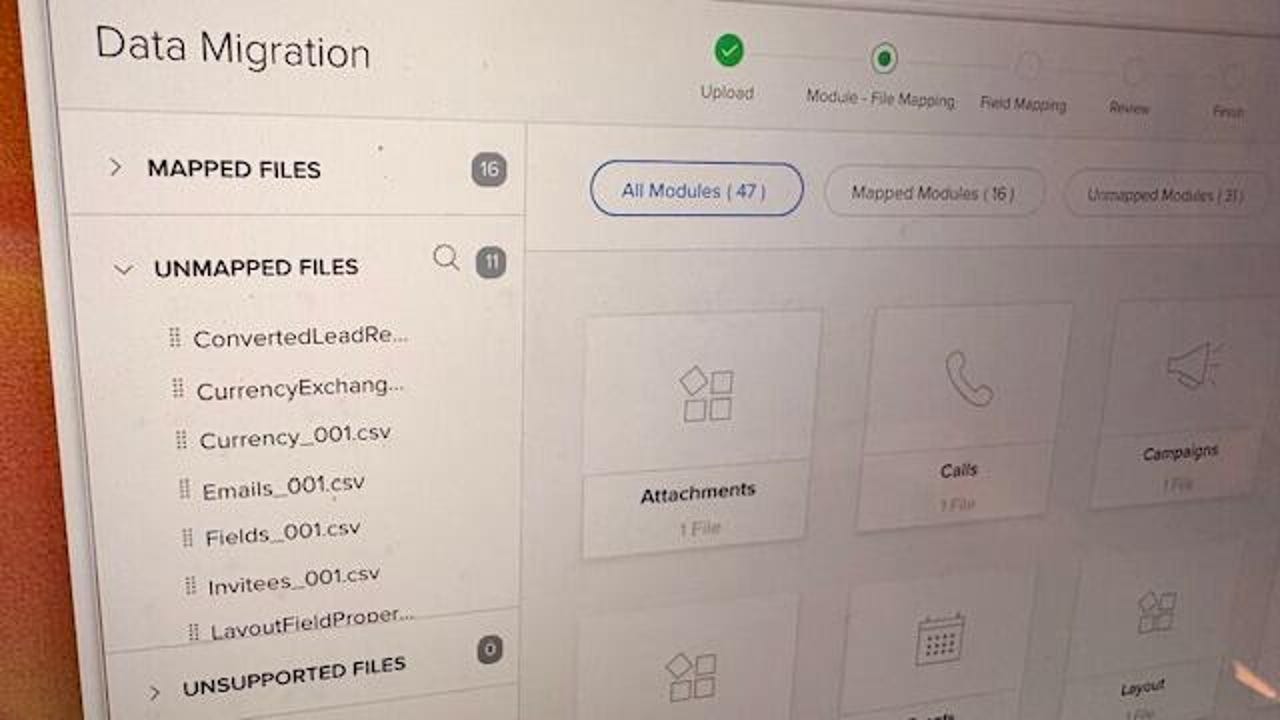
5 best practices for migrating to a new CRM


crm data migration

Allison Murray/ZDNET

Follow ZDNET: Add us as a preferred source on Google.


ZDNET key takeaways

  • You can protect your data and pipeline during a CRM switch.
  • There are five best practices to follow when migrating to a new CRM.
  • A lot of time goes into the migration, but done right, it’s worth the peace of mind.

Switching your CRM feels straightforward until you’re neck-deep in mismatched fields, duplicate contacts, and a sales team that can’t log a call. I’ve seen businesses treat a CRM migration like a simple data export, only to spend months untangling the fallout.

Also: The best CRM software 2026: Expert tested and reviewed

That confidence tends to disappear fast. According to one analysis by Vantage Point, up to 40% of CRM migrations encounter significant problems, from data integrity failures to field mappings that silently corrupt your reporting. But those problems are preventable. The five practices below won’t eliminate every headache, but they’ll keep the serious ones from derailing your rollout.

1. Audit your existing data before you move anything

The single biggest mistake I see in CRM migrations is treating the move as a copy-paste exercise. If your current system holds stale records, you’ll just be moving that mess into a new home.

Start by running a full audit of your existing data. Research consistently shows that over 70% of CRM records become inaccurate within a year, and most organizations discover they’re carrying between 10% and 30% duplicate records once they actually look. Those duplicates don’t just bloat your new system; they skew forecasting, break automated workflows, and create awkward moments when two reps call the same prospect in the same week.

Also: How to audit what ChatGPT knows about you – and reclaim your data privacy

Your audit should flag three things: duplicate records, incomplete records missing critical fields like email or company name, and outdated contacts that haven’t had any activity in years. Use this as an opportunity to decide what’s worth carrying forward. Migrating everything isn’t always the right call, and the cost of migration scales with data volume, so cutting dead weight upfront can save you real money.

2. Build a detailed field mapping document

Field mapping is where CRM migrations quietly fall apart. Data leaves your old system looking fine, lands in the new one in the wrong place, and nobody notices until a sales rep can’t find three months of deal notes.

A field mapping document is a plain reference that shows how every field in your current CRM translates to a field in the new one. Each field from the legacy system needs a corresponding field in the new CRM, including custom fields your team built for specific campaigns or processes. Don’t assume the names match: a field labeled “Company name” in your old system might map to “Account name” in the new one, and getting that wrong means relationship data between records breaks entirely.

Also: Best small business CRM software

Pay extra attention to fields that need transformation, not just transfer. A free-text industry field in your old CRM might need to become a structured picklist in the new one. A single “Full name” field might need to split into separate first and last name fields. These transformations require deliberate rules, not guesswork. Documenting them before migration starts gives you a clear audit trail if something goes wrong.

3. Run a test migration before going live

No matter how careful your planning, the first full migration will surface problems you didn’t anticipate. A test migration on a small, representative dataset lets you catch those problems without involving your entire contact database.

Pick a slice of data that covers a range of record types: a few accounts, associated contacts, some open deals, and a sample of historical activity. Run the test migration into a staging environment rather than your live system. Then check whether contact records, pipeline stages, activity histories, and reporting outputs all look right. If your deal notes didn’t come across, or your pipeline stages mapped to the wrong phase, you want to find that in a test, not on day one of your rollout.

The test migration also helps you calibrate your timeline. For mid-sized organizations, a full CRM migration typically takes 10 to 20 weeks from planning through go-live, and that range widens if data complexity is high. Running a test early gives you a realistic sense of what your full timeline actually looks like, rather than an optimistic guess.

4. Lock down roles and permissions before data goes live

Access management is one of the most overlooked steps in a CRM migration. Teams spend weeks perfecting data quality and field mapping, then push everything live with permissions that either lock people out of records they need or give the entire company visibility into deal data that should stay with specific teams.

Also: What is digital transformation? Everything you need to know about how technology is changing business

Before go-live, define your permission structure from scratch rather than copying it from your old system. Your old CRM’s permission model may have been built incrementally over years and reflects organizational structures that no longer exist. A new system is a clean opportunity to set it up intentionally. The standard migration order is to move users and roles first, before accounts, contacts, or deals, so the structure exists before the data lands in it.

Involve your data owners in this step. Every major data object, like accounts, deals, and contacts, should have a business owner who signs off on who can view, edit, and delete records. This isn’t just a security exercise; it’s how you prevent a newly onboarded rep from accidentally bulk-editing 500 contact records on their first day.

5. Train your team before go-live, not after

Even a technically clean migration can stall if the people using the new system don’t know how it works. Launching first and training later is a reliable way to breed frustration, force reps back to spreadsheets, and end up with a CRM nobody trusts.

Also: Salesforce vs HubSpot: Which is the better business CRM?

Training before go-live doesn’t have to mean formal sessions for everyone. The priority is making sure each team member understands the workflows specific to their role: how to log a call, update a deal stage, create a contact. Focus the training on what changed from the old system, since most people adapt faster when they understand what’s different rather than learning everything from scratch.

Plan for a short period after launch where someone on your team is available to answer questions quickly. Post-migration issues rarely involve catastrophic data loss when the earlier steps are handled well; they’re mostly small confusions that snowball if they go unanswered. Checking in with the team in the first few weeks to ask what’s working and what feels awkward is a practical habit that pays off quickly.

The bottom line

CRM migrations done carefully cost time upfront. But done carelessly, they cost far more on the back end, in data clean-up, team frustration, and pipeline blind spots that take months to notice. Auditing your data, mapping fields precisely, running test migrations, managing access deliberately, and training your team before launch may sound like a lot of work, but they’ll make it recoverable when things don’t go exactly according to plan.





Source link

Leave a Reply

Subscribe to Our Newsletter

Get our latest articles delivered straight to your inbox. No spam, we promise.

Recent Reviews


Forza Horizon 6 has already launched on Xbox Game Pass as a day one release, making May a big month for the subscription service. Still, what Microsoft gives, it also takes away, as two phenomenal JRPGs – Metaphor: ReFantazio and Persona 4 Golden – will leave the service at the end of the month. 

Xbox Game Pass, a CNET Editors’ Choice award pick, offers a wide selection of games that you can play on your Xbox Series X, Xbox Series S, Xbox One and PC or mobile device for as little as $10 a month. And with a subscription to the higher-tiered Game Pass Ultimate ($23 a month), you can access hundreds of games, including new ones the day they’re released, each month. 

Here are the games Microsoft plans to bring to Game Pass in May. You can also check out other games the company added to the service in April, including Hades 2, and more options in our list of the best gaming subscriptions.


Forza Horizon 6

On Game Pass Ultimate, Game Pass Premium and PC Game Pass now.

Forza Horizon 6 is the latest open-world racing game from Playground Games. This time, players can speed around Japan, from the busy cities to the countryside roads. More than 550 cars are available to collect via races, seasonal events and online challenges. The game continues the arcade-style racing the series is known for, and with more car customizations, a deeper progression system and dynamic weather changes affecting road conditions. 


Dead Static Drive

On Game Pass Ultimate, Game Pass Premium and PC Game Pass now.

Dead Static Drive mixes road trip exploration, survival horror and action gameplay in a strange post-apocalyptic world filled with supernatural threats. Players travel across highways and down while scavenging supplies, upgrading vehicles and fighting bizarre creatures. The game combines tense combat with quiet exploration, creating an eerie atmosphere with retro graphics. 


Pigeon Simulator

New to Game Pass Premium. Previously on Game Pass Ultimate and PC Game Pass.

Pigeon Simulator is a sandbox game unlike any other. As a pigeon, it’s up to the player to create as much disruption as possible in order to complete objectives, annoying pedestrians out for a walk and making use of the game’s unique physics systems. Players can fly over streets, knock over objects and find hidden secrets in this absolutely absurd game. 


Remnant 2

 On Game Pass Ultimate, Game Pass Premium and PC Game Pass now.

The soulslike subgenre is popular among gamers, and the Remnant franchise does a little something different by replacing swords with guns. In Remnant 2, players will fight off monsters and giant bosses in a world filled with secrets and loot. The sequel improves on the original by having more ways to customize your character and larger-scale battles intended for solo or cooperative play. 


Luna Abyss

On Game Pass Ultimate, Game Pass Premium and PC Game Pass now.

Luna Abyss is a fast-paced first-person shooter set in a mysterious underground colony. The sci-fi horror shooter has players descending deeper into a massive prison facility while battling enemies and learning the secrets of what happened here. The game offers stylish combat with fast movement as the story is told via the environments, which creates a tense and exciting experience built around shooting and exploration. 


Escape Simulator 

Coming to Game Pass Ultimate, Game Pass Premium and PC Game Pass on May 26.

Players work together to solve puzzles and uncover hidden clues in Escape Simulator. The cooperative escape room experience puts players in themed areas such as mysterious labs or fantasy dungeons. Each room introduces new mechanics and requires teams to work together to escape. The game’s online community can also contribute to the game by creating their own rooms with custom scenarios. 


Echo Generation 2

Coming to Game Pass Ultimate and PC Game Pass on May 27.

Echo Generation 2 continues the voxel-inspired RPG series with a new adventure focused on supernatural mysteries with turn-based combat. Players explore strange towns, investigate paranormal events and battle bizarre enemies. The sequel expands on the original game’s storytelling and combat system while keeping the colorful visuals and quirky humor.


The Outer Worlds: Spacer’s Choice Edition

Coming to Game Pass Ultimate, Game Pass Premium and PC Game Pass on May 27.

The Outer Worlds: Spacer’s Choice Edition is the complete, remastered version of the 2019 sci-fi RPG from Obsidian Entertainment. This version includes the previously released DLC, a higher level cap, better graphics, improved performance, additional animations and more improvements on the original game.  


Crashout Crew

Coming to Game Pass Ultimate and PC Game Pass on May 28.

A mix of party game chaos and cooperative action, Crashout Crew throws players into unpredictable arenas filled with traps, obstacles and physics-based mayhem. Players race to complete objectives while trying to survive the hectic action. Fast matches, colorful visuals and multiplayer gameplay make it easy to play online with friends or strangers. 


Kabuto Park

Coming to Game Pass Ultimate, Game Pass Premium and PC Game Pass on May 28.

Collecting rare insects and exploring colorful outdoor environments are at the center of Kabuto Park. You have to search forests and parks to find new species while upgrading equipment to compete in bug tournaments. The cheerful art style blends with exploration and creature collection, making for a relaxing game about finding bugs. 


Final Fantasy 6 

Coming to Game Pass Ultimate, Game Pass Premium and PC Game Pass on June 2.

Final Fantasy 6 is not only one of the best Final Fantasy games, but it’s also one of the best games ever. First released on the SNES in 1994, the game follows a cast of characters out to save the world. This version is part of the Pixel Remaster for the older Final Fantasy 2D games that improves on the visuals, updates the audio and adds modern gameplay improvements so new and returning players can enjoy. 


Jurassic World Evolution 3

Coming to Game Pass Ultimate, Game Pass Premium and PC Game Pass on June 2.

Building and managing a dinosaur theme park returns in Jurassic World Evolution 3. As the park manager, you’ll have to balance guest entertainment, scientific research and park security while also dealing with those giant dinosaurs just waiting to take over the island. Expanded customized tools, a new management system and improved creature behaviors improve on the previous games while adding more depth to the simulation gameplay, giving players a taste of what running a dinosaur park could feel like. 


Watch this: Your Phone is Disgusting: Let’s Fix That


Games that are leaving the service

While Microsoft is adding the above games to Game Pass, it will also remove five games, including two amazing JRPGs: Metaphor: ReFantazio and Persona 4 Golden. If you want to finish either of these games before the end of the month, now is the time as these games take many hours to beat.

For more on Xbox, discover other games available on Game Pass now, read our hands-on review of the gaming service and learn which Game Pass plan is right for you.


Source link