
We may receive a commission on purchases made from links.
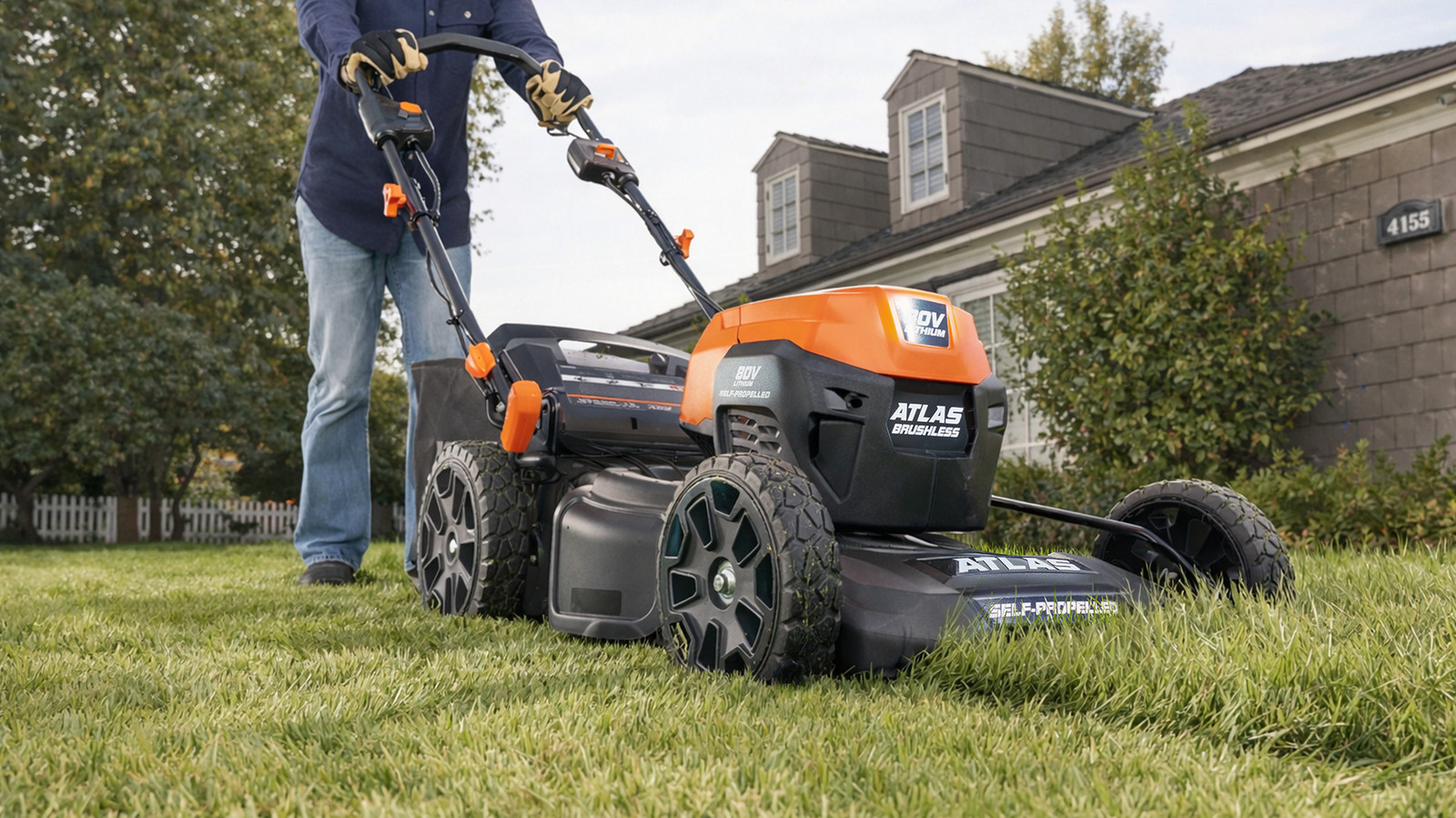
Harbor Freight is best known for its budget-friendly DIY supplies, but its range is more varied than some people might think. The retailer currently stocks 78 different brands, each of which offers a different selection of products catered to a slightly different range of customers. Its Atlas brand is aimed at outdoor cordless tool buyers needing professional-grade equipment, and one of its best-reviewed products is its 80V 21-inch self-propelled lawn mower.
The mower retails for $279.99 in tool-only form, but buyers that are new to the brand will also need to factor in the cost of batteries and a charger. Atlas recommends using two batteries to give the mower up to 80 minutes of runtime, and offers a rapid charger to recharge those batteries with minimal downtime. The brand’s 2.5Ah 80V batteries cost $139.99 each, while its high-capacity 4Ah 80V batteries retail for $249.99 each. Once you’ve paid for the mower, a pair of batteries, and the rapid charger, you’ll be spending anywhere between $639.96 and $859.96, depending on which batteries you pick.
At that price, the Atlas mower has a lot of competition. Some of its rivals also offer certain features that the Atlas mower doesn’t, even if they can’t match up in other aspects. While the Harbor Freight tool is certainly an appealing option, it’s worth sizing up its competition before you purchase one, to make sure it’s the right one for your needs.
Ryobi 40V HP 21 Inch Self-Propelled Lawn Mower Kit
One of the most significant initial costs when you’re buying a cordless lawnmower is purchasing the batteries you’ll need to get it running. Those batteries will cost hundreds of dollars, and since the vast majority of brands use their own proprietary battery systems, you’ll be locked into that brand’s ecosystem once you buy them. This is where brands like Ryobi have a big advantage: if you purchase its 40V HP 21-inch self-propelled mower kit, the batteries it comes with can also power more than 80 other Ryobi 40V tools. In contrast, Atlas’ 80V/40V dual-voltage range only includes a dozen different tools.
The Ryobi mower is also competitive in its own right against the Atlas mower, offering an identical 80 minutes of advertised runtime, along with a turbo mode to cut through tough patches of grass. Just like its Atlas rival, the Ryobi mower can also fold down for easier storage. The mower kit comes with a pair of 6Ah batteries, and when they’re depleted, the included rapid charger can recharge them in under an hour.
One of the key downsides of the Atlas mower is its measly 90 day standard warranty. Meanwhile, Ryobi ships its mower with 5 years of cover as standard, while the included battery packs are covered for 3 years. Ryobi’s offering is very competitive on cost too, with the mower kit retailing for $639.00 at Home Depot.
Kobalt 80V 21 Inch Self-Propelled Lawn Mower Kit
Tool buyers who only usually shop at Home Depot or Harbor Freight can find themselves missing out, since brands like Kobalt can’t be found anywhere other than Lowe’s. The brand with the bright blue tools has been around for more than a quarter of a century, and it sells various outdoor power tools, including the 80V 21-inch self-propelled lawn mower kit. Officially, the kit retails for $1,099.00, but a long-running promotion that extends until the end of October 2026 has dropped its price to $599.00.
At that promotional price, it’s a compelling alternative to the Atlas mower. Kobalt promises up to 75 minutes of runtime when the included pair of 80V batteries are fully charged, as well as seven different levels of adjustable cutting height, just like Atlas.
It also features a folding handle and a built-in charge indicator to help you keep an eye on its remaining battery life. Much like Ryobi, those batteries are covered by a 3 year warranty, while the mower itself gets 5 years, comfortably beating the Atlas mower. According to its maker, the Kobalt mower is best suited to yards between ½ acre and 1 acre in size.
Echo 56V 21 Inch Self-Propelled Lawn Mower Kit
The Atlas mower might be competitively priced given its capabilities, but there are cheaper options available. Take, for example, Echo’s 56V 21-inch self-propelled lawn mower, which is available at Home Depot as part of a kit for $599.00. That kit includes a 5Ah battery and a standard charger, which Echo says is enough to give the mower up to 70 minutes of runtime.
It’s the most powerful electric lawn mower that Echo offers, and it’s protected by a five-year consumer warranty, or a two-year commercial warranty. You can pick from seven levels of adjustable cutting height, and the folding handle that’s found on the Atlas mower is also present and correct here too. Like all the mowers here, the Echo can mulch grass, direct it into the bag at the rear, or discharge it from a side chute, which is sold separately. One unusual feature of the Echo mower is its built-in LED headlight, which allows you to continue mowing into the twilight hours if needed.
Echo might not offer as many tools in its 56V line as Ryobi, but it still sells a slightly larger variety than Atlas. Various different sizes of hedge trimmer are available to suit a variety of jobs, as well as a selection of blowers and even a handheld 6-inch pruning saw.
Ego 800 Series 21 Inch Self-Propelled Lawn Mower Kit
Ego offers several different electric lawn mowers, with the 1100 Series being the most powerful in the range and the 600 Series being the entry-level variant. The closest rival to the Atlas mower is the mid-range 800 Series 21-inch self-propelled model, which is available as a kit for $749.00. It’s slightly pricier than buying the Atlas mower with a pair of 2.5Ah batteries, but not as much as buying it with a pair of 4Ah batteries.
The Ego 800 Series is down on advertised runtime compared to the Atlas, offering 60 minutes on a full charge thanks to its included 7.5Ah battery. However, it has a wider range of cutting height positions, with eight different positions available stretching from 1 inch to 4 inches. It also features LED headlights, which rivals like the Echo mower have, but the Atlas doesn’t.
Plenty of buyers like to check user reviews as a way to verify that a tool is as good in the real world as its spec sheet makes it out to be, and the Ego is a particularly safe choice in that regard. It has amassed more than 28,000 user reviews at Lowe’s with an average of 4.6 out of five stars. In comparison, the Atlas mower has the same star rating on Harbor Freight’s website, but from only around 1,400 reviews.
Greenworks 80V Gen-2 21 Inch Self-Propelled Lawn Mower Kit
Both Ego and Greenworks are popular outdoor tool brands, but Costco shoppers might prefer Greenworks. A range of its tools are available at the warehouse chain, including the 80V Gen-2 21-inch self-propelled lawn mower kit. Costco buyers get an exclusive deal, with the kit including an additional 2Ah battery and a high lift blade. As standard, the kit includes a 4Ah battery and a charger, alongside the mower itself. The whole kit is available on Costco’s website for $629.99, although prices and availability might vary in the retailer’s physical locations.
Assuming both of its included batteries are fully charged, Greenworks says that its mower should be able to mow yards up to ¾ acre. According to the brand, that’s equivalent to a runtime of around 60 minutes.
The mower’s spec sheet is similar to Atlas and to all the other rivals here, with folding handles, seven-position cutting height adjustment, and mulching and side discharge capabilities. Greenworks also fitted it with onboard LED headlights, unlike the Atlas mower. Anyone looking to build an arsenal of cordless outdoor tools will find plenty to like about the Greenworks range too, since its 80V line includes more than 70 different tools.

Stephan is the sports journalist for the Maple Grove Report.