
5 Of The Safest Caribbean Destinations To Visit This Summer According To Travelers


Share The Article

Planning a summer beach trip shouldn’t give you gray hair. When you finally get the time off work to pack a suitcase, the only thing you want to worry about is whether you packed enough sunscreen. You want to sip a cold drink in the sun, not stress out about walking back to your hotel after dinner.

To figure out where people actually feel the most secure, we asked real travelers to vote on our Safety Index. The numbers are finally in, and they paint a really clear picture of where the smart travel money is going this summer.

If you are looking for a completely stress-free getaway, here are the top 5 safest spots in the Caribbean (and the beautiful Caribbean coast) right now, ranked by the travelers who just visited them.

PLUS: I’ve created an interactve quiz for you at the end of the article to find out which destination is perfect for you!

1. Aruba

Aerial shot of a beach in Aruba

Safety Index Score: 98/100

Aruba crushed the competition, scoring higher than any other destination on our entire index. It is affectionately called “One Happy Island,” and the moment you step off the plane, you understand exactly why. The tension just melts away.

  • The Vibe: You do not feel trapped in your resort here. I have personally walked back to my hotel late at night after a few drinks and felt totally completely fine. It is an island that encourages you to get out and explore.
  • The Experience: You can spend your mornings hunting for amazing street murals in the town of San Nicolas, and your afternoons driving a UTV through the wild, rocky desert on the north side of the island.
  • The Best Perk: Aruba has a pre-clearance agreement with the U.S. government. You actually go through U.S. customs before you fly home. When you land back in the States, you just grab your bags and walk out like it was a regular domestic flight!

2. Cancun, Mexico
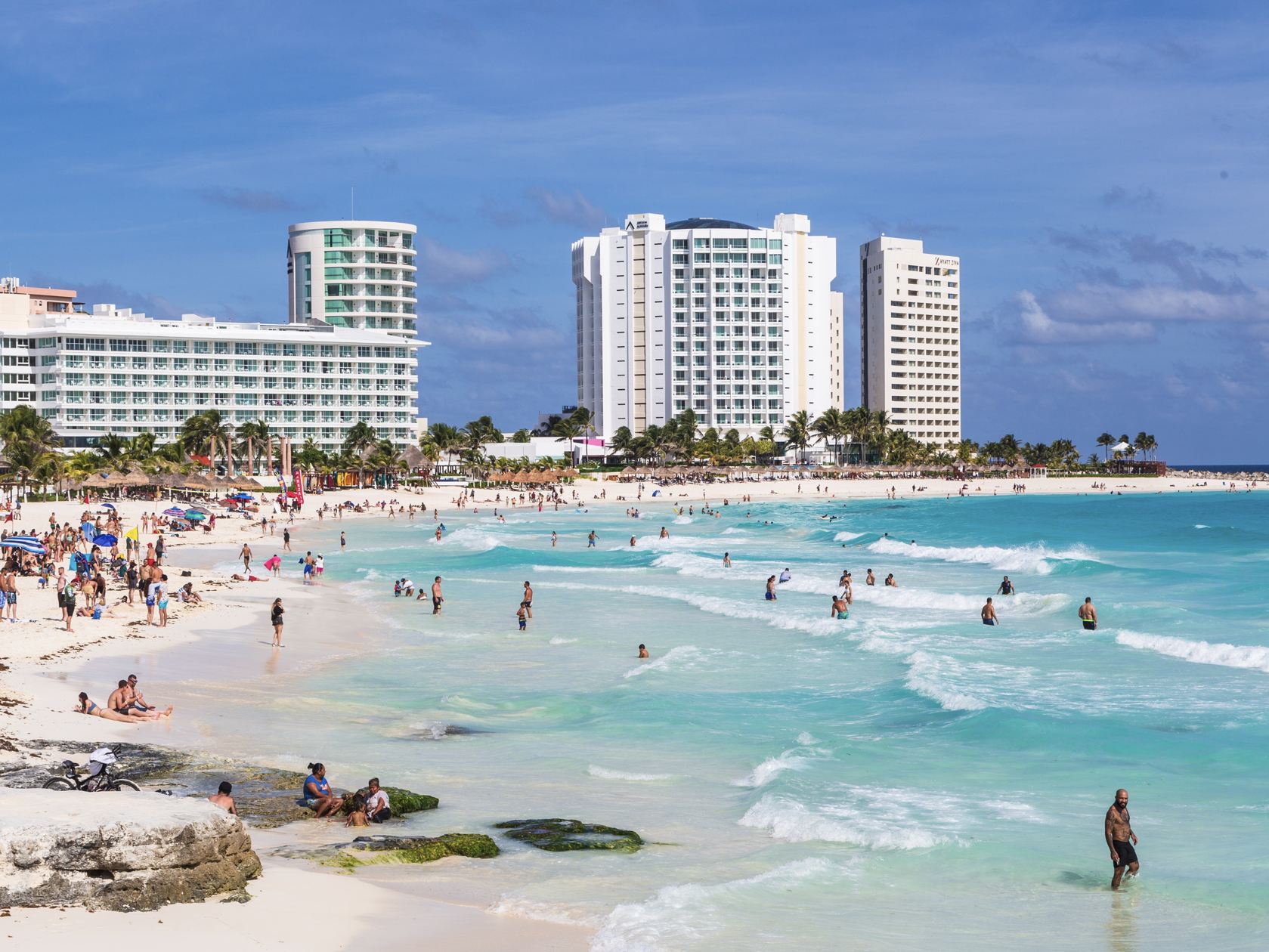
Hotel Zone Beach With American Tourists In Cancun Turquiose Blue Water

Safety Index Score: 92/100

Cancun sits right on the bright blue Mexican Caribbean, and while it sometimes gets a wild reputation on the news, travelers on the ground tell a totally different story.

  • The Vibe: The famous “Hotel Zone” in Cancun is built like a fortress of fun. It is heavily patrolled by tourist police and private security, meaning the crime rate inside this bubble is incredibly low. Travelers feel super secure walking between the giant resorts and upscale shopping malls.
  • The Experience: Cancun is simply the easiest beach trip you can take. You fly into a massive, modern airport, hop in a quick shuttle, and within an hour, you are floating in a gorgeous infinity pool with a taco in your hand.

3. Playa del Carmen, Mexico

Playa Del Carmen Beach

Safety Index Score: 92/100

Just an hour south of Cancun, Playa del Carmen offers that same warm Mexican Caribbean water, but with a much slower, walking-friendly pace. It is a massive magnet for digital nomads and expats from all over the world.

  • The Vibe: Unlike Cancun, where you mostly stay at your giant resort, Playa is all about walking. The heart of the town is 5th Avenue, a massive pedestrian-only street that stretches for miles.
  • The Experience: You can spend hours walking up and down 5th Avenue, popping into tiny coffee shops, buying local art, and eating amazing street food. Because the street is always packed with families and travelers, it feels incredibly safe and welcoming day or night.

4. Punta Cana, Dominican Republic

Punta Cana, Dominican Republic

Safety Index Score: 91/100

If your ultimate goal is to totally shut your brain off and let someone else do the cooking, Punta Cana is the undisputed king.

  • The Vibe: Punta Cana is famous for its massive, all-inclusive resort bubbles. These properties are huge, highly secure, and have absolutely everything you need right on site. You never actually have to leave the property if you don’t want to.
  • The Experience: Travelers love Punta Cana because it offers pure, uninterrupted luxury. You wake up, grab unlimited food at the breakfast buffet, and walk straight out to some of the softest white sand on the planet. The resorts work hard to keep the beaches clean and totally secure, giving you the ultimate peace of mind.

5. Costa Rica

Puerto Viejo de Talamanca Costa Rica

Safety Index Score: 84/100

Okay, while Costa Rica is in Central America, its eastern edge boasts an absolutely stunning Caribbean coast. It is the perfect spot for travelers who want to trade giant swimming pools for wild nature.

  • The Vibe: Costa Rica is famous for its “Pura Vida” (pure life) lifestyle. It is a country that focuses heavily on protecting nature and keeping things peaceful. In fact, the country is so dedicated to peace that it does not even have a standing army!
  • The Experience: Travelers looking for a safe adventure love it here. You can zip-line through the thick jungle canopy, watch sloths hang out in the trees, and surf in the warm Caribbean water. The locals are famous for being incredibly friendly and helpful to visitors, making it a wonderful spot to safely unplug and get back to nature.

Now take this quiz to find your perfect match!

Question 1 of 4

Choose your ultimate vibe:


Question 2 of 4

What’s your top activity?


Question 3 of 4

How do you want to get around?


Final Question

Pick your favorite safety perk:


🇦🇼

Aruba

One Happy (And Safe) Island

Why: You want total freedom! Aruba scored an unbeatable 98/100 on our Safety Index, encouraging you to step out of your resort and explore safely.

Pro Tip: Enjoy UTV rides in the desert and stunning street murals in San Nicolas. Plus, you clear U.S. Customs *before* flying home!

🇲🇽

Cancun, Mexico

The Fortress of Fun

Why: You want the absolute easiest beach trip possible. You can hop off a plane and be in an infinity pool within an hour.

Pro Tip: Scoring a 92/100, the famous “Hotel Zone” is heavily patrolled by tourist police, making it incredibly secure to walk between giant resorts and upscale malls.

🌮

Playa del Carmen, Mexico

The Walkable Wonder

Why: You want gorgeous Mexican Caribbean waters but prefer a slower, pedestrian-friendly pace over massive mega-resorts.

Pro Tip: Scoring a 92/100, the heart of the town is 5th Avenue. It is always packed with families, making it incredibly welcoming and safe to explore local art and street food day or night!

🇩🇴

Punta Cana, D.R.

The All-Inclusive King

Why: You want to totally shut your brain off, let someone else do the cooking, and never actually leave your highly secure hotel property.

Pro Tip: Scoring 91/100, Punta Cana’s resort bubbles offer pure, uninterrupted luxury on some of the softest white sand on the planet.

🇨🇷

Costa Rica

The Wild Pura Vida

Why: You want to trade giant swimming pools for wild nature, zip-lining, and hanging out with sloths in the jungle canopy.

Pro Tip: Scoring 84/100, Costa Rica is so dedicated to peace it doesn’t even have an army! The locals are incredibly friendly, making it a safe place to completely unplug.


Source link

Leave a Reply

Subscribe to Our Newsletter

Get our latest articles delivered straight to your inbox. No spam, we promise.

Recent Reviews


Flip phones are making a comeback, but most US adults aren’t convinced enough to upgrade. 

Smartphone brands are trying new phone concepts, like flip and foldable phones, to give us a bigger screen when we want it, while still maintaining the same functionality as the smartphones we’re used to. There’s the Samsung Galaxy Z Fold 7, for instance, and there’s even a rumor that Apple plans to release its first foldable phone

And if you remember the popular 2000s Motorola Razr, now there are rumors about the Motorola Razr 2026 — it reminds me of my old pink phone. But gone are the days of a basic keypad and a few ringtones. Smartphone brands are adding AI features, such as creating custom emoji, removing background objects from photos, and live translation. 

Yet a recent CNET survey says smartphone users aren’t sufficiently impressed by new features and concepts to consider upgrading their phones. Only 12% are motivated by AI integrations and 13% by new phone designs. Instead, price (55%) and longer battery life (52%) are the biggest drivers of their decision to get a new phone. 

If most US adults aren’t sold, why are tech brands so adamant? Let’s dive into CNET’s findings and what they mean for the future of smartphones.

  • The top three motivations for US adult smartphone owners to consider upgrading their devices are price (55%), longer battery life (52%) and more storage (38%). That’s the same top three as last year: In 2025, price was the top motivator (62%), followed by longer battery life (54%) and storage capacity (39%). 
  • Despite AI’s growing presence, only 12% of smartphone owners say AI integrations would motivate them to consider upgrading. 
  • Only 13% of smartphone owners would be motivated to consider upgrading to a new phone concept, such as a foldable or flip phone. 
  • Over half of smartphone owners (58%) experience frustration with their phone’s battery life, and 31% say their phone’s battery doesn’t hold a charge as well as it did when it was new.  

Most US adults aren’t motivated by new smartphone features and designs

Smartphone brands, like Samsung and Apple, are building in convenient features, such as a tool to remove unwanted objects from pictures, AI call screening and the ability to draft a message from a prompt. However, CNET found that US adults would consider upgrading for more practical reasons. Over half (55%) of US smartphone users are motivated by price, including 53% of Apple users and 56% of Samsung users. 

Yet brands are still exploring new concepts and features, like Apple Intelligence, a built-in AI feature. Then there’s the rumor of a book-style iPhone, potentially followed by a clamshell foldable design. But that’s not what most smartphone owners are after. 

Smartphone owners are more convinced by other design and feature factors when deciding on a new phone, such as camera features (27%) and the phone’s display or screen size (22%). Here are the top motivators to consider upgrading for all smartphone users.

Zain Awais / CNET

You’ve probably noticed the price of a basic smartphone has increased drastically over the years. Take the iPhone, for example. It was originally $600 for 4GB. But advanced features, the RAM shortage, inflation and tariffs are pushing prices even higher. Now, the baseline iPhone 17 (256 GB) is $800, and the Samsung Galaxy S26 (256 GB) starts at $900. 

There’s no way of knowing for sure, but these may be the lowest prices we’ll see on new models for a while, especially as features advance and designs become more complex. So if you’re already in the market for a new phone, you might want to think seriously about pulling the trigger now if you find a good deal.

The top upgrading motivators haven’t changed much over the years

Looking back at CNET’s survey data from 2024 and 2025, and now, people’s motivators for upgrading their phones haven’t changed much. Price, longer battery life and more storage have been top drivers in the past, and despite small dips this year, they’re still key upgrading factors.

Despite design upgrades and new features, smartphone owners are still focused on how much they’re paying and how long they can use their devices without needing a charger. Consumer sentiment about AI integrations dropped hard from 2024 to 2025, but it has edged up slightly in 2026. And smartphone owners aren’t as easily persuaded by phone color or the phone being thinner, either. 

Even with these nice-to-have capabilities, smartphone owners are looking at the basics. That includes practical features like battery life and more storage to hold their many important files, photos and apps. 

Most smartphone owners want better battery life

Taking a closer look at smartphone users’ hope for longer battery life in a new phone, over half (58%) are frustrated with their current phone’s battery life. Roughly one in three (31%) say their phone doesn’t hold a charge. 

The reality is, battery life will decline the longer you have your phone, so you may find your phone’s battery charge doesn’t last as long as it used to. Even though you can replace your phone’s battery, most phone batteries have a lifespan of two to three years before they start degrading. 

CNET Director of Editorial Content Patrick Holland examined battery life tests on over 35 current smartphones. And it’s not just iPhones that pack impressive batteries.

Based on CNET’s lab testing, the $1,200 iPhone 17 Pro Max had the best overall battery life, with a 5,088-mAh capacity. Another top performer was the $900 OnePlus 15, with a 7,300-mAh battery. 

If you’re looking for a phone with better battery life, consider one with a silicon-carbon battery to increase capacity without requiring a larger phone. The OnePlus 15, Poco F7 Ultra, OnePlus 13R and OnePlus 15R all feature silicon-carbon batteries with large capacities and all performed well in Holland’s testing. Keep in mind that other factors can impact your battery life, like your carrier’s signal, software efficiency and processor. 

Methodology

CNET commissioned YouGov Plc to conduct the survey. All figures, unless otherwise stated, are from YouGov Plc. The total sample comprised 2,486 adults, of whom 2,407 owned a smartphone. Fieldwork was undertaken from April 29 to May 1, 2026. The survey was carried out online. The figures have been weighted and are representative of all US adults (aged 18 plus). 


Source link