
We may receive a commission on purchases made from links.
In our modern, overstimulating world, camping is one of those little luxuries that teach us the value of slowing down and experiencing life. These days, we can balance both our love for nature and our need for modern comforts, especially with useful camping gadgets. Depending on what kind of camping you’re into, there are products that can help you navigate terrain without internet, enjoy a good shower after a hike, or keep insects at bay at night. However, some camping gear isn’t worth the money, and you might even find yourself spending more than you have to if you buy one that doesn’t quite fit your particular truck or SUV.
For Toyota owners, you’re in luck, since it has already rounded up official camping and overland accessories for your benefit. While there may be more affordable products out there, it’s hard to go wrong with products listed under a company’s official accessories list. Not only does it mean they’ve been tested for compatibility, but you might even be able to find it at your local dealer during your next maintenance trip. On the Toyota website, you can search for the nearest dealer near you if you’re already on the road. Or, you can even filter with your vehicle VIN or model details, so you’re sure they’re compatible with your vehicle. But if you just want an idea what options are out there, here are some official Toyota products that you might want to get for your next camping adventure.
Arb Fridge/Freezers
There are few experiences that are more satisfying in life than drinking an ice-cold drink after a long day of driving through beautiful scenery. With a portable fridge, you can enjoy one in your Toyota no matter how far you are from civilization. Toyota includes two official fridge/freezer accessories from Arb: Zero Fridge/Freezer and Elements Fridge/Freezer. On the Toyota website, it lists the Arb 47 Qt Zero Fridge/Freezer with an MSRP of $1,180.97. Arb notes that it’s also available in other sizes: 63 Qt, 73 Qt, and 101 Qt. Made to fit about 65 12 oz. cans, it has both a fridge and a freezer, an interior LED light to help you find things in the dark, dual DC inlets (front and rear), and a USB outlet to charge your devices. Alternatively, if you want something a little more durable, the Arb Elements Fridge/Freezer is more suitable for more serious campers. Priced at $1,709, it comes with a slew of durability upgrades, which includes permanent mount options, weatherproof control panels, protective corner pieces, and tamperproof steel hinges.
Depending on what fridge/freezer model you invest in, you can get something like the $535.95 Arb Elements Fridge/Freezer Slide and the $49.24 Arb Elements Zero Fridge/Freezer Tie Down System, which keeps your unit secure even when the car is moving. While Arb units can already work with 12V cigarette plugs, they are also tested to work with solar panels from certain brands.
Napier Sportz Suv Tent With Screen Room
When you’re travelling during the warmer months of the year, it’s almost a given to have a tent that can let some air in (without the bugs). At just under $460, Napier claims that its Sportz Suv tent with screen room is the “largest SUV Tent on the market”. A combination of a 10 ft by 10 ft tent, plus a 6 ft by 7 ft screen room, it’s made to sleep up to 6 people. With its relatively high headroom, it’s better suited for taller people than your average cheap tent. Its two key advantages include its 15-minute set up time and that you can access the back of your Toyota from the inside, so you don’t have to go outside to get your hands on important cargo. If you do end up switching to a different vehicle, Napier Sportz notes that its sleeve works with SUV and minivan models from other manufactures as well.
You can also use it as a regular tent if you’re camping away from your vehicle. Inside the tent, it has features like storm flaps, gear loft, gear pockets, and lantern holder. To help beat the heat, it has a pair of ceiling vents, three mesh windows, and large doors. If you can’t find it at your nearest Toyota dealership, you can get the same model on Amazon for just under $450, where it enjoys a rating of 4.4 stars from more than 500 customers.
Kammok Crosswing Car Awning
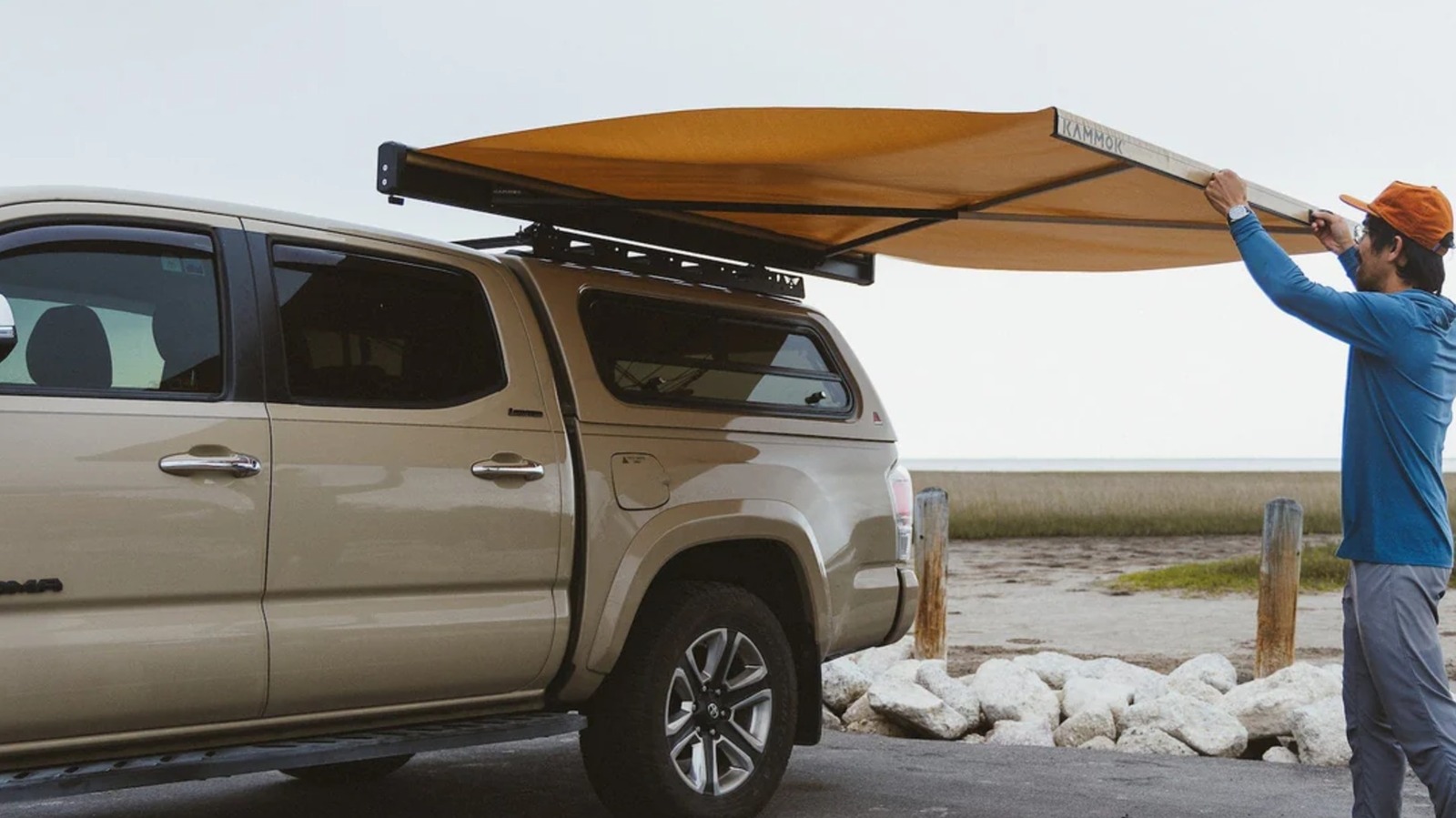
Sometimes, you don’t particularly need a whole tent set up to enjoy an afternoon overlooking the sunset on a cliff or while you’re having a small BBQ at the camping site. With your Toyota, the Kammok Crosswing Car Awning can make for a quick, compact, and versatile way to get shelter from the sun, rain, or just bugs from getting into your food. On the Toyota website, there are different awning models from Kammok which range from 5ft to 7ft with two colors (desert tan and charcoal). Depending on the size, you can expect to shell out between MSRP $1,149.95 to $1,299.95 at your local dealership. On the Kammok website, these Crosswing models have generated an average rating of 4.7 stars from more than 100 reviewers.
Boasting an impressive set-up time of only 3 seconds, you can adjust it to three lengths (3 ft, 4.9 ft, and 6.5 ft). Kammok claims that it’s durable enough to withstand 25 mph wind. To do this, it employs multiple features, like its aluminum, bag-free housing that keeps rust at bay. As for the canopy, it uses UV and mold-resistant PVC coated polyester material. Kammok also lets you replace the fabric if it gets damaged or if you ever just change your mind on your color preference. It comes with mounting hardware that works with all kinds of roof racks.
Yakima Megawarrior Roof Cargo Basket
Known as one of the better truck bed storage brands out there, Yakima’s cargo baskets are also included in Toyota’s official accessories list. Priced at $585, the Yakima Megawarrior Roof Cargo Basket measures 52 inches by 48 inches by 6.5 inches. Designed for larger vehicles, like trucks and off-roaders, it can make hauling around oddly-shaped camping gear, sports equipment, or other gear possible, especially if it doesn’t fit the inside of your vehicle. You can purchase additional extensions if you need more space. Made of heavy-duty steel, it’s also designed with aerodynamics in mind. If you have an Amazon Prime membership that you want to take advantage of, the Yakima Megawarrior Roof Cargo Basket is also available on Amazon for $648.95 with options for installment for qualified users. It has a generally positive rating of 4.4 stars from more than 220 customers, plus it’s an Overall Pick product too.
If you don’t need a huge basket, Toyota also lists a narrower model, the $529 Yakima Skinnywarrior, which is perfect for smaller equipment, like helmets or bags. Made of the same heavy-duty material, it measures 58 inches by 23 inches by 6.5 inches. It retails for $528.95 and boasts an average rating of 4.5 stars from 150 customers on Amazon. Regardless of which Yakima basket you get, you can use Toyota’s checker on their official website to know if it will work on your vehicle.
Napier Sportz Air Mattress – Compact
Retailing for $105.99, the Napier Sportz Air Mattress – Compact sets itself apart from a lot of other air mattresses in the market in two ways: its built-in pump and a design tailored to fit trucks. Measuring 75 inches by 42 inches by 5 inches, which means it’s ideal for compact-sized trucks. Apart from the Toyota Tacoma, Napier notes that it fits the Chevy Colorado, Jeep Gladiator, Ford Ranger, GMC Canyon, and Nissan Frontier. It has a weight limit of 400 lbs and is made to sleep a pair of adults. With a flocked top, it can be used both indoors and outdoors, so it’s great for a camping night under the stars if the weather is good enough. Since it uses a hand/foot pump, you don’t have to worry about bringing around an inflator and Napier says the inflation should only take up to 7 minutes. It also has a side valve so you can take the air out quickly. Out of the box, it includes a carrying bag to store it when not in use.
It’s also available on Amazon for just $99 if you want to get it under the MSRP. Apart from being an Overall Pick product, it has a positive rating of 4.1 stars from 70+ customers. If your vehicle is full-sized, it’s also sold within the same listing at just under $100 with all the same features but with an extra 8 inches of width at 50 inches.

Stephan is the sports journalist for the Maple Grove Report.