5 Things You Need To Do ASAP After Hitting A Pothole


There’s a reason almost every driver you know has a story of pothole frustration. It’s because it’s largely inevitable that you’ll fall victim to one somewhere at some point. What’s important, though, is what you do next. When our cars bump a curb or take a small jolt from a pothole, sometimes it seems so minor that we just grit our teeth and go about our day. Bear in mind, though, that you may not have gotten off as easily as you first thought. 

The fact that you felt only a minor impact doesn’t necessarily mean that your vehicle hasn’t sustained damage. If it has, it’s vital to determine what’s happened and what needs to be done next. This can prevent worse harm being done to the vehicle, as well as keep you and other drivers safe. There are also potential ways to secure compensation for the damage done by a pothole, if you know the avenues you can try to take and the time frame you have to do so. 

There are some things you can do in the immediate aftermath of hitting the pothole, while there are others that are jobs to be done in the days and weeks ahead. In either instance, though, as they’re such a ubiquitous threat on the roads, all drivers should know what to do after striking a pothole.

Pull over and check your vehicle

Of course, any time your vehicle takes a bump or a ding, all kinds of things immediately run through your mind. The first step is to pull over as soon as possible to determine what you’re dealing with. After all, it may be dangerous to drive any further. Even if that’s not the case, your vehicle may require prompt service. 

There are some immediate signs of major damage, such as buckling of the wheel arches, that will tell you that you need to see a mechanic ASAP after the pothole encounter. It’s also important to keep in mind that you may have been driving when visibility was poor, such as in the dark, so it definitely pays to have a flashlight in your vehicle as part of your emergency kit for these sorts of situations.

You should take your time to thoroughly inspect your vehicle. If you’re not a mechanic who’s experienced with all the subtle yet important signs, the first thing to ascertain is that there hasn’t been catastrophic damage to the underside of your vehicle. 

It may not even be something visible. Have a careful listen for escaping gas or any sounds that your vehicle wasn’t making before, which could indicate suspension damage or similar. It may well be a case for a mechanic, and the more information you can give them about any changes to your vehicle afterward, the better they’ll be able to diagnose and resolve problems.

Report the offending pothole

After you’ve determined that your vehicle hasn’t been damaged (or arranged proper care if it unfortunately has), your next priority should be reporting the troublesome pothole in question. To do so, you’ll first need to find out which body is responsible for that particular road.

State highways, etc., are typically administered by the state’s Department of Transportation. If on a California highway, for instance, you can use the Caltrans Division of Maintenance Customer Service Request form, which allows users to identify a pothole using a drag-and-drop pin-on-a-map graphic. As Texas’s own Department of Transportation notes, though, other roads, such as those within a city’s boundaries, are that city’s responsibility, not the state’s. Of course, these authorities usually have huge areas to maintain and significant backlogs of other repairs and improvements to make, so there’s no telling how long it may take for the repair to ultimately be made.

Still, you’re raising critical awareness about the issue, and that could save many tires and suspensions from needless extra strain or damage. On top of that, such reports can also serve as important evidence should a motorist seek compensation from the relevant authority for damage caused to their vehicle. This is because, as CNN Legal Analyst and Atlanta attorney Cody Randall put it in an Instagram post on the matter, “the city or the county, whoever’s maintaining that road, has to have knowledge that the defect exists and an opportunity to remediate it” for them to be found liable for damage caused by a pothole. 

Consider making a claim for the damage your vehicle has sustained

As the Los Angeles Times reported in 2024, 44 million drivers in the United States had their vehicles damaged by potholes in 2023. Looking a little further back, the American Automobile Association reported that pothole damage had cost the country’s drivers approximately $26.5 billion in total in 2021.

Compensation claims can be made if you act quickly. The time limit is up to 90 days after the collision in New York City, for instance, potentially differing a lot by location, though successfully receiving compensation for it is another matter. The onus is on the driver to demonstrate irrefutably that the responsible body was not taking care of the road as they should. This is why those who hit potholes should take the time to take photographs of the section of road, the pothole itself, their vehicle, and any damage. 

Be prepared to have little success with your claim. In fact, the Michigan Department of Transportation notes that “the majority of damage claims are denied under governmental immunity laws.” While Michigan law says that government agencies must “maintain the highway in reasonable repair,” defining a failure to do so is a tricky matter. As CNN Legal Analyst and Atlanta attorney Cody Randall explained on Instagram, counties and states often have “sovereign or qualified immunity,” which means, in effect, “you actually have to ask them for permission to sue them,” and they must choose to allow it. 

Determine whether your existing insurance coverage will help you

If you determine that your chance of receiving compensation from the local authorities is low, there’s another course of action that could help: Your existing car insurance. As State Farm reports, “pothole damage is usually covered with collision coverage, minus the deductible,” the latter typically being up to around $1,000. After a quote for the price of a repair, you might find that you’d end up parting with more money in the long run by taking this route. 

The Insurance Information Institute clarifies that adding collision coverage to a standard policy can cover the driver against impacts from potholes or other similar road hazards, though “it does not cover wear and tear to a car or its tires due to bad road conditions.” Such conditions often come hand in hand with potholes because of the way they form (rain freezing in existing cracks in the road expands and causes them to become larger), which also contributes to spring being the absolute worst time for potholes. A driver must prove that it was a collision with a pothole that caused the damage to get their insurance to pay out.

An additional complication to keep in mind is that your no-claims status may also be at stake from using it. All in all, as is so often the case with auto insurance, there’s a lot that needs to be considered prior to any claim. It can be important to avoid cheap car insurance to ensure your coverage is comprehensive, should it be needed for reasons like this. 

Check your tire warranty

Claims, whether through your personal vehicle insurance or for compensation from the relevant body, may be a non-starter. They may also result in lots of paperwork and evidence-gathering that adds up to much more time and/or money spent than the payout would ultimately be worth. There’s something much less time-consuming that you can consider first, though: Check the warranty on your tires. 

According to Edmunds, road hazard coverage can be added to a typical tire warranty to cover dangerous objects that could be on the road and potentially puncture a tire. Without this addition, the warranty will typically only be applicable for manufacturing defects, not accidental damage. This is why the road hazard add-on could be valuable, but it certainly doesn’t simply mean a free tire in every case. Additional fees, such as those for road hazard coverage on an additional tire, may also be added to the bill you end up receiving. The circumstances, the type of tire, and the damage it sustained are important to consider. 

Ultimately, a driver has several options available to them if they hit a pothole, and while each incident will be different and have different effects, the immediate priority is damage control. Often, the aim is to recoup as much of the expense as possible in the circumstances, which is a result in itself and better than not getting anything back at all. 


Source link

Leave a Reply

Subscribe to Our Newsletter

Get our latest articles delivered straight to your inbox. No spam, we promise.

Recent Reviews


In Cody v. Jill Acquisition LLC, No. 25-937 (S.D. Cal. June 30, 2025), the Southern District of California declined to enforce a retail site’s terms of use and compel arbitration, holding that the plaintiff, who used guest checkout to place an online order at the retail clothing site, did not have adequate notice of the terms and the arbitration clause. This case should serve as a wake-up call for online entities to reexamine electronic contracting processes. It exemplifies how, even if a website’s visual design and its placement of the hyperlinked Terms of Use during user checkout are comparable to other presentations that have been deemed enforceable, a court could still decline to enforce online terms if the context of the transaction is not the typical e-commerce transaction between a registered customer and a retail site. In this case, the court found that by checking out as a guest without creating an account, the user was less likely to expect a continuing relationship and, therefore, the site’s notice and presentation of the terms below the “Place Order” button were not conspicuous enough in this instance to bind the plaintiff.

The plaintiff in Cody filed a putative class action complaint over the site’s pricing policies for alleged violations of the California Business and Professions Code and the Consumer Legal Remedies Act. The defendant moved to compel arbitration, arguing the plaintiff had agreed to the site’s terms of use that contained a “Binding Arbitration Agreement and Class Action Waiver” when plaintiff clicked the “Place Order” button and completed her purchase from the defendant’s website.

Generally speaking, a contract will be enforceable based on an inquiry notice if: (1) the website provides reasonably conspicuous notice of the terms; and (2) the consumer takes some action, such as clicking a button, that unambiguously manifests assent to those terms. When evaluating whether there was an agreement to arbitrate, the court in Cody first considered the visual design of the webpages and found that the visual aspect of the notice was satisfied by the defendant’s website layout. As the court stated, the relevant criteria for evaluating whether the visual elements provide conspicuous notice are whether the advisal is displayed prominently enough that the court can assume a reasonably prudent Internet user would have seen it. Elements such as a “clear and legible” notice on the order page and a hyperlink placed directly above or below an action button formatted in bright, contrasting color and readable font within a relatively uncluttered web page have been favorably cited by courts in past cases.

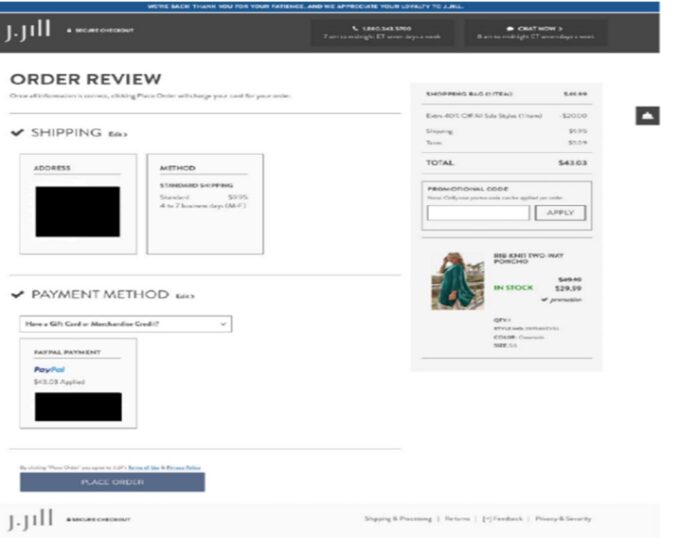
The court here found the visual design to be adequate because of factors such as the underlined blue hyperlink to the terms of use and its location directly below the “Place Order” button. [See below image from the court opinion of the final contracting screen ].

Although the court recognized that the “design of the website alone might support concluding that the notice would be reasonably conspicuous,” it went on to consider the full context of the guest checkout transaction at issue in Cody.  Here, the court distinguished it from those types of transactions where a user might anticipate “some sort of continuing relationship.” The court emphasized that when considering the notice requirement, the visual design of the website must be examined within that context. As it stated: “This means that courts should expect that a reasonable internet user is more vigilant in looking for contractual terms when the context of the transaction reasonably implies a contractual relationship.” To the court, when a user “simply purchases goods or avails herself of a one-time discount offer,” there is less reason for her to expect a continued relationship beyond the purchase. 

In the case at hand, the court considered plaintiff’s decision to check out as a guest as one where the user did not anticipate a continuing relationship, and compared it with other traditional e-commerce transactions involving registered users where the Ninth Circuit previously found that such context would put a user on inquiry notice that a purchase on the company’s website constituted an agreement to its terms.

“Generally speaking, courts are more likely to conclude that a user anticipating ‘some sort of continuing relationship’ would expect to be bound by terms, whereas a user ‘who simply purchases goods or avails herself of a one-time discount offer’ would be less likely to form such an expectation.”

“This context distinguishes this case from those in which the Ninth Circuit has found that the context of the transaction would put a user on inquiry notice that use of a company’s website or services constituted an agreement to its terms and conditions, including an arbitration provision.”

Thus, despite the adequacy of its visual aspects on the J. Jill site, the court found that proper notice was not sufficiently conspicuous in this case because of the guest checkout context of the transaction (“The context of the transaction therefore weighs against concluding that Plaintiff was sufficiently aware that, by placing an order through jjill.com, she would be entering into an agreement including an arbitration provision”).  

In another recent case, Chabolla v. ClassPass, Inc., 129 F.3d 1147 (9th Cir. 2025), the Ninth Circuit affirmed a lower court’s ruling that declined to send a proposed class action to arbitration. In the ClassPass case, the plaintiff signed up for a trial period for ClassPass, a service that sells subscription packages for access to various gyms and fitness studios, but later took issue when subscription charges resumed after gyms reopened following the COVID-19 pandemic. The contracting process in this case involved several signup screens. [An image from the court opinion of the final screen appears below].

In this case, the court’s decision was a flip, of sorts, of the Cody case, with the Ninth Circuit finding the visual presentation of the terms lacking, even though the context of the transaction would seemingly put the user on notice of an ongoing relationship that would contemplate the user agreeing to site terms. The appeals court found that while a trial subscription opportunity may not indicate an anticipation of an ongoing relationship in all instances, the context neither weighs in favor of nor against the notice requirement. This is because, as the court noted, the other aspects of the context – such as how the purchase is described as a “plan” or a “membership” and how the benefit of ClassPass is to gain access to gyms and fitness studios – conjure the idea of a continuing relationship. Nonetheless, the court ultimately decided that a reasonably prudent internet user would not be deemed to have unambiguously manifested assent to the terms by working her way through ClassPass’s multi-page website checkout process.

Taken together, these two recent decisions show that courts – at least those within the Ninth Circuit – are considering the actual context in which these internet transactions occur when deciding whether an online entity’s contracting and checkout process binds the user to the terms. While visual presentation and web flow design remains important for e-commerce sites, the above two court decisions show that context also matters.

We have previously highlighted the importance of web design in determining if a service’s terms are deemed enforceable. Now, companies might take a second look at their own user registration and e-commerce purchase processes to ensure they offer reasonably conspicuous notice of the existence of contract terms and obtain the user’s manifestation of assent to those terms in all contexts and types of transactions, including those transactions where guest or expedited checkout is used.

Contexts that indicate transient relationships, such as guest checkout or a trial opportunity, may mean that even an ordinary presentation of terms in the form of a hyperlink to the terms located beneath a “Place Order” button – a presentation that is used regularly by many sites – might need to be bolstered, in some cases, to provide the user additional notice that he or she is entering into a transaction that mandates acceptance of contractual terms. As the Cody court commented: “[T]he onus must be on website owners to put users on notice of the terms to which they wish to bind consumers.” Ultimately, the above court decisions accentuate the need for counsel to be involved in the decisions underlying the design and wording of online contracting processes and presentation of terms so entities can attain adequate user notice and assent that would satisfy even the most exacting scrutiny for any type of transaction.


Source link