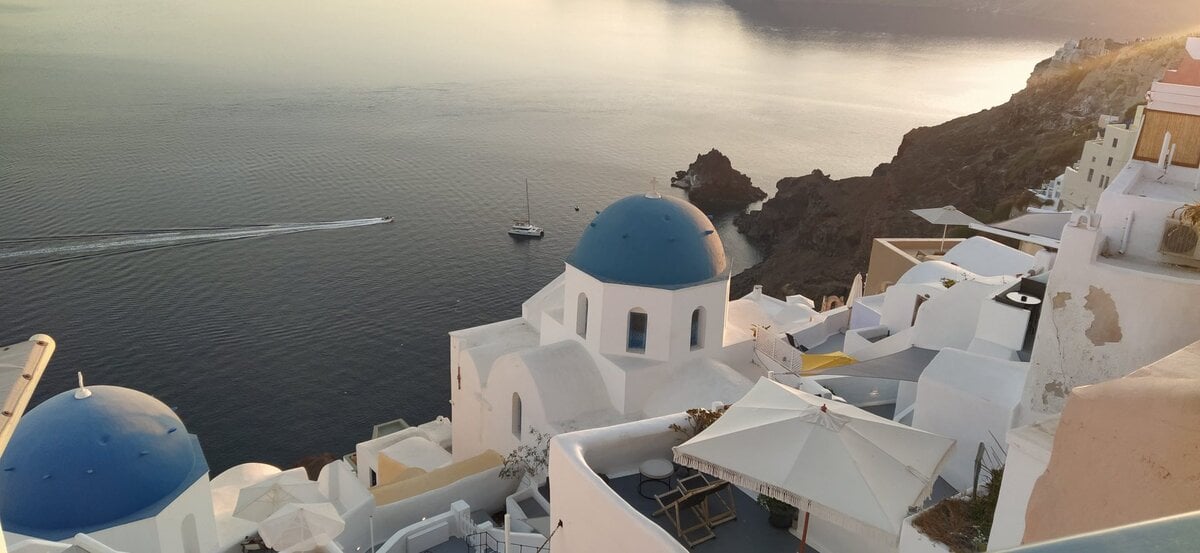

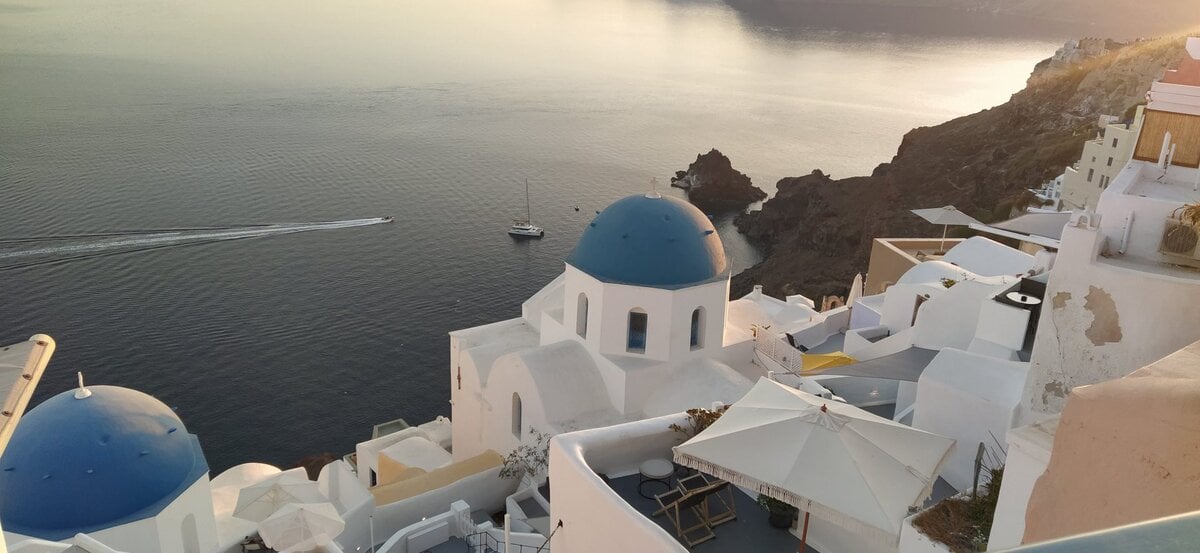
The light changes fast here. One moment, the caldera walls are bone-white in the afternoon glare; fifteen minutes later, they’re the color of warm stone and cooling copper. If you’ve positioned yourself well, you already have the shot. If you’re still looking for parking in Oia, you’ve missed it.
Santorini’s golden hour is genuinely unlike most European sunset destinations — not because of hype, but because of geography. The caldera faces west, the white architecture acts as a reflective surface, and the elevation of the villages creates natural compositional layering that a flat coastal town simply can’t offer. Knowing where to stand and when to arrive is most of the work.
Santorini Snapshots Tour (4 Hours)
Capture the soul of Santorini in just a few unforgettable hours as you explore its most photogenic highlights.
→ Visit iconic Oia with its whitewashed houses and blue domes
→ Scenic cliffside walk from Firostefani to Fira
→ Multiple dedicated photo stops overlooking the caldera and volcano
→ Free time for light shopping in Fira’s local boutiques and artisan stores
👉 Book your Santorini Snapshots experience now and take home unforgettable views
Why the Light Behaves Differently Here
The island sits on the rim of a submerged volcanic crater, which means most of the inhabited villages — Oia, Imerovigli, Fira, Firostefani — are perched on cliffs that drop sharply to the sea. That elevation creates an unobstructed western horizon. When the sun drops toward the Aegean, there’s nothing to interrupt it: no headland, no hill, no neighboring island at the wrong angle.
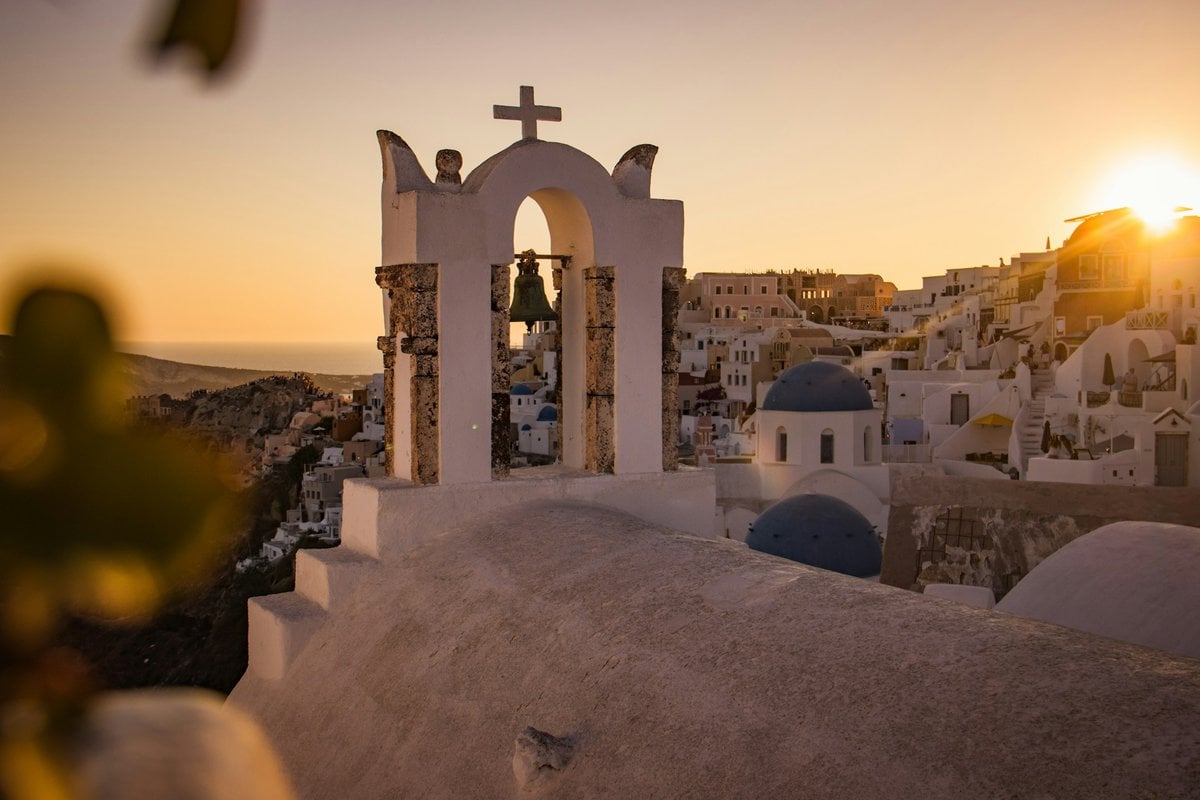
The whitewashed Cycladic architecture amplifies the effect. As the angle of light lowers, it stops washing out the white and starts warming it — and because every surface faces a slightly different direction, the tonal variation across a single roofline becomes enormous. Domes go from blue-grey to deep cobalt. Walls shift from white to ochre to a faint rose. It’s a short window — roughly 20 to 30 minutes of optimal light before the gradients become muddy, which is why timing and position matter more than equipment.
Related read: How to Reserve the Best Romantic Sunset Restaurants in Santorini, Greece
Seven Viewpoints Worth Knowing
1. Oia Castle
The most photographed spot on the island, and for reasons that hold up on arrival. The ruined Venetian kastro sits at the northern tip of Oia and looks directly southwest over the caldera. During the final 30 minutes of sunlight, the cliffside cave houses below glow in layered warm tones, and the windmills to the east catch the last direct light.
The reality: this spot draws several hundred people on a normal evening, and considerably more in July and August. Arrive 90 minutes before sunset to secure a position on the upper walls. If you arrive 20 minutes before, you’ll be photographing the backs of other people’s heads.
2. Imerovigli
Sitting between Fira and Oia along the caldera path, Imerovigli is quieter than both and offers a longer elevated perspective — you can see the curve of the caldera wall stretching south toward Fira, which Oia’s more concentrated view doesn’t give you. The light here is the same quality, the crowd is a fraction of the size, and the walking path along the rim gives you flexibility to shift your angle as the sun moves.
3. Skaros Rock
A plus/minus 20-minute hike from Imerovigli leads to Skaros Rock, a volcanic promontory that juts into the caldera. The walk involves some uneven terrain and a modest descent, so go in proper footwear and give yourself 35 minutes total from Imerovigli to reach the tip with time to settle.
The reward is compositional: you’re surrounded by sea on three sides, the caldera wall rises behind you, and you’re shooting without buildings in the foreground. It’s a different kind of golden hour photograph than the dome-and-sunset classic — more raw, less postcard. On a summer evening, you might share the rock with a handful of other people.
4. Firostefani
The village immediately north of Fira proper has the same caldera-edge path but far less foot traffic. The blue-domed churches here — smaller and less famous than Oia’s — sit close to the path and work well as foreground elements against the late sky. For anyone who wants the iconic dome-and-sunset composition without fighting for position, Firostefani delivers it at a fraction of the effort.
5. Pyrgos
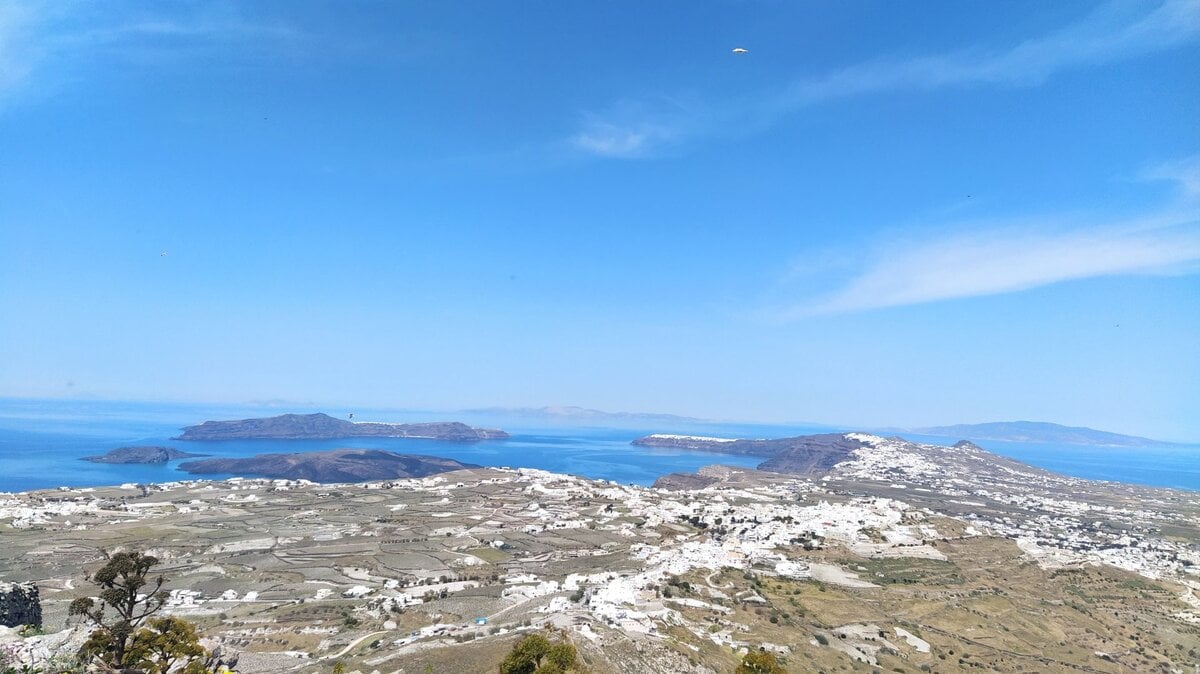
The highest traditional village on the island sits roughly in the center of Santorini, away from the caldera entirely. From the castle ruins at the top, you get a 360-degree panorama — caldera to the west, the eastern coastline and Perissa beach to the east, and the full width of the island in between. The light here isn’t the same drama as a caldera-facing viewpoint, but the perspective is genuinely different from anything else on the island: you’re above it all rather than on its edge.
This is a good option if you want solitude and a wide landscape frame, or if you’ve already done the caldera viewpoints and want something that feels less staged.
Related read: Medieval Santorini Villages: Where the Island Finally Slows Down
6. Akrotiri Lighthouse
Located at the island’s southwestern tip near the archaeological site, the lighthouse sits on low cliffs above open sea. There are no whitewashed buildings in the frame — just the structure itself, the sea, and the horizon. The crowd here is small even in peak season. It’s best suited to minimalist compositions and to photographers who find the village viewpoints too busy.
Practical note: it’s a 10-minute drive from Akrotiri village. There’s a small parking area. The path from the road to the lighthouse takes about five minutes on foot.
7. Profitis Ilias
At 565 meters, Profitis Ilias is the highest point on Santorini and accessible by road. The monastery at the summit is a working Orthodox monastery, so dress accordingly if you plan to enter the grounds. The view from the upper path near the telecoms towers offers a panorama of both the caldera side and the eastern beaches — something no other viewpoint on this list does.
The light quality differs from the caldera edge because you’re above the architecture’s reflection layer. It suits wide-landscape photography better than intimate golden-hour compositions.
Photography Preparation
- Arrive before you think you need to. For Oia Castle, 90 minutes is the minimum. For other spots, 45 to 60 minutes gives you time to assess the light, choose your position, and settle before the optimal window opens.
- Expose for the midtones, not the sky. The white architecture is highly reflective and will blow out easily. Shoot in RAW if your camera supports it, and bracket your exposures during the 10 minutes either side of peak light. A manual exposure that retains wall detail will give you more to work with in post than a sky-correct JPEG.
- Keep your ISO low. The light during golden hour is still relatively strong, and low ISO preserves the tonal gradients in the architecture that make these shots interesting. On most cameras, ISO 100–400 is workable until about 20 minutes after sunset.
- Stay for blue hour. The 20 to 30 minutes after the sun drops below the horizon produce a cooler, more even light that photographs differently than golden hour, but is worth the extra time. The dome colors shift, artificial lights in the villages start to become visible, and the caldera takes on a depth that direct sunlight flattens out.
- Use foreground deliberately. At caldera-facing viewpoints, a terrace railing, a dome, or a cluster of cave house rooftops in the immediate foreground gives the shot scale and context. Without it, you’re left with a sky photograph that could have been taken anywhere.
Getting Around Without a Car
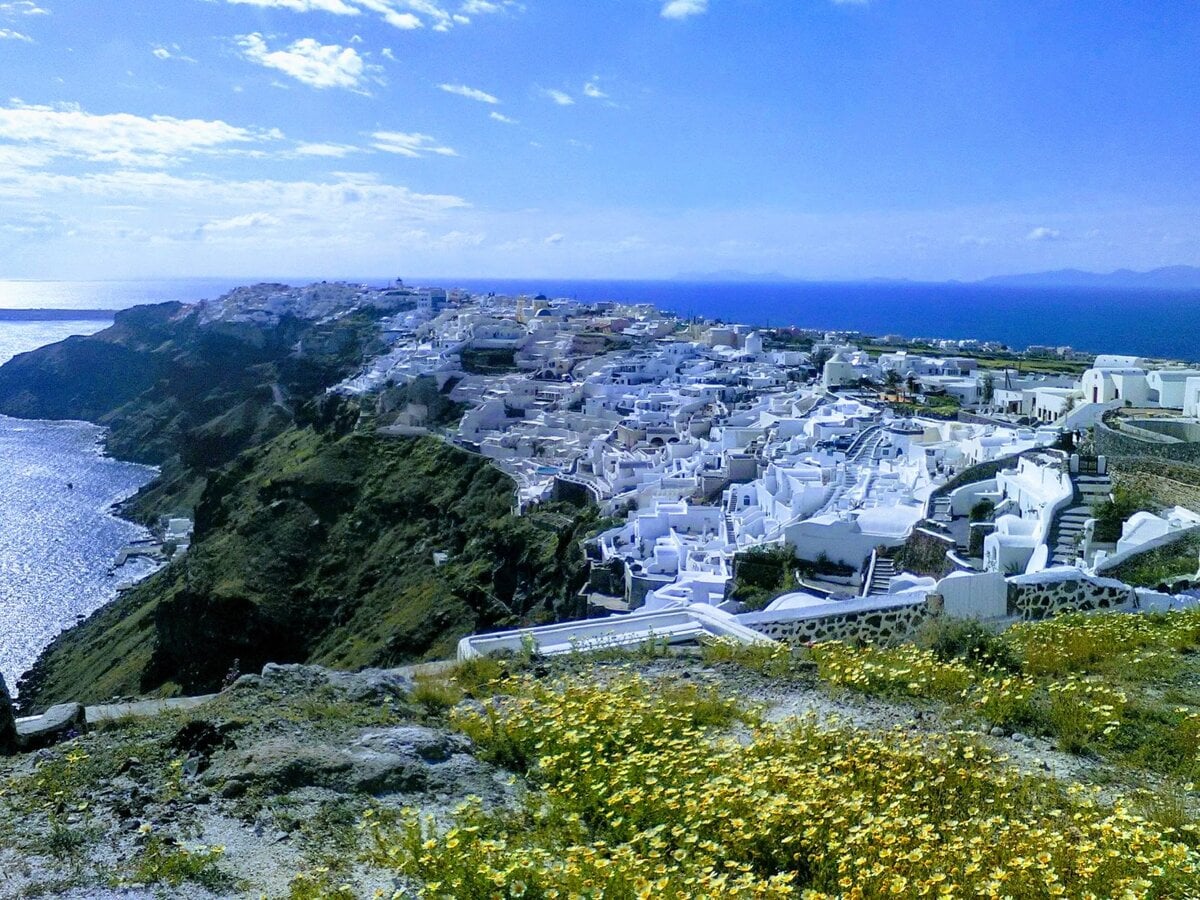
The caldera path connects Fira, Firostefani, Imerovigli, and Oia on foot, covering approximately 10 kilometers. The walk takes three to four hours at a relaxed pace and passes directly by viewpoints 2, 3, and 4 on this list. If you’re based in Fira and want to reach Oia for sunset, allow at least 2.5 hours of walking time and add 30 minutes if you plan to stop at Skaros Rock.
KTEL buses connect Fira to Oia, Pyrgos, Akrotiri, and the airport. The bus from Fira to Oia takes approximately 25 minutes and runs regularly in summer. For Profitis Ilias and the Akrotiri Lighthouse, a rental car or taxi is the practical option — the lighthouse in particular has no bus service. Note that bus schedules change frequently, so times may vary.
Practical Information
- Sunset timing: Varies through the season. In June, sunset is around 20:45–21:00 local time. In September, around 19:45. Check a local weather service the morning of your visit for the exact time and cloud forecast.
- Getting to Santorini: Santorini International Airport (JTR) has direct connections from Athens (45 minutes), and seasonal direct flights from major European cities. High-speed ferries from Athens (Piraeus) take approximately 5 hours; conventional ferries take 7–8 hours.
- Photography equipment: A standard kit lens (24–70mm equivalent) covers most golden hour compositions. A 70–200mm equivalent is useful for compressing the caldera wall layers from Imerovigli. A tripod becomes useful from blue hour onward.
Related read: How to Find and Capture the Famous Blue Domes in Santorini
Frequently Asked Questions
What time should I arrive at Oia for the sunset?
In peak season (June–August), aim to arrive at the Oia Castle viewpoint at least 90 minutes before the official sunset time. The viewing area fills steadily from two hours out, and the best positions on the upper walls go early. In shoulder season (April–May, September–October), 60 minutes is usually sufficient.
Is Oia worth it for sunset, or is it too crowded?
That depends on what you’re after. The view from Oia Castle is genuinely excellent — the caldera composition from that angle is hard to match. But on a July evening, you’ll be sharing it with many others. If crowd intensity affects your experience, Imerovigli or Firostefani offer comparable light quality with a fraction of the foot traffic.
Can I walk between the main caldera viewpoints?
Yes. The caldera footpath connects Fira, Firostefani, Imerovigli, and Oia continuously. The full route is around 10 kilometers and takes 3 to 4 hours on mostly paved and stone paths. Some sections near Skaros Rock involve steeper, rougher terrain. The path is unlit after dark, so bring a torch or use your phone’s flashlight for the return.
What’s the weather like during golden hour in spring and autumn?
April, May, September, and October are generally the most reliable months for clear golden hour light. Summer (July–August) can have stronger atmospheric haze in the afternoon that softens the colors. Spring and autumn also bring cooler temperatures — expect 18–24°C in the late afternoon — which makes standing on a viewpoint for an hour or two considerably more comfortable.
Is Profitis Ilias accessible without a car?
Not practically. There’s no regular bus service to the summit, and the road is steep. A rental car, scooter, or taxi is the realistic option. The drive from Fira takes about 15 minutes. If you’re renting a scooter, check the gradient before committing — some smaller scooters struggle with the incline in low gear.
How long should I plan for a golden hour visit at one of these viewpoints?
Allow a minimum of two hours in total: 45–60 minutes before sunset to find your position and settle, 20–30 minutes for the active golden hour window, and 20–30 minutes after sunset for blue hour. If you’re walking between viewpoints along the caldera path, add travel time accordingly.

Stacie Harris is a local resident and reporter of the Maple Grove area. Stacie reports on medicine and science for the Maple Grove Report.