The Wall Street Journal recently suggested that, while a decade ago, we thought self-driving cars had arrived, now they might really be here. First though, we have infrastructure issues to solve and also the trolley dilemma.
The Trolley Dilemma
Imagine for a moment that an out-of-control streetcar is hurtling toward five people. Sitting at the controls, the driver can do nothing and assume those five individuals will die. They can though flip a switch and instead hit a single person.
Doing nothing results in five fatalities. Acting will cause one person’s death. What to do?
MIT’s Moral Machine said it might all depend on where you live.
The Study
A group at MIT wanted to identify what people believe is ethical because self-driving vehicles will have to make decisions. Yes, most involve the everyday traffic rules we (are supposed to) observe. However, especially in emergencies, some will be about life and death. A machine will have to decide whether to strike someone who is old or young. It could have to choose between harming men or women, more or fewer people, animals or humans. An autonomous vehicle can act or do nothing.
To see the ethical driving decisions that should be made by self-driving vehicles, those MIT researchers created a survey. Called the Moral Machine, 13 scenarios were presented to millions of people in 233 countries. All had situations in which someone had to die. Their task was deciding who.
The Results
Among the participants, there was general agreement about three moral dilemmas:
- humans over animals
- save many rather than a few
- preserve the young instead of the old
However, it wasn’t quite that easy. Moving from general preferences to specific answers, researchers uncovered much more division.
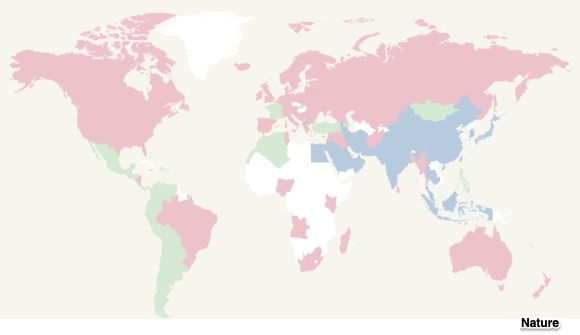
Geographically, the responses to the Moral Machine questions divided into three groups:
- The Western Cluster: Values that related to Christianity characterized the answers from North America and some of Europe.
- The Eastern Cluster: People with a Confucian or Islamic heritage from places that included Japan, Indonesia, and Pakistan tended to have similar opinions.
- The Southern Cluster: The third group, not explicitly tied to specific religious roots, was from Central and South America, France, and former French colonies.
Nature Magazine illustrated the differences through a moral compass: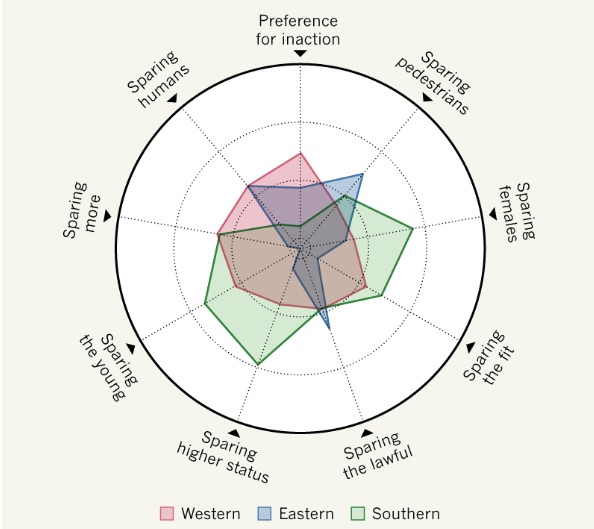
In addition to geography and religion, ethics varied by gender, age, education, income, and politics. Institutions mattered. In more affluent countries like Finland and Japan where norms were established, they even condemned illegal jaywalkers. As for age, respondents in the Southern Cluster tended to spare the young rather than the aged.
Our Bottom Line: Infrastructure
In addition to a trolley problem with no answer (or many answers), we have an infrastructure challenge.
An infrastructure is a network of connections. If it’s transport, then those connections include roads and bridges, airports, and gasoline stations. During the 19th century, a financial infrastructure emerged through a network of banks that connected savers and borrowers. Through our financial infrastructure, money traveled around the economy. Now, we can add an information infrastructure that began with Benjamin Franklin and the 18th century postal service. Today it continues with our online iconnections.
Somewhat similarly, autonomous vehicles require an infrastructure. Ranging from a nationwide network of charging stations to new forms of insurance, the infrastructure is regulatory, physical, financial, and philosophical.
It might also mean we have to select among cars that have a Western, an Eastern, or a Southern personality.
My sources and more: Having looked at ethical AVs in the past, today, I looked back at our sources and found some new ones. My foundation though was this Nature article. From there, I also returned to The New Yorker. But then, more recently, S&P Global and WSJ, here and here, updated us.
Please note that almost all of today’s post, at different times, with different formats, and with some variety, was published previously.

Nicole Byers is an entertainment enthusiast! Nicole is an entertainment journalist for the Maple Grove Report.