
Ranging from hospital care to weight loss drugs, the United States is spending more on healthcare than any other country.
Hospital Healthcare Spending
Market Concentration
Whether looking at inpatient total knee replacements, childbirth C-sections, or appendectomys, the U.S. is more expensive than its peers.
According to the American College of Rheumatology, at 790,000, the yearly number of total knee replacements in the U.S. is rising because of our aging population. Compared to peer nations, the median cost of the inpatient knee procedure in the U.S. is $29,000 while a dataset of 8 peer nations indicates the equivalent elsewhere is $11,000.
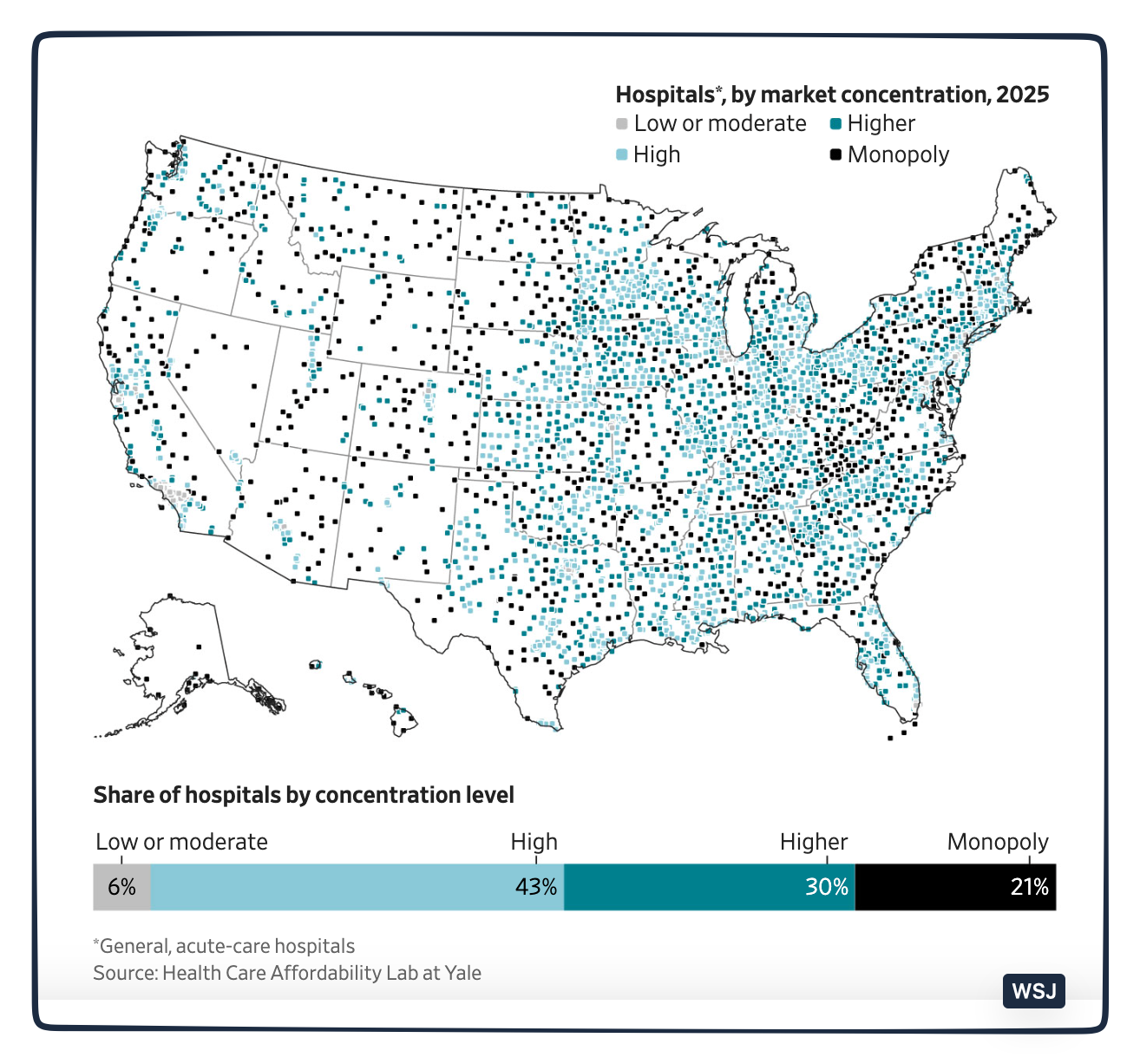
One reason is market concentration. Because of consolidation, the trend is toward one big hospital system dominating a region. Through their size, these hospital systems have been able to negitiate higher rates from insurance companies:
Geography
So yes, the median price of typical surgeries exceeds our peers. However, a closer look reveals considerable price differences.
In a 2026 paper, Brown University researchers discussed the locational price variations. While their map illustrated the geographical differences for diagnostic colonoscopies, they said it reflected many more procedures:

The Brown University paper also points out that price even varies among nearby hospitals.
Price Shopping
Finally, we can ask if we knew the price of a hip replacement, or a blood test, would we would choose the cheapest?
Not necessarily.
Completely different from shopping for the cheapest sweater, surgeries involve unfamiliar information. For a back MRI, someone might not have known if it was supposed to be lumbar or thoracic. They might not know the technical name the provider is using (which could differ from one provider to the next.) They needed to know if they were looking for the facility costs, the physician, the radiologist, and the post-op care–the bundle–or several or one part of a procedure. Those who were insured had to calculate what might be out-of-pocket. In addition, we have little reason to compare prices if we have insurance. And finally, many of us value our relationships with our doctors. Not only do we do what they suggest but also, medical centers like us to coordinate care under one roof.
All of this takes us healthcare’s transaction costs.
Our Bottom Line: Transaction Costs
More than money, a transaction cost is the hassle we experience when trying to accomplish a task. Just like in physics, a transaction cost creates the friction that slows down movement. It could involve telephone wait time or the documents we have to complete. Indeed, whether dealing with a hospital or an insurance provider, information and incentive barriers create the friction. Especially when dealing with illness, they constrain the behaviors that generate more efficiency.
My sources and more: Thanks to WSJ for inspiring today’s post. From there, the American College of Rheumatology had the statistics. Then, this past econlife post and this JAMA paper had the analysis.
Please note that several of today’s sentences were in a previous econlife post.

Nicole Byers is an entertainment enthusiast! Nicole is an entertainment journalist for the Maple Grove Report.