“The Jungle,” a play about a refugee settlement during the 2015 European migrant crisis, soars in a new production by Mixed Blood Theatre. Artistic Director Mark Valdez masterfully directs an incredible cast of seasoned and emerging actors. The production is well-crafted, and perhaps too beautiful. British playwrights Joe Robertson and Joe Murphy mine trauma for poetics, and don’t fully escape the colonial gaze at the project’s foundation.
Robertson and Murphy spent seven months at a refugee encampment in Calais, France, and started a theater company there, called the Good Chance Dome, which they ran for seven months. After returning to England, they developed their play, “The Jungle,” based on their experiences in Calais. In a series of workshops back in England, they collaborated with immigrant and refugee actors – including people they met in Calais – as well as British-born actors. The show premiered at the Young Vic, in London, in 2017. Mixed Blood’s production of the play runs through May 3.
Migrants and volunteers built the Calais encampment during a time when over a million people were migrating into Europe. Most were fleeing the Syrian civil war, but conflict and crisis displaced others from Afghanistan, Pakistan, Iraq, Nigeria, Eritrea and other places. The camp became a staging ground near the Port of Calais and the Channel Tunnel for people planning to stow away to the UK.
Related: Iranian artists in Minnesota respond to war
Scottish food and travel writer A.A. Gill made the trip to Calais. In an essay for The Sunday Times, he said people would roll their eyes when he told them about the theater troupe at the encampment. “What a monument to bleeding-heart liberal pretension, a theatre in a refugee camp, I was told,” Gill wrote.
Gill’s own view toward the theater troupe is less dismissive, but there is a danger when writers and artists engage in atrocity tourism. Chinese artist Ai Weiwei received criticism for using life jackets for giant art installations (including one at the Minneapolis Institute of Art, which presented the life jackets on its exterior wall – see local criticism here). Iranian critic Hamid Dabashi described a related work by Weiwei work as suffering “turned to art.” I wonder about that question in regard to Robertson’s and Murphy’s play.
Gill’s essay describes some of the makeshift restaurants built in the camp, and particularly notes a Pakistani restaurant owner named Mohammed Ali, whose red bean curry, reheated fried chicken and stew of chicken livers earns Gill’s exuberant praise.
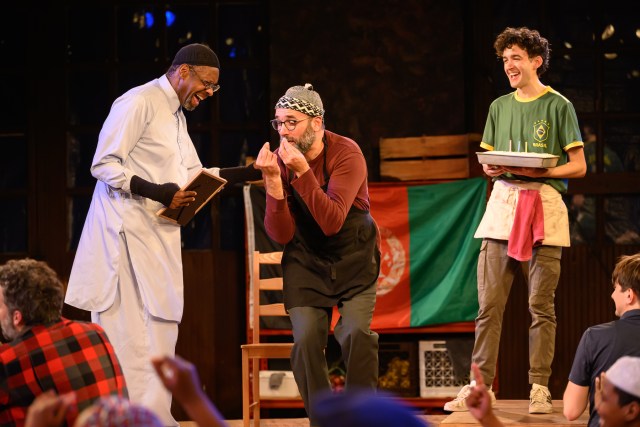
A similarly glowing restaurant review emerges as a plot point in “The Jungle,” when Salar, a character from Afghanistan played by Mohamed Yabdri, learns his restaurant has received a glowing review in the newspaper.
Yabdri gives a magnetic performance, channeling righteous anger, distrust, and kindness in equal measure. His rivalry with Mohammed, a leader in the Sudanese community (played by a wonderful Bruce A. Young), evolves into mutual respect over the course of the show.
Valdez adeptly orchestrates the play’s staging. During transitions between scenes, actors move set pieces seamlessly and create movement almost approaching dance. There’s great use of two carriage doors facing 4th Avenue (Mixed Blood used to be a fire station). The doors burst open at key moments, revealing Minneapolis’ own Cedar-Riverside neighborhood through the doorway.

The doors don’t stay open for long, and the night I attended, there wasn’t necessarily bustling activity happening on the street outside. And yet, opening those doors connects the production to Cedar-Riverside’s rich immigrant neighborhood, where many residents are refugees. In the wake of Operation Metro Surge, which particularly targeted immigrant communities, Valdez’ directorial gesture proves impactful.
Actors from Los Angeles and New York elevate the cast. The fresh-faced Ahmad Maher, who plays Salar’s restaurant helper and friend Norullah, chills with his intensity, while Eric Staves, as the leftist volunteer Derek, keeps the energy high.
Meanwhile, newcomer Abdoul Manaf-Kondo, as the teen refugee Okot, takes on the most challenging material for his Mixed Blood debut. With a flat, almost emotionless delivery, Manaf-Kondo tells of the most horrendous experiences imaginable. Okot recalls torture, violence, and horror as he makes his case for asylum to an empathetic volunteer.
The poetic language voiced by Safi (Tony Larkin) counterbalances the gruesome details of Okot’s testimony. Safi acts as a narrator throughout the play, and reflects on the camp with elevated, pithy statements. He quotes Queen Mary I at one point (“When I am dead and opened, you shall find Calais lying in my heart”) and drops philosophical lines like, “when does a place become a place?” Larkin performs with empathy, yet the playwrights try too hard to provide a neat takeaway for the audience through Safi’s monologues.
Related: The Jungle Theater’s ‘The Effect’ tackles issues of love, mental illness and medication
There are moments where Robertson and Murphy show an awareness of their own privilege through their characters. One of the more unflattering Brits portrayed in the show is Sam, played by Alex Mitchell. He’s an Eton graduate who creates the design where the new shipping containers will be placed, but unwittingly becomes a part of the encampment’s demise. The script pokes fun at Sam, but overall gives him a sympathetic portrayal.
Even with a few negative portrayals of the non-refugee characters, the playwrights don’t quite go far enough in their critique of the imperialist forces that led up to the Calais crisis. The play asks the audience to feel deeply for the refugees while leaving the structural power of the Western “savior” largely intact.
Still, the issues raised by the play resonate not only with ongoing issues of displacement – particularly with the U.S. dismantling of its own foreign aid – but also at a local level.
As I watched the play, I was keenly aware of how the city continues a policy of evicting local homeless encampments despite a chronic shortage of shelter beds. Beyond arguments about the efficacy (or not) of temporary encampments, the play uses art to emphasize the humanity of every human life, particularly those forced from their homes.
I’m left with a question: when is it OK to create beauty from the trauma of others? “The Jungle” shapes the experiences of refugees into stunning theater. Its extractive methodology leaves the playwrights’ own privilege unexamined, a tension they never quite resolve.
Performances every night this week at 7:30 p.m. at Mixed Blood Theatre, 1501 South Fourth Street Minneapolis. ($0-$50).
Related