
Sony’s AI Robot Took On Human Table Tennis Pros – Here’s Who Came Out On Top


To reach an elite level in any sport, athletes need to combine split-second reaction times with a deep knowledge of playing techniques and a high level of physical agility. Take, for example, table tennis, where if a player loses track of the ball for even the smallest amount of time or misjudges its trajectory, they’ll lose the point. Table tennis has been used as a way to test the capability of robots for a while now, but in a new study published in the journal Nature, Sony has detailed how it built what it calls the first robotic system that can compete with elite-level table tennis players.

In the study, Sony pitted Ace, its table tennis-playing robot, against five elite-level athletes and two professional athletes. It defined elite athletes as those with more than a decade of playing experience who participated in regional or national table tennis championships in Japan. A step above those players were the professional athletes, who both compete in the Japanese professional table tennis league. In the initial study, the robot managed to win seven out of 13 games it played against elite-level athletes, but it only won one out of seven games against the professionals.

The robot didn’t need special treatment

Previous studies involving robot table tennis players have seen the rules of the game tweaked to suit the capabilities of the robot, but Sony’s Ace robot played according to standard Japanese competitive table tennis rules. The tournament even featured a pair of professional umpires to officiate each match.

Although it proved to be competitive, researchers found that there were a few key differences between the playing styles of a human competitor and the playing style of the AI bot. Humans scored points against the robot mostly by playing a similar type of shot — high-speed shots with top spin — while the robot scored points using multiple different techniques. Winning shots played by humans also tended to be stronger than their average shot, while the robot’s winning shots weren’t much different from its average ones.

Despite it potentially being a great way for human players to improve their game, Sony’s Ace robot isn’t going to be available to buy on Amazon anytime soon. It has been primarily created as a test bed for AI development, and its makers continue to improve it.

Sony has continued to improve its Ace robot

Studies published in academic journals often take months to come out thanks to the strict pre-publication review requirements. Although this article was published in April 2026, the initial tests took place a full year earlier. In the intervening months, Sony says that it has refined its robot, making it even more competitive. It pitted Ace against four new players, two being elite-level and two being professionals, in December 2025. In that tournament, the robot managed to win against three out of four players, losing only to one professional opponent.

Winning table tennis matches might be impressive, but on its own, a table tennis-playing robot is of limited use in the real world. However, Peter Stone, chief scientist at Sony AI, says that the “breakthrough is much bigger than table tennis,” because it represents “the first time […] an AI system can perceive, reason, and act effectively in complex, rapidly changing real-world environments that demand precision and speed.” That could help researchers develop more effective AI-powered robots far outside the world of sports.

Sony’s Ace robot was limited in mobility to the confines of a table tennis court, but other robotics companies have been making waves in other, less confined sporting disciplines. Earlier in 2026, a humanoid robot completed the Beijing half-marathon, beating the human record time in the process. Not every new AI debut has been so successful, though, with a Russian AI robot recently taking a dive moments after its stage debut.


Source link

Leave a Reply

Subscribe to Our Newsletter

Get our latest articles delivered straight to your inbox. No spam, we promise.

Recent Reviews


The Windows Insider Program is about to get much easier

Ed Bott / Elyse Betters Picaro / ZDNET

Follow ZDNET: Add us as a preferred source on Google.


ZDNET’s key takeaways

  • Microsoft is making the Insider Program less complicated.
  • Beta channel will be a more reliable preview of the next retail release.
  • Other changes will allow testers to quickly enable/disable new features.

Last month, Microsoft took official notice of its customers’ many complaints about Windows 11. Pavan Davaluri, the executive vice president who runs the Windows and Devices group, promised sweeping changes to Windows 11. Today, the company announced the first of those changes in a post authored by Alec Oot, who’s been the principal group product manager for the Windows Insider Program since January 2024.

Those changes will streamline the Insider program, which has lost sight of its original goals in the past few years. (For a brief history of the program and what had gone wrong, see my post from last November: “The Windows Insider Program is a confusing mess.”)

Also: If Microsoft really wants to fix Windows 11, it should do these four things ASAP

If you’re currently participating in the Windows Insider Program, these are meaningful changes. Here’s what you can expect.

Simplifying the Insider channel lineup

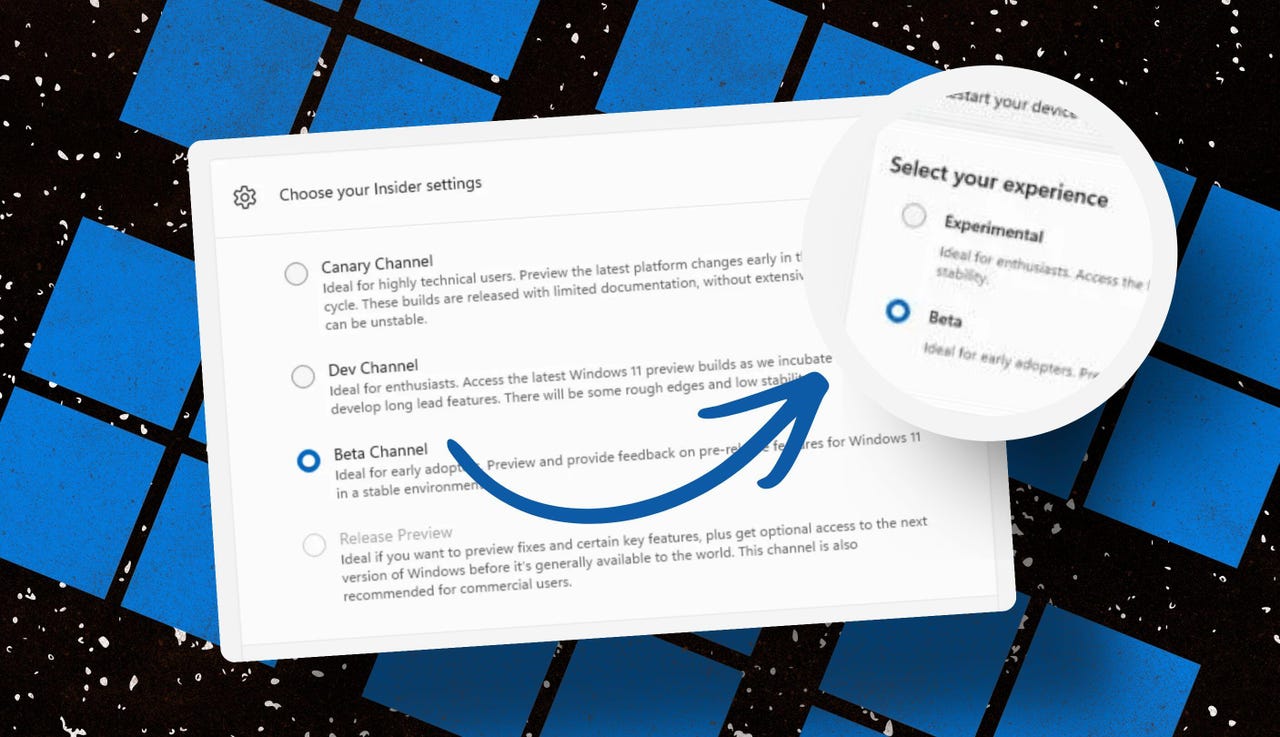
Throughout the Windows 11 era, signing up for the Insider program has required choosing one of four channels using a dialog in Windows Settings. Here’s what those options look like today on one of my test PCs.

insider-program-channels-lineup-old

The current Insider channel lineup is confusing, to say the least.

Screenshot by Ed Bott/ZDNET

Which channel should you choose? As the company admitted in today’s post, “the channel structure became confusing. It was not clear what channel to pick based on what you wanted to get out of the program.”

The new lineup consists of two primary channels: Experimental and Beta. The Release Preview channel will still be available, primarily for the benefit of corporate customers who want early access to production builds a few days before their official release. That option will be available under the Advanced Options section.

windows-insider-channel-lineup-new

This simplified lineup is easier to follow. Beta is the upcoming retail release, Experimental is for the adventurous.

Screenshot courtesy of Microsoft

Here’s Microsoft’s official description of what’s in each channel now, with the company’s emphasis retained:

  • Experimental replaces what were previously the Dev and Canary channels. The name is deliberate: you’re getting early access to features under active development, with the understanding that what you see may change, get delayed, or not ship at all. We’ve heard your feedback that you want to access and contribute to features early in development and this is the channel to do that.
  • Beta is a refresh of the previous Beta Channel and previews what we plan to ship in the coming weeks. The big change: we’re ending gradual feature rollouts in Beta. When we announce a feature in a Beta update and you take that update, you will have that feature. You may occasionally see small differences within a feature as we test variations, but the feature itself will always be on your device.

These changes will apply to the Windows Insider Program for Business as well.

Offering a choice of platforms

For those testers who want to tinker with the bleeding edge of Windows development, a few additional options will be available in the Experimental channel. These advanced options will allow you to choose from a platform that’s aligned to a currently supported retail build. Currently, that’s Windows 11 version 25H2 or 26H1, with the latter being exclusively for new hardware arriving soon with Snapdragon X2 Arm chips.

Also: Microsoft account vs. local account: How to choose

There will also be a Future Platforms option, which represents a preview build that is not aligned to a retail version of Windows. According to today’s announcement, this option is “aimed at users who are looking to be at the forefront of platform development. Insiders looking for the earliest access to features should remain on a version aligned to a retail build.”

windows-insider-advanced-options-new

The Future Platforms option is the equivalent of the current Canary channel

Screenshot courtesy of Microsoft

Minimizing the chaos of Controlled Feature Rollout

Last month, I urged Microsoft to stop using its Controlled Feature Rollout technology, especially for builds in the Beta channel. Apparently, someone in Redmond was listening.

One of the most common questions we receive from Insiders is “why don’t I have access to a feature that’s been announced in a WIP blog?” This is usually due to a technology called Controlled Feature Rollout (CFR), a gradual process of rolling out new features to ensure quality before releasing to wider audiences. These gradual rollouts are an industry standard that help us measure impact before releasing more broadly. But they also make your experience unpredictable and often mean you don’t get the new features that motivated many of you to join the Insider program to begin with.

Moving forward, Insider builds in the Beta channel will no longer suffer from this gradual rollout of features. Meanwhile, the company says, “Insiders in the Experimental channel will have a new ability to enable or disable specific features via the new Feature Flags page on the Windows Insider Program settings page.”

windows-insider-feature-flags

Builds in the Experimental channel will include the option to turn new features on or off.

Screenshot courtesy of Microsoft

Not every feature will be available from this list, but the intent is to add those flags for “visible new features” that are announced as part of a new Insider build.

Making it easier to change channels

The final change announced today is one I didn’t see coming. Historically, leaving the Windows Insider Program or downgrading a channel (from Dev to Beta, for example) has required a full wipe and reinstall. That’s a major hurdle and a big impediment to anyone who doesn’t have the time or technical skills to do that sort of migration.

Also: Why Microsoft is forcing Windows 11 25H2 update on all eligible PCs

Beginning with the new channel lineup, it should be easier to change channels or leave the program without jumping through a bunch of hoops.

To make this a more streamlined and consistent experience, we’re making some behind the scenes changes to enable Insider builds to use an in-place upgrade (IPU) to hop between versions. This will allow in most cases Insiders to move between Experimental, Beta, and Release Preview on the same Windows core version, or leave the program without a clean install. An IPU takes a bit more time than your normal update but migrates your apps, settings, and data in-place.

If you’ve chosen one of the future platforms from the Experimental channel, those options don’t apply. To move back to a supported retail platform, you’ll need to do a clean install.

Also: Apple, Google, and Microsoft join Anthropic’s Project Glasswing to defend world’s most critical software

The upshot of all these changes should make things a lot clearer for anyone trying to figure out what’s coming in the next big feature update. Beta channel updates, for example, should offer a more accurate preview of what’s coming in the next big feature update, so over the next month or two we should get a better picture of what’s coming in the 26H2 release, due in October.

When can we start to see those changes rolling out to the general public? Stay tuned.


Source link