Soups are go-to purchases when we want a budget meal. As a result, when Campbell’s raised its prices, they sold less of their Chunky and Home Style soups.
The problem was the can.
Tin Can Demand
Because they are made of thinly rolled steel that is coated with tin, many of our cans need steel. Consequently, can prices rose because of steel tariffs. As high as 50% they pushed up the prices of canned fruits, vegetables, and, as Campbell’s told us, of soups.
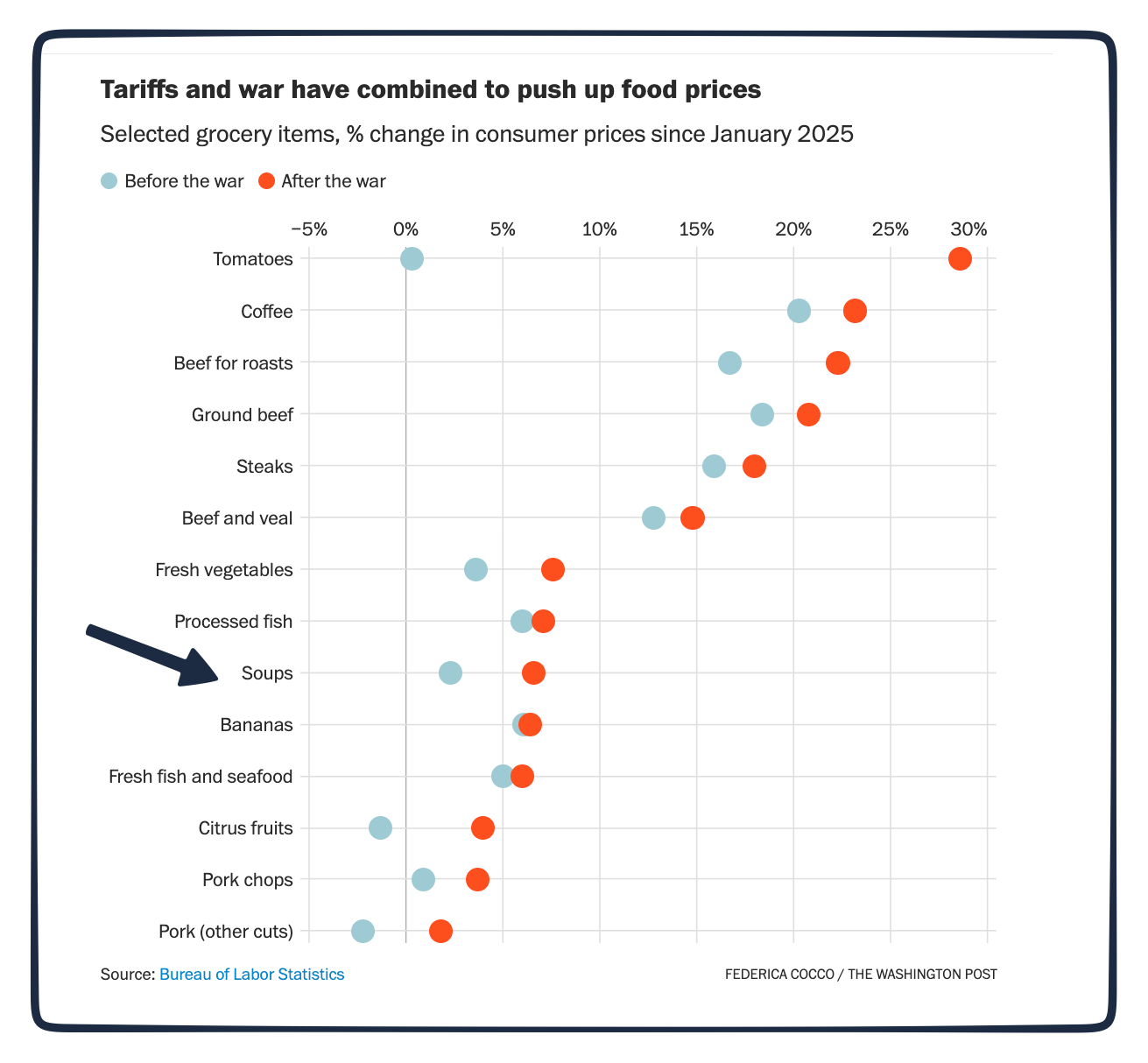
At one-third the wholesale price of a can of Campbell’s Chunky Soup, the can helped nudge soup prices skyward by 7%:
American can makers import two-thirds of their tin plate. A U.S. tin plate maker explained to the NY Times that he was not entirely absorbing the 50% tariff. But, although his suppliers helped out with discounts, on the demand side he had to add a single-digit percentage point.
And that returns us to Campbell’s. Having paid more for cans, after raising some prices, they saw meal volume drop by 3% (Axios) in the quarter ended November 2.
Our Bottom Line: Complementary Goods
But there is much more to a can of soup than a tariff.
Cans and Can Openers
During the early 1800s, the opening instructions on the first cans read, “Cut round the top near the outer edge with a chisel and hammer.” As thick as 3/16th of an inch, they were heavy and tough to open. However, it took until 1858 for Ezra T. Warner to invent the first can opener. Similar to a sickle blade, the army used it but consumers thought it was too dangerous. The big breakthroughs (pun) came during the 1920s with rotary openers that gripped the can.
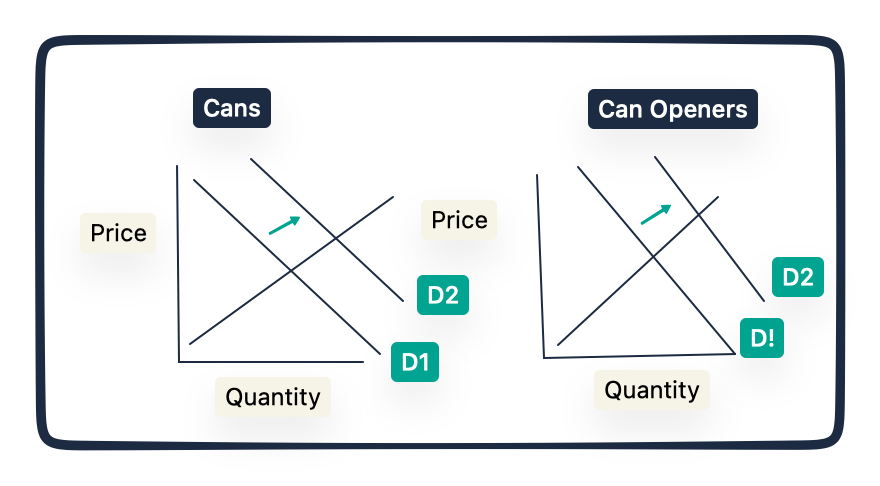
An economist would call the can and its opener complementary products. As a demand determinant, the change in the can shifts the opener’s demand curve (as long as the can does not have a pop-up lid).
Below, increasing price and the quantity supplied, the canned food demand curve first shifts to the right. Moving to our can opener graph, we then see that a change in can demand affects its can opener complement. For armies that depend on canned food, I assume it’s many openers. For us, it might just be one:
Most simply, with complements, more of one creates demand for at least one of the other:
The Butterfly Effect
A sequence of demand determinants can take us to the Butterfly Effect.
The basic idea from chaos theory–called the Butterfly Effect–is that a small event can wind up having a large far-off impact.
Or, as James Gleick said in Chaos,

So yes, we can have a President that tariffs steel. Affecting tin plate and cans and Campbell’s, the result is a family that cannot afford its Chunky Soup.
My sources and more: An especially good summary, this NY Times article was where we began. Related, the tin can and can opener were our next focus and then soup prices, here and here. And finally, for another can story, econlife looked at India’s Diet Coke shortage.

Nicole Byers is an entertainment enthusiast! Nicole is an entertainment journalist for the Maple Grove Report.