Does Porting An Intake Manifold Affect Engine Performance?


We may receive a commission on purchases made from links.

Automakers strive to produce the highest-performing engines that meet their budget goals. That often means the performance gains from porting and polishing intake (and exhaust) ports aren’t cost-effective in a volume business like producing automobiles. For reference, there’s a factory in China that builds a car every 60 seconds.

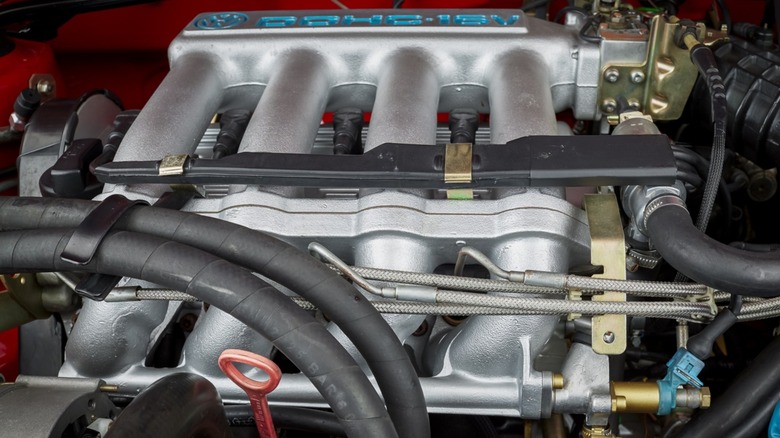
Porting and associated polishing of an intake manifold can increase airflow into the engine by removing or smoothing ridges, bumps, or excess material left behind during the casting process. Ultimately, more air flow through the intake manifold can increase the car’s horsepower. An internal combustion engine is essentially an air pump at its core. It pulls air (and fuel) in during the intake stroke and pumps air (and spent fuel) out during the exhaust stroke. Sandwiched between those strokes in the typical four-stroke engine are the compression and power strokes, the latter of which provides the energy to drive the others.

With just a few simple tools, time, and patience, you can enjoy the benefits of a higher-flowing intake manifold by porting and polishing it in your home garage. It’s a DIY-friendly project that should still leave some time to enjoy a portion of your weekend basking in the afterglow of a successful project.

DIY porting your intake manifold
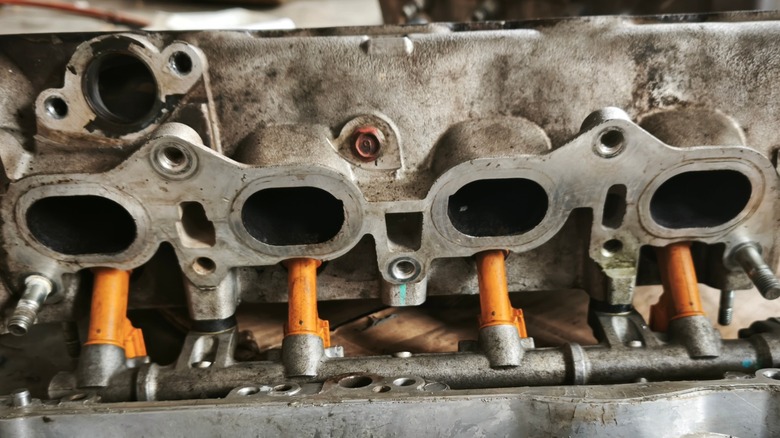
The first, and likely most daunting, part of porting your intake manifold is removing it from the car (unless you’re porting a new intake in preparation for a swap). Either way, once you have your intake manifold on your workbench, you’ll need to make a plan of attack.

To accomplish your porting job, you’ll need a type of power grinder known as a die grinder. It can be electric, battery-powered, or pneumatic. If you have a Dremel-type tool, that’ll work in a pinch. You’ll also need a selection of grinding burrs and sanding attachments for your die grinder.

A good method for determining areas that require porting is to coat the intake manifold’s gasket mounting surface with a layout marking fluid, such as Dykem Steel Blue. Allow a few minutes for it to dry, lay the gasket in place using a few bolts as pins, and scribe around the inner gasket openings. Use the scribed line as a guide to open the intake ports and remove or smooth any internal port steps, bumps, and ridges, while avoiding grinding into water passages, neighboring ports, or the exterior of the intake manifold. When finished grinding, you can smooth out the rough casting marks, but avoid polishing the intake ports to a mirror finish.

While porting your intake manifold gives the engine more potential intake air, the exhaust side, starting with the cylinder head exhaust ports, has to keep up. You’ll have to decide how far you’re willing to go chasing performance gains. Will you go all-in with match-ported exhaust manifolds or headers, or with a free-flowing exhaust system? Or will you enjoy the slight bump in power from a simple intake manifold port and polish?


Source link

Leave a Reply

Subscribe to Our Newsletter

Get our latest articles delivered straight to your inbox. No spam, we promise.

Recent Reviews


Researchers in South Korea developed a wearable system that uses seven smart rings to read finger and hand motions to translate American Sign Language and International Sign Language into text. The purpose is to make communicating easier between those who sign and nonsigners without needing a separate human interpreter. 

AI Atlas

According to the study, published Friday in the journal Science Advances, the system reliably recognized 100 ASL and ISL words during testing. It also performed well with users the system had not seen before, and it didn’t require recalibration for each person. Because the system detects words in sequence, it can produce sentence-level translations without extra training on grammar. 

ASL and ISL are the everyday languages of more than 72 million deaf and hard-of-hearing people. However, most hearing people do not know any words in these languages or have a very basic understanding. That gap makes certain tasks, like ordering at a restaurant or asking for help, much more difficult. 

A graphic shows two illustrated people talking in sign language, ASL and ISL. The graphic also shows the different components of the ring as well as pictures of hands modeling the rings.

A concept of how the rings work in the real world. 

American Association for the Advancement of Science (AAAS)

Existing sign language translator prototypes often rely on bulky gloves that can distract from or block natural hand movement or feel uncomfortable for the wearer, which limits real word adaption. Camera-based technologies can work well in controlled environments but are often limited to those places where a camera can be set up with a clear line of sight, the researchers wrote. 

To solve these problems, the researchers designed sensing rings for each finger that can capture precise motion and finger position while letting the hands move naturally. The rings can detect both signs that involve movement, like the words for “dance,” “fly” and “sun,” and signs that are held still, like “I” and “you.”

“These advances suggest that [the device could enable] barrier-free public translation systems for unseen users and unrestricted daily assistive interfaces,” the authors wrote in the study. 

The authors are affiliated with Yonsei University, Hankuk University of Foreign Studies and the Korea Institute of Science and Technology, among others. While the technology is still experimental, the authors wrote that the technology has the potential to ease communication difficulties. The underlying idea could also help improve controls for other systems, like virtual or augmented reality.

“Beyond sign language translation, the ring-type, wireless, and modular architecture of (wirelessly connected, ring-type sign language translators) may also be extended to other gesture-driven applications such as virtual or augmented reality control, touchless device interfaces, or rehabilitation monitoring systems where fine-grained hand movement tracking is essential,” they wrote.


Source link