Anker Soundcore Nebula P1i Projector Review: Huge Ears, Bright Image, Affordable Price


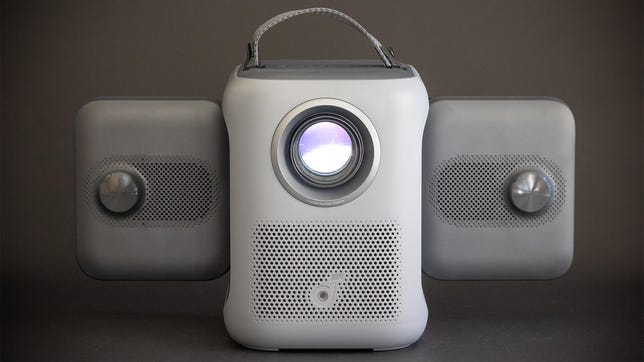
The gray Anker Nebula P1i Portable Projector has unique speakers that stick out from the side of the device.

Pros

  • Clever rotating “ears”
  • Decently bright
  • Google TV streaming

Cons

  • Budget lens limits placement options
  • A bit noisy at full brightness

The Soundcore Nebula P1i has speakers that fold out and rotate. They look a lot like little elephant ears. They’re also gray. So if you add a trunk and a second eyeball — and you squint a lot — then it’s sort of a mini robot elephant. It’s actually a projector, of course, and a budget one at that.

What’s most impressive beyond the adorable and functional “ears” is the fact that the P1i performs far better than you’d expect for a projector that includes Google TV and costs less than $400. It has a simplistic lens that requires it to be positioned at roughly midpoint of the image it is projecting (no upward throw), but as long as you don’t mind that, a trapezoidal image or a bit of keystone correction, this is a great budget projector.

 Specs and such

  • Resolution: 1080p 
  • Lumens spec: 380 (ANSI)
  • Zoom: No
  • Lens shift: No
  • Light source type: LED

To avoid confusion, a quick explanation about naming. Parent company Anker seems to hate the name Anker and has numerous subbrands, but also, they drop and combine subbrands regularly. So the Nebula subbrand has been absorbed into Soundcore, the subbrand famous for quite decent Bluetooth headphones and speakers. It’s an odd pairing in my mind, but what do I know? So you can alternately call this the Anker Soundcore Nebula P1i or the Soundcore Nebula P1i by Anker. That’s a mouthful. Also, apparently the “S” is lowercase in their branding, but no, sorry, that’s a bridge too far.

The P1i has 1080p resolution, quite a step up from the 720p that was common in budget projectors not too long ago. Unless you’re sitting exceptionally close to a normal-sized image or trying to project an abnormally huge image, this resolution is more than enough — you’re not going to see pixels.

The Soundcore Nebula P1i on a black background with its speakers folded.

Geoffrey Morrison/CNET

Soundcore claims a light output of 380 ANSI lumens. I measured 382 in its most accurate mode. That is, I think, the closest a company’s claims have ever been to my real-world measurements. Usually they’re more… let’s say “optimistic.” Even more impressive is the P1i is actually capable of even more. In the least accurate Conference mode, it’s capable of 603 lumens. That’s quite good for an inexpensive projector, brighter than many portables and not far off something like the Epson Flex Plus, which I measured as 655 in its most accurate mode, though a far brighter 817 in its brightest.

The biggest issue with the P1i is the lens, in that it’s a simple design similar to other budget projectors like the TCL A1 and Vimgo P10. While there are benefits, not least reduced cost, the drawback is no upward throw. The vast majority of projectors create an image that’s slightly above its lens. This allows for coffee-table placement or mounting on a ceiling, and the projected image appears somewhere near the middle of the wall. 

The P1i, instead, projects its image straight out the front. The middle of the lens is basically the middle of the image. It’s rare that anyone would mount a projector around four feet in the air to project on the middle of a wall, so if you place it on a low-slung table this gives you two choices: The easiest is just dealing with a trapezoidal image, but almost as easy is using the P1i’s built-in keystone correction. This isn’t ideal because it’s only using a portion of the imaging chip, so you’re losing resolution and brightness as well as potentially adding some artifacts. For a $370 projector, this isn’t a huge deal, but it’s worth keeping in mind.

Connections

  • HDMI inputs: 1
  • USB port: 1 USB-A
  • Audio output: 3.5mm headphone, Bluetooth
  • Internet: Wi-Fi
  • Streaming interface: Google TV
  • Remote: Backlit

The main attraction of the P1i is the adjustable speakers. For a projector that’s clearly intended for use in impromptu spaces, this seems like a great idea. People might be gathered around in front, beside, behind or all of these. Many small projectors only have speakers facing one direction, maybe two, and if they’re not facing you, the sound is often quieter or more muffled. The P1i’s speakers can rotate out 90 degrees so they’re facing backward, and then they can rotate so they face forward or up. They’re independent, so one can face one direction and the other in a different direction. It’s a clever idea that I imagine a lot of people will use. 

The back of the Soundcore Nebula P1i on a black background with the speakers facing different directions.

Geoffrey Morrison/CNET

Each speaker has 10 watts of power at its disposal, so they can play fairly loud. However, the sound is rather thin, without much bass even graded on the curve of small drivers in a small box. While the audience is more likely to hear what’s going on with the P1i compared to some portable speakers, they’re not going to be overwhelmed with the sound quality. Fair, perhaps, given the price, but as you’ll read in the next section, the price isn’t a totally valid excuse.

The streaming interface is Google TV, like nearly all modern projectors. It’s slick enough in daily use and gives you access to all the major streaming services and countless minor ones, too. If you want to connect a gaming console or your own streaming stick, like Roku or Amazon, there’s an HDMI input on the back. Curiously, the 3.5mm audio output is labeled AUX, implying a line-level input, but it’s a headphone output.

Picture quality comparisons

TCL A1

The most logical competitor to the P1i I’ve reviewed recently is TCL’s A1. This is also a budget projector with built-in streaming. It also has a simple lens, so no upward throw. Pricing at launch was a lot more expensive, $500 to the P1i’s $370, but currently the A1 is cheaper just about everywhere. I compared them both side by side on a 1.0-gain screen.

The Soundcore Nebula P1i sitting on its speakers which are facing up and back.

Geoffrey Morrison/CNET

Physically, the P1i is larger, roughly twice the overall volume of the A1. Its gray-on-gray exterior uses cheaper-looking plastic with none of the A1’s classy design. While the A1’s has a handle, which can double as a stand, it’s the P1i’s rotating ears which steals the show. Being able to direct sound directly at the audience is an absolute boon for a low-power sound system. That’s not to say the P1i sounds better, exactly. The A1 has a fuller sound with better bass. The P1i has a little clearer treble. So I’d say the A1 has a slight edge in sound quality, but the P1i is far more versatile and will be better heard by more people sitting around the projector.

In their regular modes, both the Anker and the TCL have similar brightness. I measured 382 and 433 lumens respectively. That’s not enough of a difference to notice. However, you can get more light from the Anker using the less accurate Standard mode, which is only slightly cooler/bluer than the Movie mode. This results in a roughly 45% increase in brightness, which is noticeable, and likely the mode most people will use. However, there’s also a lot more fan noise compared to the dimmer mode or the TCL A1. A low noise mode reduces the fans but also the brightness, and this is back down to roughly the same brightness as the A1. 

In terms of contrast ratio, the A1 is definitely better, with an as-measured 2,522:1 to the P1i’s still-decent 826:1. So the darkest parts of the A1’s image look less gray, but given the greater light output of the P1i, this is less of a factor than if they had the same brightness. Contrast ratio is great, and generally the most important aspect of a display’s performance, but the additional light output is more practical since you can create a bigger image that’s still watchable. 

A side view of the Soundcore Nebula P1i with its remote on a black background.

Geoffrey Morrison/CNET

Color is probably the biggest difference between the two. The P1i’s color is more saturated and more accurate than the more washed-out colors of the A1. Grass is greener; reds are richer and deeper. After the overall brightness, the color difference is what’s most noticeable. The A1 is fine for the price, but in terms of color, the P1i looks like a more expensive projector.

The TCL A1 wins on aesthetics and, slightly, sound quality. The P1i, however, creates a better image than its price implies and the rotating speakers are likely far more useful in a wider variety of situations. There are two other options that aren’t direct competitors but are worth considering. Both Anker’s own Mars 3 Air and TCL’s PlayCube are roughly twice the price of the P1, but both are smaller and have built-in batteries. If portability is your main goal, those are worth checking out.

It’s all in the ears

The Soundcore Nebula P1i on a black background with its speakers extended.

Geoffrey Morrison/CNET

Soundcore (nee Nebula, nee Anker) has designed some real oddball projectors recently, and to be honest, I’m here for it. I’ve been reviewing projectors for a very long time, and it’s refreshing to see companies try different things. 

The P1i is one of the best budget options I’ve seen for the occasional movie night or wall-sized gaming session. I think the price is great, especially considering you get Google TV streaming, a rarity at that price not long ago. Performance, overall, is better than you’d expect for one of the least expensive projectors I’ve ever reviewed. 

My only issue is the lack of upward throw, which basically requires you to use keystone correction if you don’t place it pretty high off the floor. This isn’t a huge issue, especially since I doubt anyone buying a sub-$400 projector is expecting a perfect image. Overall, the image is better than the price implies, so if it’s a bit trapezoidal, so be it. 


Source link

Leave a Reply

Subscribe to Our Newsletter

Get our latest articles delivered straight to your inbox. No spam, we promise.

Recent Reviews


  • Law establishes national prohibition against nonconsensual online publication of intimate images of individuals, both authentic and computer-generated.
  • First federal law regulating AI-generated content.
  • Creates requirement that covered platforms promptly remove depictions upon receiving notice of their existence and a valid takedown request.
  • For many online service providers, complying with the Take It Down Act’s notice-and-takedown requirement may warrant revising their existing DMCA takedown notice provisions and processes.
  • Another carve-out to CDA immunity? More like a dichotomy of sorts…. 

On May 19, 2025, President Trump signed the bipartisan-supported Take it Down Act into law. The law prohibits any person from using an “interactive computer service” to publish, or threaten to publish, nonconsensual intimate imagery (NCII), including AI-generated NCII (colloquially known as revenge pornography or deepfake revenge pornography). Additionally, the law requires that, within one year of enactment, social media companies and other covered platforms implement a notice-and-takedown mechanism that allows victims to report NCII.  Platforms must then remove properly reported imagery (and any known identical copies) within 48 hours of receiving a compliant request.

Support for the Act and Concerns

The Take it Down Act attempts to fill a void in the policymaking space, as many states had not enacted legislation regulating sexual deepfakes when it was signed into law. The Act has been described as the first major federal law that addresses harm caused by AI. It passed the Senate in February of this year by unanimous consent and passed the House of Representatives in April by a vote of 409-2. It also drew the support of many leading technology companies.

Despite receiving almost unanimous support in Congress, some digital privacy advocates have expressed some concerns that the new notice-and-takedown mechanism could have some unintended consequences for digital privacy in general.  For example, some commentators have suggested that the statute’s takedown provision is written too broadly and lacks sufficient safeguards against frivolous requests, potentially leading to the removal of lawful content –especially given the short 48-hour time to act following a takedown request.  [Note: In 2023, we similarly wrote about abuses of the takedown provision of the Digital Millennium Copyright Act]. In addition, some have argued that the law could undermine end-to-end encryption by possibly forcing such companies to “break” encryption to comply with the removal process.  Supporters of the law have countered that private encrypted messages would likely not be considered “published” under the text of the statute (which uses the term “publish” as opposed to “distribute”).

Criminalization of NCII Publication for Individuals

The Act makes it unlawful for any person “to use an interactive computer service to knowingly publish an intimate visual depiction of an identifiable individual” under certain circumstances.[1] It also prohibits threats involving the publishing of NCII and establishes various criminal penalties. Notably, the Act does not distinguish between authentic and AI-generated NCII in its penalties section if the content has been published. Furthermore, the Act expressly states that a victim’s prior consent to the creation of the original image or its disclosure to another individual does not constitute consent for its publication.

New Notice-and-Takedown Requirement for “Covered Platforms”

Along with punishing individuals who publish NCII, the Take it Down Act requires covered platforms to create a notice-and-takedown process for NCII within one year of the law’s passage. Below are the main points for platforms to consider:

  • Covered Platforms. The Act defines a “covered platform” as a “website, online service, online application, or mobile application” that serves the public and either provides a forum for user-generated content (including messages, videos, images, games, and audio files) or regularly deals with NCII as part of its business.
  • Notice-and-Takedown Process. Covered platforms must create a process through which victims of NCII (or someone authorized to act on their behalf) can send notice to them about the existence of such material (including a statement indicating a “good faith belief” that the intimate visual depiction of the individual is nonconsensual, along with information to assist in locating the unlawful image) and can request its removal.
  • Notice to Users. Adding an additional compliance item to the checklist, the Act requires covered platforms to provide a “clear and conspicuous” notice of the Act’s notice and removal process, such as through a conspicuous link to another web page or disclosure.
  • Removal of NCII. Within 48 hours of receiving a valid removal request, covered platforms must remove the NCII and “make reasonable efforts to identify and remove any known identical copies.”
  • Enforcement. Compliance under this provision will be enforced by the Federal Trade Commission (FTC).
  • Safe Harbor. Under the law, covered platforms will not be held liable for “good faith” removal of content that is claimed to be NCII “based on facts or circumstances from which the unlawful publishing of an intimate visual depiction is apparent,” even if it is later determined that the removed content was lawfully published.

Compliance Note: For many online service providers, complying with the Take It Down Act’s notice-and-takedown requirement may warrant revising their existing DMCA takedown notice provisions and processes, especially if those processes have not been reviewed or updated for some time.  Many “covered platforms” may rely on automated processes (or a combination of automated efforts combined with targeted human oversight) to fulfill Take It Down Act requests and meet the related obligation to make “reasonable efforts” to identify and remove known identical copies.  This may involve using tools for processing notices, removing content and detecting duplicates. As a result, some providers should consider whether their existing takedown provisions should also be amended to address these new requirements and how they will implement these new compliance items on the backend using the infrastructure already in place for the DMCA.

What about CDA Section 230?

Section 230 of the Communications Decency Act (“CDA”), 47 U.S.C § 230, prohibits a “provider or user of an interactive computer service” from being held responsible “as the publisher or speaker of any information provided by another information content provider.” Courts have construed the immunity provisions in Section 230 broadly in a variety of cases arising from the publication of user-generated content. 

Following enactment of the Take It Down Act, some important questions for platforms are: (1) whether Section 230 still protects platforms from actions related to the hosting or removal of NCII; and (2) whether FTC enforcement of the Take It Down Act’s platform notice-and-takedown process is blocked or limited by CDA immunity. 

On first blush, it might seem that the CDA would restrict enforcement against online providers in this area, as decisions regarding the hosting and removal of third party content would necessarily treat a covered platform as a “publisher or speaker” of third party content. However, a deeper examination of the text of the CDA suggests the answer is more nuanced.

It should be noted that the Good Samaritan provision of the CDA (47 U.S.C § 230(c)(2)) could be used by online providers as a shield from liability for actions taken to proactively filter or remove third party NCII content or remove NCII at the direction of a user’s notice under the Take It Down Act, as CDA immunity extends to good faith actions to restrict access to or availability of material that the provider or user considers to be “obscene, lewd, lascivious, filthy, excessively violent, harassing, or otherwise objectionable.” Moreover, the Take It Down Act adds its own safe harbor for online providers for “good faith disabling of access to, or removal of, material claimed to be a nonconsensual intimate visual depiction based on facts or circumstances from which the unlawful publishing of an intimate visual depiction is apparent, regardless of whether the intimate visual depiction is ultimately determined to be unlawful or not.” 

Still, further questions about the reach of the CDA prove more intriguing. The Take It Down Act appears to create a dichotomy of sorts regarding CDA immunity in the context of NCII removal claims.  Under the text of the CDA, it appears that immunity would not limit FTC enforcement of the Take It Down Act’s notice-and-takedown provision affecting “covered platforms.” To explore this issue, it’s important to examine the CDA’s exceptions, specifically 47 U.S.C § 230(e)(1).   

Effect on other laws

(1) No effect on criminal law

Nothing in this section shall be construed to impair the enforcement of section 223 or 231 of this title [i.e., the Communications Act], chapter 71 (relating to obscenity) or 110 (relating to sexual exploitation of children) of title 18, or any other Federal criminal statute.

Under the text of the CDA’s exception, Congress carved out Section 223 and 231 of the Communications Act from the CDA’s scope of immunity.  Since the Take It Down Act states that it will be codified at Section 223 of the Communications Act of 1934 (i.e., 47 U.S.C. 223(h)), it appears that platforms would not enjoy CDA protection from FTC civil enforcement actions based on the agency’s authority to enforce the Act’s requirements that covered platforms “reasonably comply” with the new Take It Down Act notice-and-takedown obligations.

However, that is not the end of the analysis for platforms.  Interestingly, it would appear that platforms would generally still retain CDA protection (subject to any exceptions) from claims related to the hosting or publishing third party NCII that have not been the subject of a Take It Down Act notice, since the Act’s requirements for removal of NCII by platforms would not be implicated without a valid removal request.[2]  Similarly, a platform could make a strong argument that it retains CDA immunity from any claims brought by an individual (rather than the FTC) for failing to reasonably comply with a Take It Down Act notice.  That said, it is conceivable that litigants – or event state attorneys general – might attempt to frame such legal actions under consumer protection statutes, as the Take It Down Act states that a failure to reasonably comply with an NCII takedown request is an unfair or deceptive trade practice under the FTC Act.  Even in such a case, platforms would likely contend that such claims by these non-FTC parties are merely claims based on a platform’s role as publisher of third party content and are therefore barred by the CDA. 

Ultimately, most, if not all, platforms will likely make best efforts to reasonably comply with the Take It Down Act, thus avoiding the above contingencies.  Yet, for platforms using automated systems to process takedown requests, unintended errors may occur and it’s important to understand how and when the CDA would still protect platforms against any related claims.

Looking Ahead

It will be up to a year before the notice-and-takedown requirements become effective, so we will have to wait and see how well the process works in eradicating revenge pornography material and intimate AI deepfakes from platforms, how the Act potentially affects messaging platforms, how aggressively the Department of Justice will prosecute offenders, and how closely the FTC will be monitoring online platforms’ compliance with the new takedown requirements.

It also remains to be seen whether Congress has an appetite to pass more AI legislation. Less than two weeks before the Take it Down Act was signed into law, the Senate Committee on Commerce, Science, and Transportation held a hearing on “Winning the AI Race” that featured the CEOs of many well-known AI companies. During the hearing, there was bipartisan agreement on the importance of sustaining America’s leadership in AI, expanding the AI supply chain and not burdening AI developers with a regulatory framework as strict as the EU AI Act. The senators listened to testimony from tech executives calling for enhanced educational initiatives and the improvement of infrastructure needed for advancing AI innovation, alongside discussing proposed bills regulating the industry, but it was not clear whether any of these potential policy solutions would receive enough support to be signed into law.

The authors would like to thank Aniket C. Mukherji, a Proskauer legal assistant, for his contributions to this post.


[1] The Act provides that the publication of the NCII of an adult is unlawful if (for authentic content) “the intimate visual depiction was obtained or created under circumstances in which the person knew or reasonably should have known the identifiable individual had a reasonable expectation of privacy,” if (for AI-generated content) “the digital forgery was published without the consent of the identifiable individual,” and if (for both authentic and AI-generated content) what is depicted “was not voluntarily exposed by the identifiable individual in a public or commercial setting,” “is not a matter of public concern,” and is intended to cause harm or does cause harm to the identifiable individual. The publication of NCII (whether authentic or AI-generated) of a minor is unlawful if it is published with intent to “abuse, humiliate, harass, or degrade the minor” or “arouse or gratify the sexual desire of any person.” The Act also lists some basic exceptions, such as publications of covered imagery for law enforcement investigations, legal proceedings, or educational purposes, among other things.

[2] Under the Act, “Upon receiving a valid removal request from an identifiable individual (or an authorized person acting on behalf of such individual) using the process described in paragraph (1)(A)(ii), a covered platform shall, as soon as possible, but not later than 48 hours after receiving such request—

(A) remove the intimate visual depiction; and

(B) make reasonable efforts to identify and remove any known identical copies of such depiction.


Source link