Are Smart Ovens Replacing Air Fryers As The New ‘Hot’ Kitchen Gadget?


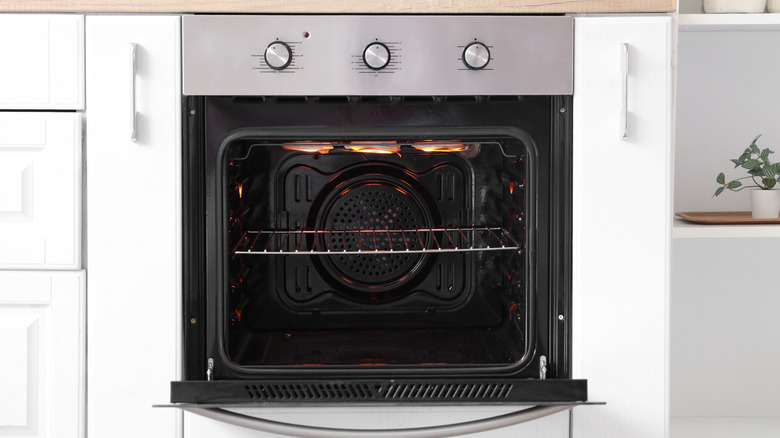
Air fryers have become almost as universal as microwave ovens. This is partly because some models are made to fit your small kitchen, and also because of their capability overall. But with the rise of smart ovens, you might wonder if the air fryer has lost some of its luster. The truth is that while smart ovens are increasing in popularity, air fryers aren’t going away anytime soon.

The global air fryer market continues to show strong growth, with Grand View Research estimating its value at $1.28 billion in 2023 and projected to reach $2.07 billion by 2030. Factors like healthier cooking and even social media influence are helping to drive this growth. By contrast, Global Market Insights found that smart ovens held a market value of just over $317 million in 2024. That number is expected to climb toward $918 million by 2034. This growth is driven in part by an increasing demand for smart home appliances with advanced features like multiple cooking modes. This modern approach allows for Wi-Fi connectivity, voice control, and app-based monitoring.

Based solely on the data, the gap between smart ovens and air fryers is still significant. But both categories are showing steady growth. Rather than one device overtaking the other, what emerges is a broader shift toward modern kitchen appliances that overlap in capability and continue to evolve.

The overlap between smart ovens and air fryers
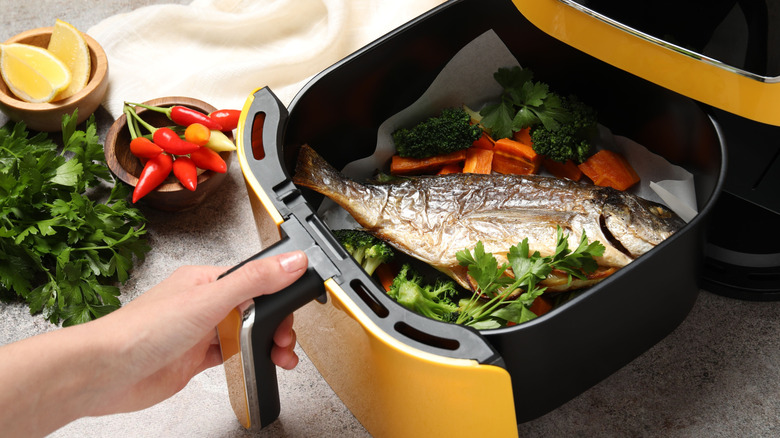
Smart ovens and air fryers are linked because smart ovens can perform all the same functions as a regular oven, and some of them have the air fryer feature built in. An air fryer’s size generally means it uses less electricity than an oven, but there’s the matter of counter space, which some people just don’t have. Combining appliances is not just convenient, it also saves room.

In fact, some critics believe the air fryer is indeed a waste of space, arguing that while it can cook faster than a traditional oven, it doesn’t always do so consistently. This is especially true for raw proteins like beef and pork, which can either be undercooked, or overcooked, depending on the method and timing. There’s also the issue of versatility, as air fryers are often better suited to reheating instead of handling more complex recipes.

But a smart oven’s ability to properly air fry foods can vary based on the model. For example, a smart oven from a tech brand like Samsung, might be spot-on for air frying in terms of results versus recommended cooking times. Or you might need to adjust the temperature or cook time to compensate. Your cleanup could also vary, since you’d only be washing the pan or container you used in the oven, versus washing the entire air fry basket.


Source link

Leave a Reply

Subscribe to Our Newsletter

Get our latest articles delivered straight to your inbox. No spam, we promise.

Recent Reviews


Google is experimenting with a new policy restricting the amount of free storage provided to some accounts. New Google accounts (including new Gmail accounts) created in certain regions will be limited to 5GB of free storage when they’re first set up. That’s only one-third of the amount of storage that has been typically offered. There is a way of increasing the amount of free storage you get when setting up a new account, though: you can unlock it by linking your phone number.

When approached for comment by Android Authority, a Google spokesperson confirmed that the new policy was being tested to “help us continue to provide a high-quality storage service to our users, while encouraging users to improve their account security and data recovery.” The statement didn’t clarify which regions the policy is being tested in, nor for how long the testing period will last.

Notably, a Google One Help support page about account storage has been updated to state that each Google account contains “up to 15 GB of storage”, as noted by 9to5Google. Previously, the page didn’t say “up to”; it simply stated that accounts come with 15 GB of storage. So far, the experiment doesn’t appear to stretch to pre-existing accounts.

Per a screenshot shared by Reddit user Sungusungu on R/DeGoogle (a subreddit dedicated to finding alternatives to Google services and products) Google is collecting phone numbers to make sure that the full 15 GB of storage is only redeemed once per person. Of course, that’s easily evaded by using a burner phone to set up multiple accounts, should you want to. The pop-up directs users to a webpage to learn more about storage management. However, at the time of writing, the link redirects to the help center landing page instead.

How to link your Google account with a phone number

If you’re in the process of setting up a new Google account in an impacted region, then you might be prompted with the option of unlocking an extra 10 GB of storage using your phone number via a simple pop-up menu. If so, you can go ahead and follow those steps. However, if you want to link your phone number with a pre-existing Google account, then here’s what you need to do. Using your computer, you need to:

  1. Open your browser and head to myaccount.google.com, then navigate to “Security and sign in” on the left-hand toolbar. This should open a list of security options.

  2. Select “Use your phone to sign in” and then “Set it up”. 

  3. Add a phone number using the “Recovery phone” option.

  4. Follow the on-screen steps to verify your number and finish linking it to your account.

Your options might look a little different if you already have a recovery number set up with your account.

Alternatively, you can connect a phone number to your Google account from your Android device, iPhone, or iPad. Much like on a computer, you connect your number by adding it as a recovery phone. First, head over to myaccount.google.com. Then select “Personal info”, followed by “Phone”. From there, you should be able to add or edit your phone number by navigating to the “Recovery phone” section.


Source link