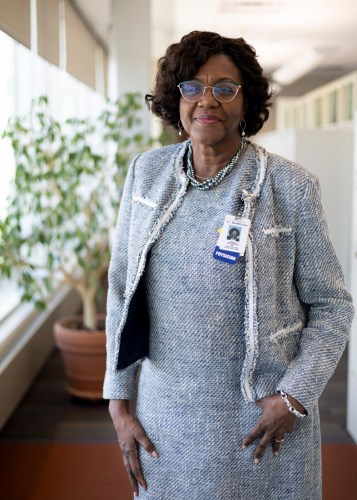

Growing up in the Caribbean, Dr. Allyson Brotherson noticed that every doctor, no matter their specialty, had to know general medicine because it was the community’s greatest need. So when she moved from Trinidad to the United States to pursue medicine, she decided on general practice.
She ended up at Hennepin Healthcare, where her work is a daily reminder of “what it meant to be a doctor in a country like where I grew up,” she told MinnPost.
Today, Brotherson is the chair of the Hennepin County Medical Center Department of Family Medicine, which houses Minnesota’s largest family medicine residency training program at a single site.
In the wake of recent attention on HCMC’s financial woes and resulting bailout from the state Legislature, the training program –one of 11 residencies at the hospital – offers an under-the-radar example of the stakes for public health should the hospital continue to falter.
Related: HCMC is a winner in the legislative deal Tim Walz announced Wednesday. Here is what else to know.
Since its establishment in 1970, the residency has trained over 550 doctors – about 34 at any given time. Roughly 75% of graduates have stayed in Minnesota to practice, according to Hennepin Healthcare figures.
The safety-net hospital’s financial difficulties, brought on by changes to Medicaid, the shutdown of Minnesota-based insurer UCare and the rising cost to treat publicly insured or uninsured patients, led to serious contemplation of its closure – and residency programs with it.

“Everybody in the system is under stress right now. Everybody is trying their best and to focus on patient care, but it is really weathering everybody,” Dr. Kris Schwacha, a family medicine physician at HCMC and faculty member of the residency program, told MinnPost earlier this month.
On May 18, lawmakers passed a funding bill to stabilize HCMC in the short-term. The legislation also calls for the creation of a task force to focus on longer-term sustainability and to recommend a new governance structure.
‘More expensive and less effective’
Any disruption to the family medicine residency would exacerbate the state’s long-time physician shortage, said Dr. Jamie Conniff, president of the Minnesota Academy of Family Physicians.
Forecasts project Minnesota will need nearly 1,200 more family physicians by 2030 in order to meet the needs of residents. Additionally, the majority of counties in the state are designated as Health Professional Shortage Areas (HPSA), a label given to places that do not have enough providers compared to the number of people that need care.

“The result of a family physician and a primary care provider shortage is that our care is more expensive and less effective than it would be if we were adequately meeting the primary care needs of our communities,” said Conniff, who serves a rural population near Cloquet.

Dr. David Councilman, the interim program director for HCMC’s residency, said a bulk of its residents practice in rural communities after graduating. He added that family medicine doctors practice in every corner of the state, unlike more niche specialists, and typically provide a continuity of care, meaning patients can see the same provider for decades.
“Who’s going to meet our patients in their community?” he asked.
Relief, but still work to be done
In a last-minute deal earlier this month, legislators secured $205 million from the state’s general fund and an additional $500 million in reserve funds over the next five years to stabilize HCMC.

Dr. M. Reza Chaudhry, a second-year HCMC family medicine resident, said the news came as a relief. “I feel like this legislation and the funding is a clear indication that everyone understands that HCMC and the family medicine program is an investment in the future of Minnesota,” he said.
But as hospital and county leaders will attest, work remains to steady the institution.
“The stabilization funding does not resolve the long‑term impacts of HR1 or the structural deficits that uniquely challenge safety‑net hospital systems,” Joshua Yetman, Hennepin County spokesperson, said in an email statement to MinnPost. “But it does accomplish two essential things: it delivers historic support that prevents closure, and it gives us the time and stability to work with the state on durable, long‑term solutions.”
Related: HCMC bailout fine print, the bonding bill, and a last push to police the immigration police: What the Minnesota Legislature accomplished in its final hours
Schwacha said that so far, the residency program has heard a bit about next steps. Funding is not coming in all at once, she said, but is trickling in in a way that will allow residents and other physicians to keep providing care.
Amid the financial stress, Brotherson saw a silver lining in the appreciation expressed from the community for the hospital’s work.
“I hope we don’t change because the mission is critical, not only to the people who work here, but to the patients who come here for care. So if not us, I don’t know who would do it,” Brotherson said. “Sometimes a crisis is good for you to kind of rethink and have people realize how important we are.”
Related