
Follow ZDNET: Add us as a preferred source on Google.
ZDNET’s key takeaways
- Small solar mistakes can cut output by up to 50%.
- Poor panel placement is the biggest power killer.
- Small solar systems may save only cents per day.
I’ve been harvesting and using solar power for several years. My love affair started when I visited Scotland for six weeks, and the only power I had came from my small power station and two solar panels (and those solar panels weren’t waterproof!). Since then, solar has grown into a bit of an obsession, and it’s at the point where I’m in the process of constructing an off-grid cabin that will rely solely on solar.
Also: Considering plug-in solar? My expert advice after setting up the DIY energy tech at home
But solar is a very different technology from using the grid, and the truth is that a lot of solar users lose power and money because of mistakes relating to installation, usage, maintenance, and planning. Simple mistakes can slash your power output by anywhere from 10% to 50% and more, not to mention shorten equipment lifespan, create all sorts of safety hazards, and affect the return you get on your investment.
Let’s take a look at some of the most common issues, as well as easy fixes.
1. Pointing solar panels away from the sun
Seems basic, but you’ll be surprised how often I see panels pointing in all sorts of directions.
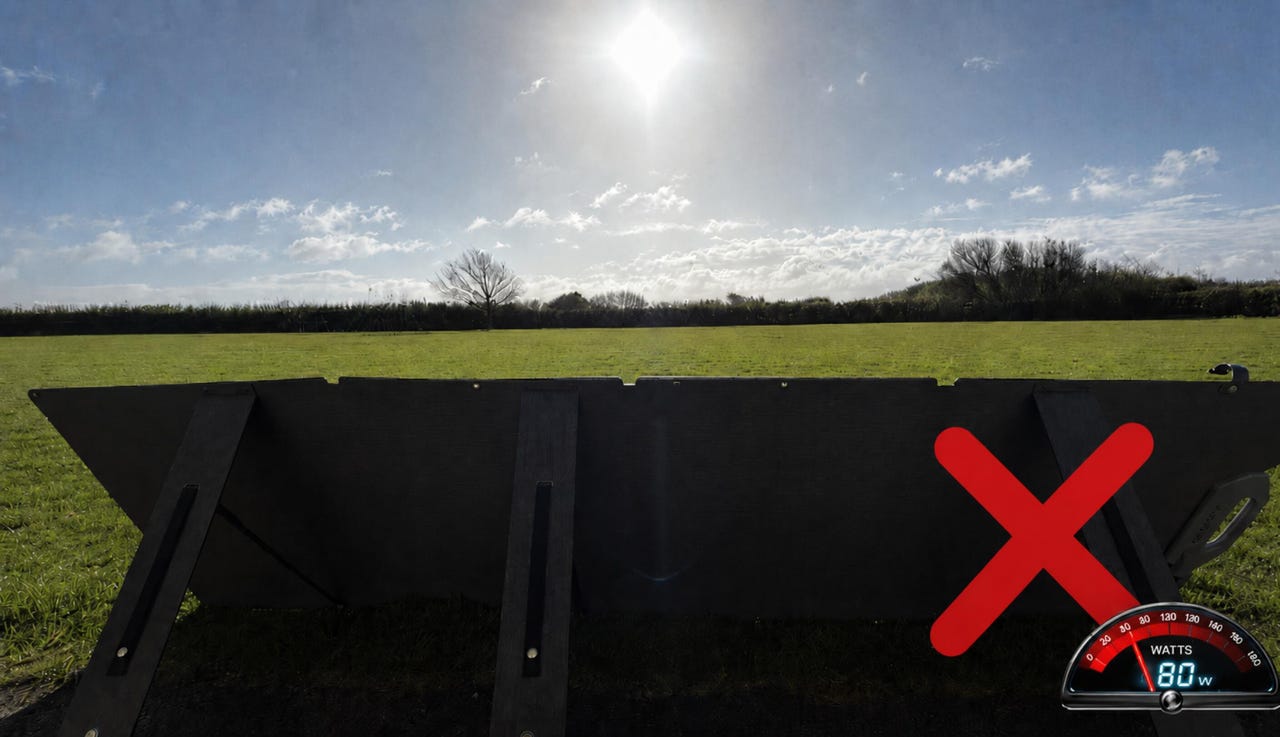
Assuming that you’re in the Northern Hemisphere, a general rule of thumb is having the panels facing south at an angle of around 45 degrees as a good start.
Also: How I make my solar panels last long enough to pay for themselves
For portable systems where I’m setting up the system and leaving it for the day, I’ll point the panels due south at 45 degrees, away from anything that might shade them, and hope for the best.
If I’m in camp, I’ll make the effort to point the panels at the sun and move them every couple of hours. This gives me the best possible chance at getting the most out of panels, especially smaller, portable units.
For balcony “plug-in” solar systems where your panels are fixed, it’s crucial that your panels face south-ish. If your balcony or garden doesn’t face south, or southeasterly or southwesterly, forget about it. Don’t be fooled by people who tell you that solar panels work great when pointed away from the sun; they don’t.
For fixed installations, it’s also vital that the location doesn’t get shaded too much by things like buildings or trees, because even the smallest bit of shade on your panels will dramatically cut their collecting power.
Bear in mind that trees grow and get leaves. A tree that might be fine now might be problematic in summer or in a few years — so plan for the future.
Also: This is the power backup setup I trust after years of testing – solar panels included
Another factor to consider for balcony solar is that hanging the solar panels over the balcony so they’re perpendicular to the ground is highly inefficient. Again, 45 degrees is a good ballpark to aim for, but if you want to get scientific, and you have a way of controlling the angle, find your latitude (you can find that out here) and set the angle to that.
2. Not being realistic about power
Think that 800W of solar panels is going to give you 800W of power during daylight hours, day in and day out? Think again.
You need to find out peak sunlight hours, or PSH, which is a measure of how many hours the sunlight is strongest at your location. Luckily, you can find tables that will give you the PSH for various locations. Bear in mind this is a theoretical number, and all sorts of factors — weather being the biggest — can affect this.
Also: Considering plug-in solar at home? How to know if it’s legal in your state – and actually worth it
But as a ballpark way to figure out the maximum your panels can ever achieve, it’s a good start.
Once you have this PSH figure, you will need to do some math.
Take the power rating of your panels and multiply that by the PSH for your location. For example, if you live in Utah, which gets a PSH of between 6 and 7 (we’ll take the figure in the middle here of 6.4), and have a 400W solar panel, the absolute maximum you’ll get is:
400 Watts x 6.5 Hours = 2,400 Wh or 2.4 kWh
To make this even more realistic, it’s common to factor in a derate figure to smooth out losses through inefficiencies in the system. You’ll find all sorts of derate figures online, but the industry standard seems to be 0.77. This drops the maximum amount of usable power collected as follows:
400 Watts x 6.5 Hours x 0.77 = 1,848 Wh or 1.8 kWh
How much is this amount of power worth if it came from the grid? Well, to work this out, you need to find the cost of power in your area (in Utah, it’s 0.1333 cents per kWh) and multiply the maximum power your panels will deliver by this figure.
1.8 x 0.1333 = 0.24 cents per day.
A decent 400W solar panel will set you back around $400, so you’re looking at it taking about four and a half years from now for the panels alone to pay for themselves.
While aimed at fixed solar panel installations, Google’s Project Sunroof tool can give you some idea of how much power your solar panels could capture.
3. Keeping your panels dirty
OK, so you have your panels pointing in the right direction. The next thing you need to make sure of is that they are clean. Even a thin layer of dust or pollen can slash their energy-collecting potential by as much as 20%, and when you’re dealing with such small margins to begin with, every percentage point counts.
Also: I set up backyard solar panels to save on my electricity bill – here’s my advice 30 days later
While there are all sorts of products for cleaning panels, I’ve never gone wrong with some lightly soapy water and a microfiber cloth. If there’s any stubborn dirt — bird poop is the common culprit here — resist trying to scratch it off, as this could damage the panel. Instead, let the soapy water soak so it lifts off easily.
4. Forgetting to check connectors
I’ve lost count of the number of times I’ve gone to look at someone’s solar panels only to find one is not connected and just pointing at the sun doing nothing. It’s easy to tell if one panel isn’t working when that’s all you’ve got, but when you have two or more, it becomes more tricky to spot when a panel goes offline.
Also: How I boosted my portable solar panels’ power by up to 30% – 11 expert-approved tips
Most solar panels use the MC4 connector, and they’re pretty robust and won’t usually come apart on their own, but on portable systems, it’s always a good idea to check.
MC4 connectors are pretty reliable, but I have seen them come apart.
Adrian Kingsley-Hughes/ZDNET
5. Not remembering solar power is dangerous
A lot of people forget that the power coming from their power station is the same sort of AC power that comes from an AC outlet in their wall and is perfectly capable of seriously injuring or even killing people. Be careful when using power stations outdoors, and think carefully before you start trailing extension cables.
Also: Most solar power banks I’ve tested were gimmicks – this one is the real deal
A point worth making about power stations is that because of the fact that they make use of something called a “floating ground,” you can’t rely on using an inline Residual Current Device (RCD) or Ground Fault Circuit Interrupter (GFCI) on any extension cable, and you’re relying on the power station’s own internal safety mechanisms.
6. Fully charging your power station at all times
I know some people who aren’t happy unless their power stations are fully charged at all times and will pump mains AC into them rather than let them charge up slowly over a few days using solar. Remember, solar might be slower, but it’s free.
Also: How my portable wind turbine compares to solar panels – 2 years of testing later
If you have a time-variable power tariff where you can buy power cheaper off-peak to use during peak hours, then if you time things right, it might make sense to timeshift power if you’re a heavy user.
Otherwise, it’s best to let the solar panels do as much of the work as possible because, after all, your goal is to maximize your return from your solar investment.
7. Buy cheap, buy twice
Beware of cheap “too good to be true” deals on power stations or solar panels, and definitely avoid the secondhand market like the plague.
Also: I used a single power station to keep my off-grid cabin running – how it all worked out
A good power station or solar panel should give you 10-plus years of service because you need that sort of longevity out of your investment to have any hope of getting your money back.
8. Not being efficient
You need to stop thinking of power as an unlimited resource that flows from AC outlets and start thinking about being efficient. That means replacing high-draw items like incandescent bulbs and old-style water heaters with LED lights and smart heaters, so your solar power goes further.
Also: The hidden metric that makes these portable power stations truly worth your money
Also, I highly recommend using smart outlets that you can control remotely and monitor for energy usage. There’s nothing like seeing how much power things are using to encourage you to switch them off. Smart plugs are cheap — about $8 apiece — and they’re a great complement to your solar power endeavors.