Utility Crews Might Not Need Permission To Dig In Your Yard – Here’s Why


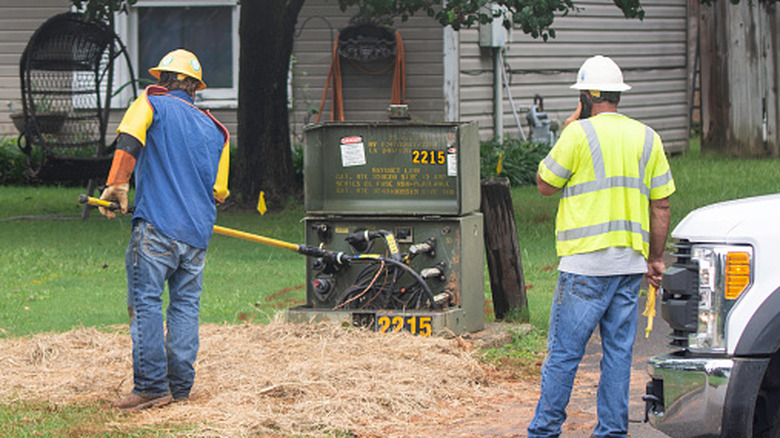
When you purchase a home, it’s important to be familiar with the idea of a “public utility easement”. It is a legal right granted to utility companies that allows them to roll up to your property and begin digging — without ever asking for your permission.

Utility easements are part and parcel of whatever municipality/city/state you live in, and they’ve been around for a long time. They give someone who’s not the property owner access to use your property without your consent.

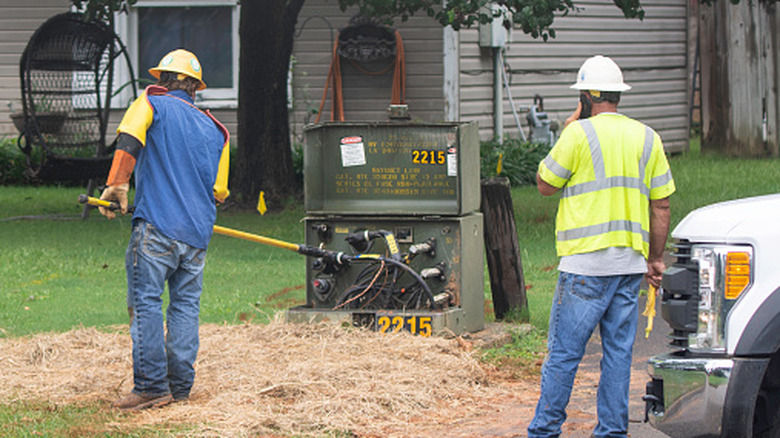
This is allowed so they can maintain essential services — gas and power lines, water mains, and the like — which may be buried throughout the neighborhood. That’s what those little flags and paint are for. Easements come in all shapes and sizes (express, implied, by necessity, prescriptive, in gross, positive, negative, right of way) and have subtly different yet very specific meanings. Whatever the case, they can continue into perpetuity, even if you sell the land to someone else.

Utility easements can impact property values
Utility easements can have either a positive or negative impact on property values. Let’s start with what might be considered the glass-half-full variety. Easements allow companies to maintain their services, and properties can be worth more than those without a well-maintained infrastructure.

However, if a new utility easement needs to be established, the owner might be compensated either for the use of the land or for any nuisance that might come with it. Today, most utilities (water, gas, telecom, etc.) are buried underground from the jump, keeping them out of sight, out of mind, and out of weather, so easement use is usually temporary and far less noticeable.

Unfortunately, the negative effect can be far more impactful. Owners might be subject to restrictions that prohibit adding to the home, erecting new fencing, installing a pool, or creating lavish landscape features. Visible utilities, like transmission towers or overhead power/communication lines, might ding the property value because that scenario might be unacceptable to the next home buyer. Plus, those who don’t fully grasp the finer details of what an easement allows may balk at the whole concept.

What’s more, owners won’t be able to prevent utility companies from entering their property and possibly damaging any existing installations (driveway, landscaping, etc.). Of course, anything that gives potential buyers even a hint of hesitation can diminish property value.


Source link

Leave a Reply

Subscribe to Our Newsletter

Get our latest articles delivered straight to your inbox. No spam, we promise.

Recent Reviews


Researchers in South Korea developed a wearable system that uses seven smart rings to read finger and hand motions to translate American Sign Language and International Sign Language into text. The purpose is to make communicating easier between those who sign and nonsigners without needing a separate human interpreter. 

AI Atlas

According to the study, published Friday in the journal Science Advances, the system reliably recognized 100 ASL and ISL words during testing. It also performed well with users the system had not seen before, and it didn’t require recalibration for each person. Because the system detects words in sequence, it can produce sentence-level translations without extra training on grammar. 

ASL and ISL are the everyday languages of more than 72 million deaf and hard-of-hearing people. However, most hearing people do not know any words in these languages or have a very basic understanding. That gap makes certain tasks, like ordering at a restaurant or asking for help, much more difficult. 

A graphic shows two illustrated people talking in sign language, ASL and ISL. The graphic also shows the different components of the ring as well as pictures of hands modeling the rings.

A concept of how the rings work in the real world. 

American Association for the Advancement of Science (AAAS)

Existing sign language translator prototypes often rely on bulky gloves that can distract from or block natural hand movement or feel uncomfortable for the wearer, which limits real word adaption. Camera-based technologies can work well in controlled environments but are often limited to those places where a camera can be set up with a clear line of sight, the researchers wrote. 

To solve these problems, the researchers designed sensing rings for each finger that can capture precise motion and finger position while letting the hands move naturally. The rings can detect both signs that involve movement, like the words for “dance,” “fly” and “sun,” and signs that are held still, like “I” and “you.”

“These advances suggest that [the device could enable] barrier-free public translation systems for unseen users and unrestricted daily assistive interfaces,” the authors wrote in the study. 

The authors are affiliated with Yonsei University, Hankuk University of Foreign Studies and the Korea Institute of Science and Technology, among others. While the technology is still experimental, the authors wrote that the technology has the potential to ease communication difficulties. The underlying idea could also help improve controls for other systems, like virtual or augmented reality.

“Beyond sign language translation, the ring-type, wireless, and modular architecture of (wirelessly connected, ring-type sign language translators) may also be extended to other gesture-driven applications such as virtual or augmented reality control, touchless device interfaces, or rehabilitation monitoring systems where fine-grained hand movement tracking is essential,” they wrote.


Source link