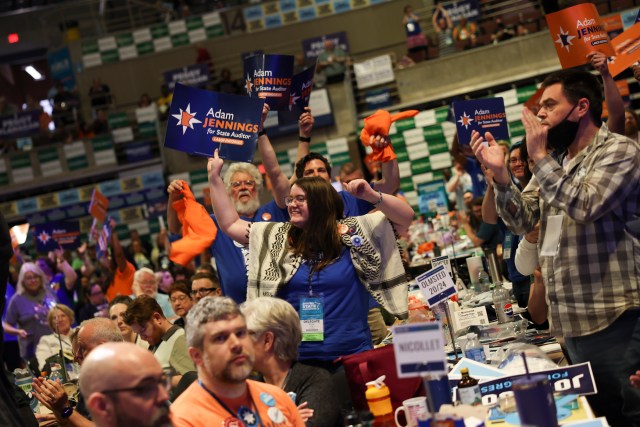
WASHINGTON – Last weekend’s tumultuous DFL and GOP state party conventions have prompted some Democrats and Republicans to again consider scrapping the way Minnesota chooses political candidates and replacing it with something else.
The state’s modern system of caucuses was established more than a century ago in 1922 and is imbued with tradition and woven into the state’s political culture. But it is also an outlier in American politics.
Only eight other states, including California and Michigan, endorse or nominate candidates at state party conventions.
Minnesota’s nominating conventions have caused problems before and once again there is talk of abolishing endorsing conventions and moving up the date of Minnesota’s primary election, now scheduled for Aug. 11, to an earlier date, perhaps in June.
Related: An educational, patience-testing weekend at the DFL convention
Making those changes would need the approval of the state parties and the Legislature. But pressure for that change is building, especially after last weekend’s conventions. There are several reasons why.
“(Party) endorsements do not produce the most electable candidates,” said Blois Olson, a political analyst and publisher of dailyagenda.com
That’s because the selection of delegates gives activists on the far right and far left the opportunity to have outsized influence, said Jessica Shaten, a delegate to the DFL convention from south Minneapolis.
“What the endorsement process has become is a way for extremist candidates to take control of their parties,” she said.

Like many seeking change, Shaten believes the delegates who vote to endorse candidates at statewide conventions (1,200 attended the DFL convention and 2,000 attended the GOP’s event this year) do not represent the millions of Minnesota voters.
The delegates to the statewide conventions are chosen in sub-caucuses at the local and congressional district levels that many more attend, but those caucus-goers still represent a fraction of the state’s more than 3.8 million registered voters.
Shaten said the choice of favored candidate should be left up to voters who cast ballots in a primary election. “Let all the voters choose, then the parties could endorse those nominees at a (post-primary) convention,” Shaten said.
A defeat for moderation
The Republican Party convention that was held in Duluth was roiled by distrust of some delegates after GOP officials announced there were “anomalies” in a round of balloting.
In that round to endorse a gubernatorial candidate, businessman Kendall Qualls leaped ahead of state House Speaker Lisa Demuth. Qualls, who is running to the right of Demuth, eventually won the endorsement.
Also at the GOP convention, former sportscaster Michele Tafoya, a candidate for the U.S. Senate who is supported by the National Republican Senatorial Committee (NRSC), was rejected by delegates who gave more than 60% of their votes to former Navy SEAL Adam Schwarze.
Like Qualls, Schwarze is considered more conservative and MAGA-aligned than his GOP rival.
Tafoya had already said she would not abide by the endorsement and continue to the primary. Because of the snafu with the balloting, the Minnesota Republican Party decided Monday night to release all candidates from the endorsement process, allowing Demuth, who had said she would abide, to continue to the primary, too.
Mike Lindell, the CEO of MyPillow, is also staying in the race.
On the Democratic side, Rep. Angie Craig, D-2nd District, who was losing a battle for the support of delegates to Lt. Gov. Peggy Flanagan, decided she would skip the DFL convention in Rochester and move on to the primary in the race to win retiring Sen. Tina Smith’s seat. Once again, Craig is considered the more moderate candidate in that race.
So, the delegates’ picks were devalued this weekend in one way or another and there will be hard-fought primary battles for Smith’s seat in both parties and for governor in the Republican Party.
The only statewide candidate that will avoid a tough primary battle is Sen. Amy Klobuchar, who is running for governor. But even that popular politician was considered too moderate for about 30% of the delegates at the DFL convention who cast their votes for 26-year-old progressive Kobey Layne.
‘Parties could still have influence’
Jason Franzen, who since the 1990s has often been a GOP delegate to his party’s convention, said the idea of scrapping the endorsement process was discussed in Duluth.
“Admittedly, the endorsement process is archaic, but it’s very ‘small d’ democratic,” he said.
Yet Franzen, a supporter of Qualls who is running for mayor in Delano, predicted that calls to end that process “would continue to persist, and perhaps gather strength.”
“And if that’s what people in Minnesota want, well, that’s fine,” he said.
Frank Long, a delegate and longtime party activist from Watertown Township who supports Schwarze, also said there was talk at the GOP convention about changing the process, especially from delegates who are Demuth’s colleagues at the Legislature.
“I hear that talk all the time, but I heard it more this time,” Long said.
Long, however, said delegates who come up through the caucuses have a better sense of what voters want in a candidate than those who determine who would run in a primary.
“They are a small group of people who are recruiting and funding candidates,” he said.
However, Hamline University political science professor David Schultz said Republicans, especially, should be eager to change the system and there’s a reason for this.
DFL candidates are more likely to continue their campaigns to the primary, even if they are not endorsed. Gov. Tim Walz and former Gov. Mark Dayton are among those who flouted the endorsement process to win their party’s primary and then a general election.
But GOP candidates who don’t abide by the endorsement are usually punished by Republican voters in a primary.
Schultz said this often hurts the better candidate.
“Since they haven’t won a statewide election in 20 years, there are probably enough people in the Republican Party who are saying, ‘If we keep doing this and we keep losing, maybe we should do something else,” Schultz said.
Yet change brings risk.
Olson, the political analyst, said attempts to eliminate the endorsement process would result in “blowback” from certain organizations that field delegates, including unions and hardline ideological groups.

And it would weaken the power of state parties, but in a limited way. “Parties could still have influence,” he said. “They just wouldn’t endorse a political candidate.”
And Minnesota’s political parties could still hold statewide conventions to draft new bylaws and platforms and develop strategies.
Minnesota Republican Party Chairman Alex Plechash and Democratic Party Chairman Richard Carlbom declined requests to comment for this story.
Summertime blues
Thirty-one states hold their primaries before the end of June.
Minnesota’s August primary puts it in a minority of states who pick their nominees later in the year.
Changing that, allowing a longer general election period and curbing the influence of state parties, would be a political lift.
Related: GOP primary awaits after Schwarze tops Tafoya for party’s U.S. Senate endorsement at GOP convention
The Legislature would have to pass a new law to establish a new election calendar, something that has been tried before in Minnesota and not succeeded.
One obstacle, Schultz said, is that members of the Legislature, who are still in session in mid-May on an election year and could be subject to a special session if their work is not done, would have a short time to campaign for reelection if the primary is in June.
About a dozen other election deadlines would have to be moved up to accommodate the change.
Yet June primaries bring benefits, too. Many voters are on vacation in August and otherwise not paying attention to politics. Schultz said there’s evidence that August primaries have depressed voter turnout when compared to those held earlier in the year. Secretary of State Steve Simon, then a member of the state House, testified in 2017 that a June date would find more Minnesotans available to vote and leave more time for voters to consider their general election options.
Related