Spirit Airlines Has Shut Down. What Now?


Spirit Airlines announced over the weekend that it is permanently ceasing all operations, effective May 2. All Spirit flights were immediately canceled, stranding thousands of passengers and leaving them more uncertain about future travel plans. 

Here’s what to know about the collapse of Spirit Airlines, what happens next and what you can do right now.

Why did Spirit Airlines collapse?

Spirit Airlines simply ran out of money. Years of financials losses and two bankruptcies since 2024 were exacerbated by the surging jet fuel costs tied to the war in Iran. According to CNBC, the airline was in negotiations with the Trump administration to secure a $500 million government bailout, but the plan was rejected, forcing the airline to shut down on Saturday. 

“For more than 30 years, Spirit Airlines has played a pioneering role in making travel more accessible and bringing people together while driving affordability across the industry,” said Dave Davis, Spirit’s CEO, in the airline’s shutdown announcement (PDF). “Sustaining the business required hundreds of millions of additional dollars of liquidity that Spirit simply does not have and could not procure. This is tremendously disappointing and not the outcome any of us wanted.” 

How many people have been affected?

It’s unclear exactly how many travelers have been affected by Spirit Airlines’ shutdown, but news reports indicate that thousands of passengers were stranded midtrip or had their flights canceled, causing major disruptions at Spirit hubs such as Orlando and Fort Lauderdale.

Spirit said 17,000 direct and indirect employees have lost their jobs due to this shutdown. 

What should you do now if your flight was canceled? 

Spirit Airlines said it is aiming for an “orderly wind-down” that includes eliminating all flights and customer service operations. If you’re stuck in limbo with canceled flights, do not go to the airport. If you need to travel immediately, check other airlines for limited-time rescue fares. You can use your Spirit Airlines confirmation number and proof of purchase to rebook with another airline as soon as possible.

The National Consumers League provided some tips for affected flyers, including keeping all booking information, receipts and records for a potential bankruptcy claim or refunds (more on that below). The NCL also recommends monitoring your accounts for a refund, checking your travel insurance policy and taking advantage of capped or reduced airfare when rebooking flights. 

“Not all Spirit customers should assume a refund will automatically appear,” John Breyault, vice president of public policy, telecommunications and fraud at the NCL, said. “When an airline shuts down this suddenly, it’s up to travelers to take proactive steps to have the best chance of getting their money back.”

Can you receive a refund for a canceled Spirit flight?

Yes. If you bought your ticket directly through Spirit Airlines with a debit or credit card, the company said it will automatically refund those ticket costs. If you booked through a travel agent, contact your agent directly for a refund.

If you booked your tickets with vouchers, credits or loyalty points, your refund process will not be immediate, and Spirit said it may not result in a full refund. According to Spirit, compensation “will be determined at a later date through the bankruptcy process.” 

If your refund is significantly delayed, you can use your card issuer’s dispute or chargeback process to seek compensation. You can also explore travel insurance claims and bankruptcy claims as a last resort. According to the Department of Transportation, if an airline completely liquidates as Spirit has, you may be able to file a “Proof of Claim” in the bankruptcy proceeding for a potential refund, but you’re likely only to receive a partial refund, if anything. 

How could this impact airfare costs? 

Spirit Airlines’ shutdown and cancellation of all flights is expected to increase airfares across the US. 

Airfares have surged in 2026 due to rising jet fuel costs and high demand. According to NerdWallet, airfare costs are up 14.9% over the past year, with customers bearing the brunt. With Spirit ceasing all operations, there are fewer budget options than ever, and competition is shrinking in several markets, especially South Florida. Other airlines are likely to fill some routes in the coming weeks and months, but addressing capacity and personnel gaps will take time. 


Source link

Leave a Reply

Subscribe to Our Newsletter

Get our latest articles delivered straight to your inbox. No spam, we promise.

Recent Reviews


In Cody v. Jill Acquisition LLC, No. 25-937 (S.D. Cal. June 30, 2025), the Southern District of California declined to enforce a retail site’s terms of use and compel arbitration, holding that the plaintiff, who used guest checkout to place an online order at the retail clothing site, did not have adequate notice of the terms and the arbitration clause. This case should serve as a wake-up call for online entities to reexamine electronic contracting processes. It exemplifies how, even if a website’s visual design and its placement of the hyperlinked Terms of Use during user checkout are comparable to other presentations that have been deemed enforceable, a court could still decline to enforce online terms if the context of the transaction is not the typical e-commerce transaction between a registered customer and a retail site. In this case, the court found that by checking out as a guest without creating an account, the user was less likely to expect a continuing relationship and, therefore, the site’s notice and presentation of the terms below the “Place Order” button were not conspicuous enough in this instance to bind the plaintiff.

The plaintiff in Cody filed a putative class action complaint over the site’s pricing policies for alleged violations of the California Business and Professions Code and the Consumer Legal Remedies Act. The defendant moved to compel arbitration, arguing the plaintiff had agreed to the site’s terms of use that contained a “Binding Arbitration Agreement and Class Action Waiver” when plaintiff clicked the “Place Order” button and completed her purchase from the defendant’s website.

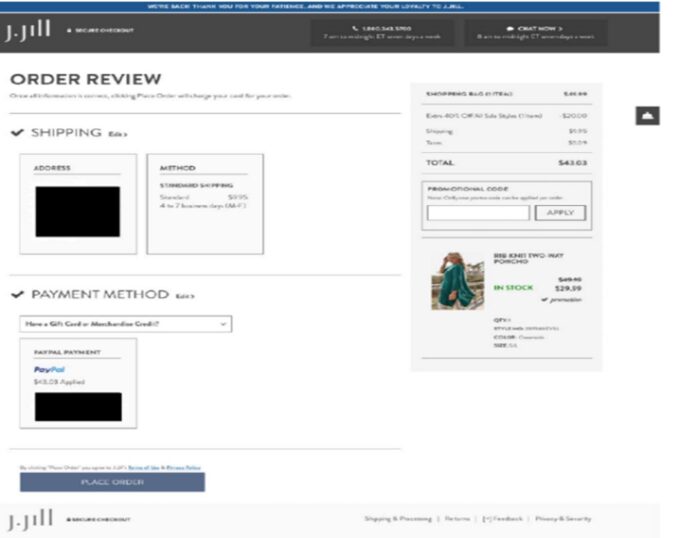
Generally speaking, a contract will be enforceable based on an inquiry notice if: (1) the website provides reasonably conspicuous notice of the terms; and (2) the consumer takes some action, such as clicking a button, that unambiguously manifests assent to those terms. When evaluating whether there was an agreement to arbitrate, the court in Cody first considered the visual design of the webpages and found that the visual aspect of the notice was satisfied by the defendant’s website layout. As the court stated, the relevant criteria for evaluating whether the visual elements provide conspicuous notice are whether the advisal is displayed prominently enough that the court can assume a reasonably prudent Internet user would have seen it. Elements such as a “clear and legible” notice on the order page and a hyperlink placed directly above or below an action button formatted in bright, contrasting color and readable font within a relatively uncluttered web page have been favorably cited by courts in past cases.

The court here found the visual design to be adequate because of factors such as the underlined blue hyperlink to the terms of use and its location directly below the “Place Order” button. [See below image from the court opinion of the final contracting screen ].

Although the court recognized that the “design of the website alone might support concluding that the notice would be reasonably conspicuous,” it went on to consider the full context of the guest checkout transaction at issue in Cody.  Here, the court distinguished it from those types of transactions where a user might anticipate “some sort of continuing relationship.” The court emphasized that when considering the notice requirement, the visual design of the website must be examined within that context. As it stated: “This means that courts should expect that a reasonable internet user is more vigilant in looking for contractual terms when the context of the transaction reasonably implies a contractual relationship.” To the court, when a user “simply purchases goods or avails herself of a one-time discount offer,” there is less reason for her to expect a continued relationship beyond the purchase. 

In the case at hand, the court considered plaintiff’s decision to check out as a guest as one where the user did not anticipate a continuing relationship, and compared it with other traditional e-commerce transactions involving registered users where the Ninth Circuit previously found that such context would put a user on inquiry notice that a purchase on the company’s website constituted an agreement to its terms.

“Generally speaking, courts are more likely to conclude that a user anticipating ‘some sort of continuing relationship’ would expect to be bound by terms, whereas a user ‘who simply purchases goods or avails herself of a one-time discount offer’ would be less likely to form such an expectation.”

“This context distinguishes this case from those in which the Ninth Circuit has found that the context of the transaction would put a user on inquiry notice that use of a company’s website or services constituted an agreement to its terms and conditions, including an arbitration provision.”

Thus, despite the adequacy of its visual aspects on the J. Jill site, the court found that proper notice was not sufficiently conspicuous in this case because of the guest checkout context of the transaction (“The context of the transaction therefore weighs against concluding that Plaintiff was sufficiently aware that, by placing an order through jjill.com, she would be entering into an agreement including an arbitration provision”).  

In another recent case, Chabolla v. ClassPass, Inc., 129 F.3d 1147 (9th Cir. 2025), the Ninth Circuit affirmed a lower court’s ruling that declined to send a proposed class action to arbitration. In the ClassPass case, the plaintiff signed up for a trial period for ClassPass, a service that sells subscription packages for access to various gyms and fitness studios, but later took issue when subscription charges resumed after gyms reopened following the COVID-19 pandemic. The contracting process in this case involved several signup screens. [An image from the court opinion of the final screen appears below].

In this case, the court’s decision was a flip, of sorts, of the Cody case, with the Ninth Circuit finding the visual presentation of the terms lacking, even though the context of the transaction would seemingly put the user on notice of an ongoing relationship that would contemplate the user agreeing to site terms. The appeals court found that while a trial subscription opportunity may not indicate an anticipation of an ongoing relationship in all instances, the context neither weighs in favor of nor against the notice requirement. This is because, as the court noted, the other aspects of the context – such as how the purchase is described as a “plan” or a “membership” and how the benefit of ClassPass is to gain access to gyms and fitness studios – conjure the idea of a continuing relationship. Nonetheless, the court ultimately decided that a reasonably prudent internet user would not be deemed to have unambiguously manifested assent to the terms by working her way through ClassPass’s multi-page website checkout process.

Taken together, these two recent decisions show that courts – at least those within the Ninth Circuit – are considering the actual context in which these internet transactions occur when deciding whether an online entity’s contracting and checkout process binds the user to the terms. While visual presentation and web flow design remains important for e-commerce sites, the above two court decisions show that context also matters.

We have previously highlighted the importance of web design in determining if a service’s terms are deemed enforceable. Now, companies might take a second look at their own user registration and e-commerce purchase processes to ensure they offer reasonably conspicuous notice of the existence of contract terms and obtain the user’s manifestation of assent to those terms in all contexts and types of transactions, including those transactions where guest or expedited checkout is used.

Contexts that indicate transient relationships, such as guest checkout or a trial opportunity, may mean that even an ordinary presentation of terms in the form of a hyperlink to the terms located beneath a “Place Order” button – a presentation that is used regularly by many sites – might need to be bolstered, in some cases, to provide the user additional notice that he or she is entering into a transaction that mandates acceptance of contractual terms. As the Cody court commented: “[T]he onus must be on website owners to put users on notice of the terms to which they wish to bind consumers.” Ultimately, the above court decisions accentuate the need for counsel to be involved in the decisions underlying the design and wording of online contracting processes and presentation of terms so entities can attain adequate user notice and assent that would satisfy even the most exacting scrutiny for any type of transaction.


Source link