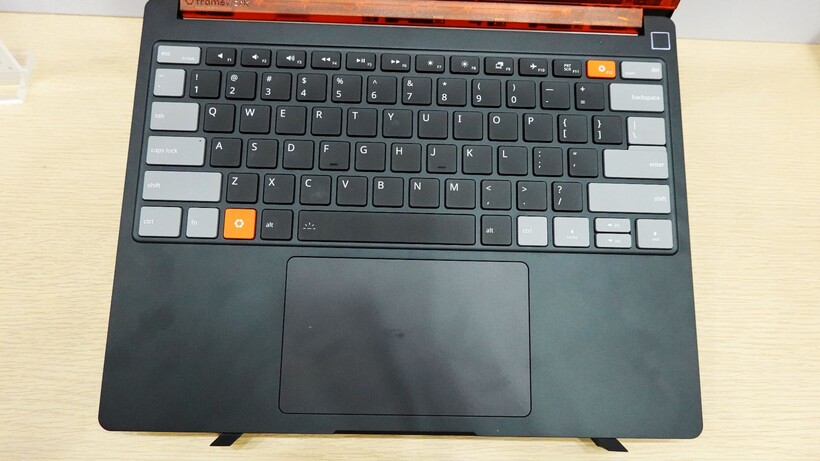

As the old saying goes, you can’t necessarily have your cake and eat it. When it comes to premium ultrabooks and even the mere thought of repairability and modularity, that’s been a definite for a long time, although the new Framework Laptop 13 Pro I’ve spotted at Computex 2026 proves you might finally be able to have that sweet treat and scoff it right down in one fell swoop.
For many years now, Framework has been pleading the case in favour of letting folks configure, build, and then upgrade or repair their laptops, with seemingly endless possibilities as to which SoC, RAM, storage, ports and even chassis a laptop comes in.
I loved the Framework Laptop 13 (2025) when I tested it last year, and felt the small premium for such a repairable laptop over its rivals was worth it for the long term, although there were caveats to the AMD chip my sample came with, and for the price it commanded against more premium rivals with brisker processors inside.
For the new Laptop 13 Pro, Framework hasn’t reinvented the wheel or the brand itself, choosing to grow even further into its own convictions.
This is still a quintessential Framework device after all, sticking with a sturdy CNC-machined aluminium chassis and snappy keyboard. With this new model, it’s supplemented with a slick haptic trackpad plus some fun pops of colour for the frame to provide a little more personality against a more generic grey chassis.

Likewise, there has been a small but important change to the brand’s ingenious expansion ports. They now toggle open and closed with a switch rather than requiring you to push and pull cards in and out, a small change that makes the whole system feel considerably more polished to me. Plus, you still get the same versatile treasure trove as before, with everything from USB-C to DisplayPort, and from full-size Ethernet to an additional 1TB expansion card for drop-in storage, and it’s all as configurable as you’d expect from Framework.
With this being the ‘Pro’ model, the brand has also moved to some impressive silicon, opting to use Intel’s immense Panther Lake SoCs, or the Core Ultra Series 3 chips. At the time of writing, you have the choice of the base Core Ultra 5 325 chip, plus the Core Ultra X7 358H. The top-end Core Ultra X9 388H was on the Framework stand, but it is sold out online.
With this in mind, for price to performance, I maintain the Core Ultra X7 358H is the sweet spot of the range, with minimal compromise against the top-end chip when it comes to real-world performance and the fact it packs the full-fat B390 iGPU inside with its 12 Xe3 cores and beefy performance. Having tested Panther Lake extensively in laptops such as the Samsung Galaxy Book 6 Pro, I came away impressed by what the B390 iGPU can do — and the Laptop 13 Pro puts all of that capability into a modular, repairable chassis that no other manufacturer is offering at this price point.

If you spec it out in with a comparable spec sheet to some of the best ultrabooks I’ve put through their paces with 32GB of RAM and a 1TB SSD (eschewing a costly Windows licence in case you want to use Linux or save money by sourcing Windows from elsewhere), then the Laptop 13 Pro is going to run you £2313/$2319 with the default selection of expansion cards for ports for a rounded and modern set, plus a detailed 2.8K LCD screen and large 74Whr battery where Framework is quoting up to 20 hours of runtime. In the grand scheme of things, that’s about right when you compare it to its rivals – perhaps owing to the ongoing memory crisis and some of Framework’s decisions about the RAM specs, it’s been able to make the Laptop 13 Pro surprisingly competitive against less repairable and equally potent choices from bigger manufacturers.
For instance, the Asus Zenbook A14 (2026) – one of my favourite laptops of 2026 so far, with its Snapdragon X2 Elite chip delivering exceptional endurance and a featherlight chassis – comes in at a lower price point, but trades on different strengths entirely. The Samsung Galaxy Book 6 Pro with its Core Ultra X7 358H processor is a more direct comparison, and while Samsung’s fit and finish is arguably more immediately impressive out of the box, it offers little in the way of modularity, repairability, or upgrade potential that Framework brings to the table.
This makes the Laptop 13 Pro a proposition that I see as getting all the more compelling the longer you spend with it. After all, modern laptops are less repairable than they were even a few years ago, meaning the time we’re likely to spend with a device is shortened compared to what it used to be. Likewise, if anything goes wrong, then you’ll need to send it out to a service centre or get an entirely new device in the worst-case scenario.

To me, Framework’s approach is different in every meaningful way: the mainboard is swappable, the expansion cards let you configure your port selection to suit whatever you’re doing, and spare parts are sold directly by the company with repair guides to match. It means this laptop is one that’s designed to grow and change with you, rather than you simply moving on to something else if your existing laptop slows down or it isn’t what you want or need anymore.
One technical detail worth dwelling on that Framework has employed is this laptop’s LPCAMM2 memory. Most ultrabooks at this price point have soldered RAM — it’s how manufacturers keep things thin, light, and thermally manageable, but it also means that whatever memory configuration you buy is the one you’re stuck with for the life of the laptop.
Framework has taken a different approach with the Laptop 13 Pro, using LPCAMM2 modules that are not only user-replaceable but also mighty fast, with speeds of up to 7467 MT/s. Framework also told me that they’re also reportedly more affordable to acquire than the usual SO-DIMM standard it’s used in the past, suggesting the brand is doing everything in its power to keep prices both competitive and reasonable for consumers, which is always nice to see.
It’s also worth noting that the 13 Pro is Framework’s first Ubuntu Certified machine, with a preloaded Linux option available alongside Windows 11. That’s a deliberate signal about the kind of user Framework is courting – professionals, developers, and power users who want a laptop that works the way they do rather than the way the manufacturer or a software partner prefers. In a market increasingly dominated by AI features that nobody seems to have asked for and software experiences it’s difficult and time-consuming to opt out of or remove entirely, there’s something quietly clever about a laptop that simply gets out of your way.

In stepping back, there’s arguably a bigger point to be made about the Laptop 13 Pro. Framework occupied a small stand at Computex 2026, and this year marked its first time at the big trade show, coming in a week where we’ve seen some ridiculous ambition from the hardware industry such as with Nvidia promising to reinvent the modern ultrabook with RTX Spark and much more.
Framework is doing something different to everyone else. The Laptop 13 Pro isn’t the most powerful, exciting, or even desirable laptop shown off at the show, but I’d wager it’s the most thoughtful and considered, which needs to be rewarded. This is a laptop that rewards you for keeping it and building on it over time rather than replacing it when the next generation arrives. It seems that at a show that’s been about plentiful new releases and lofty claims about where the laptop industry is heading next, Framework’s answer is to hand the control back to the consumer and provide a fantastic product while doing so.

Stephan is the sports journalist for the Maple Grove Report.