
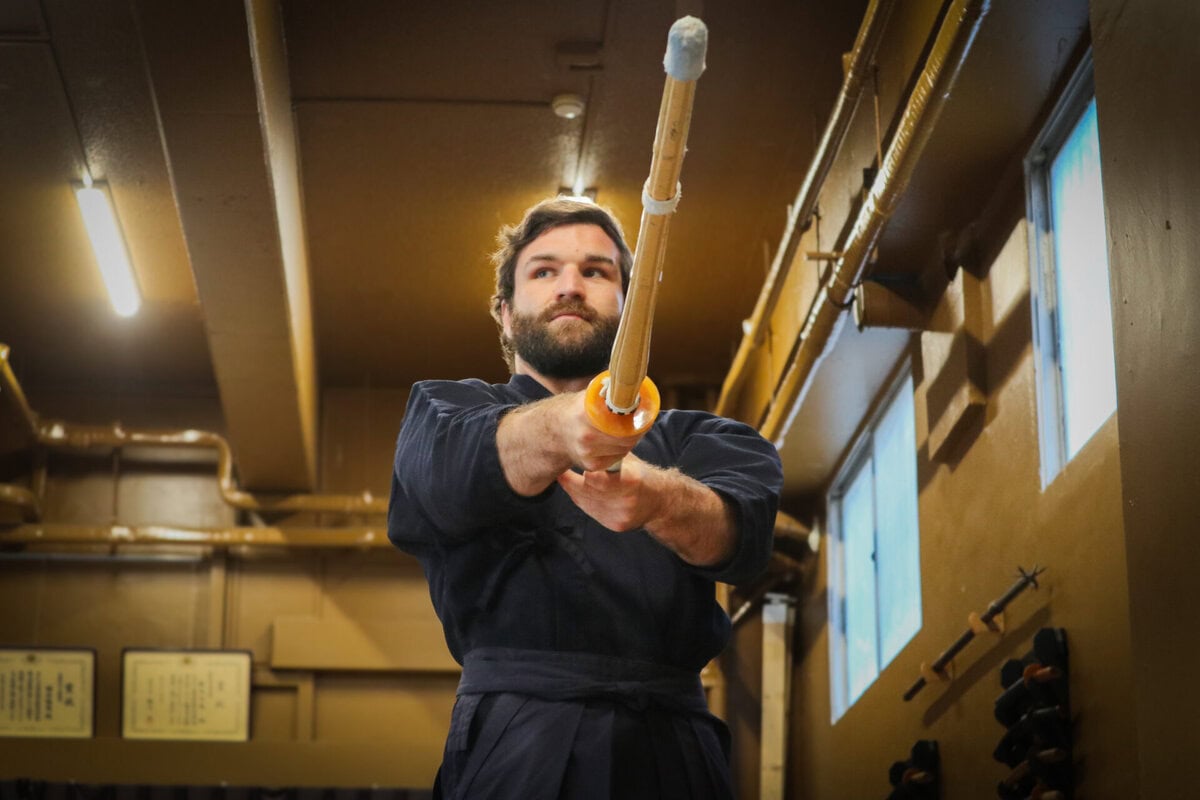

Stepping into a kendo dojo in Tokyo means leaving the city behind and entering a space where centuries of practice still shape daily training. As someone who has practiced kendo for over 20 years, I’ve watched travelers arrive expecting to learn about samurai culture and leave with something they weren’t looking for: a question about how they want to live.
You don’t start by holding a sword. You start by understanding where kendo comes from and why it still matters.
Where Japan’s Samurai Spirit Is Still Practiced
Kendo isn’t a museum piece or a performance. It’s a living tradition — and this two-hour session in a working Tokyo dojo is one of the few ways a visitor can step inside it.
What the session covers:
→ A traditional opening ceremony — bowing not as formality, but as the first lesson in how kendo practitioners face others
→ Ki (spirit): how samurai channel focused intent, not aggression
→ Tai (body): traditional footwork, balance, and readiness
→ Ken (sword): how to hold, swing, and move with a shinai — only once the foundation is in place
→ Ki-Ken-Tai-Icchi: bringing spirit, body, and sword together in a single strike
→ A real practice match — those who want to can face a veteran instructor and feel what that pressure is actually like
→ A demonstration bout between instructors, showing what years of practice produces
→ A closing ceremony that most participants say lands differently than the opening one did
Duration: 2 hours | Difficulty: Moderate | Location: Tokyo
No kendo experience required. Bring comfortable clothing and an open mind — the dojo provides everything else.
Beyond the Sword: Understanding Ki-Ken-Tai-Icchi
Before anyone touches equipment, we begin with a traditional bowing ceremony. Many guests treat it as a formality at first. It isn’t. It represents one of the central ideas in kendo: your opponent is not an enemy. They are someone who helps you grow. The same is true for your teachers, training partners, equipment, and the dojo itself.
From there, we explore the three elements of kendo — ki (spirit), ken (sword), and tai (body) — and the principle that joins them: ki-ken-tai-icchi, the unity of spirit, sword, and body.
Guests begin with movement. Through footwork and posture, it becomes clear that kendo is not about swinging a sword. Every movement requires focus, awareness, and self-control. Only then do they pick up a shinai, the bamboo practice sword, and learn to coordinate all three elements as one.
The dojo fills with kiai — the sharp, purposeful shout that expresses spirit and commitment. Between exercises, silence. Both are part of the training.
For many visitors, this is when they first realize that kendo is not a martial art the way they imagined one. It is a method for training the body and the mind at the same time.

The Philosophy Hidden in Every Movement
Kendo is not really about winning or losing. Most people who arrive expecting a sword lesson leave thinking about something else entirely.
One guest told me he came expecting to learn about samurai culture and left thinking about his own life — that kendo wasn’t a martial art to him but a way of examining how he wanted to live. Another said it was something he thought everyone should experience at least once.
These reactions make sense to me. Kendo doesn’t teach respect, self-discipline, gratitude, and perseverance as concepts. It puts you in situations where you feel them, or fail to. As guests put on armor and step onto the floor, the pressure of facing an opponent, the need to stay calm, and the challenge of overcoming hesitation reveal things about themselves that explanation never would.
At that point, kendo stops being something they are studying and becomes something they are doing.

Facing a Master: The Reality of Authentic Challenge
At the end of the session, guests have the opportunity to face an experienced instructor in a practice match.
This is not about winning. It is about putting everything they have absorbed into a single, live situation.
When the match begins, the atmosphere shifts. The sound of kiai fills the dojo. The distance between you and your opponent becomes very real. Even in a training context, most guests feel it — the nerves, the instinct to hesitate, the moment when they choose whether to move forward anyway.
What makes this valuable is not the result. It is the information. When people hesitate, they discover their hesitation. When they become impatient, they notice their impatience. When they find the courage to commit, they experience that directly.
In kendo, the opponent is described as a mirror. Through facing another person, you begin to see yourself more clearly. For many guests, this becomes the moment the whole session comes into focus.

The Ceremony That Changes Everything
We end exactly as we began: with the same bowing ceremony.
The movements remain unchanged, but many guests see them completely differently now. What first appeared to be a simple formality becomes an expression of respect, gratitude, and connection.
One of the most important words in Japanese is arigatou (ありがとう), meaning “thank you.”
In kendo, gratitude is not something added to training. It is part of the training itself.
Your opponent is not an enemy. They are someone who helps you grow. The same is true for your teachers, training partners, equipment, and even the dojo itself. Kendo teaches us to notice and appreciate the people and things that support us, including those we often take for granted.
For many guests, this realization changes the meaning of the final bow.
In that moment, they understand that kendo is not only about learning techniques. It is also about learning how to relate to other people and the world around you.
The philosophy is no longer something they have heard about. It is something they have experienced for themselves.

The Questions That Define Bushido
People often ask me, “What is Bushido?”
My answer is simple:
“How do you want to live? And why?”
For me, Bushido begins with those questions.
Bushido is often presented as something that belonged only to the samurai of the past. In reality, it raises timeless questions about how to live. That is why it continues to resonate with people today.
There is no single correct answer.
What matters is taking the time to reflect on those questions and searching for your own answer.
Through kendo, guests are given an opportunity to do exactly that. The training, the challenges, and the interactions with others become opportunities to learn not only about Japanese culture, but also about themselves.
Perhaps that is why so many people leave the dojo with a different impression of both Japan and their own lives.

Practical Information
Kendo Spirit welcomes complete beginners, and no martial arts experience is required.
The experience takes place in a real dojo in Tokyo and typically lasts around two hours. All equipment is provided, including armor and bamboo swords, so guests can participate without bringing any special gear.
Participants should wear comfortable clothing suitable for light physical activity and be prepared to train barefoot on the dojo floor.
More important than physical preparation is an open mind. Kendo is not only a physical practice, but also an opportunity to experience a different way of thinking about respect, discipline, and personal growth.
Frequently Asked Questions
Do I need any martial arts experience to join a kendo session in Tokyo?
No experience is needed, and most participants arrive as complete beginners. The session is designed to be accessible from the first minute — you’ll cover the foundational concepts, footwork, and technique before picking up a shinai, so nothing is assumed in advance.
How long does the kendo experience take, and what is the format?
Sessions run approximately two hours and follow a structured arc: bowing ceremony, philosophy and movement fundamentals, shinai technique, armored practice, and a closing match against an instructor. There is time for reflection and questions throughout.
What should I wear, and what equipment is provided?
Wear comfortable clothing you can move in freely — loose trousers and a t-shirt work well. All kendo equipment is provided, including the keikogi (training uniform), bogu (armor), and shinai. You’ll train barefoot, so socks are not needed on the dojo floor.
Is the practice match against the instructor safe for beginners?
Yes. The match uses bamboo practice swords and full protective armor, and the instructor controls the pace and intensity based on each guest’s level. The purpose is not competition — it’s to give you a live context where what you’ve practiced becomes real.
Is this experience suitable for children or older travelers?
The session is physically light — closer to a focused movement practice than a demanding workout — and has been completed comfortably by guests across a wide age range. If you have specific mobility considerations, contact the dojo in advance and the session can be adjusted accordingly.

Stacie Harris is a local resident and reporter of the Maple Grove area. Stacie reports on medicine and science for the Maple Grove Report.





