This story was originally reported by Kate Sosin of The 19th. Meet Kate and read more of their reporting on gender, politics and policy.
For Juniper Simonis, that night in 2012 replays like the start of a favorite movie. It’s a warm summer evening, and she’s speeding through Ithaca, New York, on her bike. The wind is in her hair — at least as much as it could be under a bike helmet. Mariee Siou, the American folk singer, is blasting through her headphones.
The moment is memorable because of the feelings of freedom and hope sparked by an email she has just received. It says that the Ithaca League of Women Rollers derby team voted to allow her to play.
“As somebody who played sports and was queer, but those were two very separate parts of my life, the promise and the opportunity … to integrate those was very hopeful for me.”
Related: Trump administration sues Minnesota over transgender athletes in girls sports
Simonis is transgender. She had been voted on by an all-women’s team.
“Getting a message that was like, ‘You are welcome,’ was very, obviously, very uplifting.”
Years before trans athletes in sports embroiled national politics, roller derby — the five-player high-contact sport with punk rock nicknames — tackled the question of inclusion. The policies and practices are often imperfect. Transgender women and men as well as athletes of color still face discrimination in the sport. But time and again, its athletes have opted to remain inclusive.

Nicole Williams, known as Bonnie Thunders on the track, is widely considered to be the greatest derby skater of all time and often referred to as the “LeBron James” of the sport. She’s been skating for 20 years and has seen the sport evolve on trans issues.
She acknowledges that there was a time when she and other skaters knew less about trans women and what it might mean to skate with them, but the experience of actually playing with them changed minds over the years. She says a sport that excludes trans people just doesn’t make sense to her.
“When I see, ‘protect women’s spaces,’ that feels so repressive,” she said. “I don’t want to discount that women’s spaces are important. They are, but I don’t really identify with that in the way that I used to.”
The history of derby
Roller derby traces its roots back to the 1930s, when sports promoter Leo Seltzer got the idea to hold a roller skating endurance race on a banked track. Even in its first iteration, roller derby was co-ed, according to the Smithsonian — though men made more money than women.
That endurance race that Seltzer started gave rise to the contact sport we know today, according to derby veteran and Angel City League Derby Director Rachel”Rotten” Johnston.
“Over the course of these races, people start to run into each other. They get tired, they try to sabotage each other,” Johnston said. “And so that’s the thing that people started to get really into.”
Derby evolved from the 1960s through the 1980s into a five-player sport and a highly produced televised spectacle. But it wouldn’t become nationally governed until the early aughts. As it evolved, it also became heavily centered on women, though the sport has some men’s teams.
In 2001, a group of women in Austin, Texas, decided to give the sport organization and structure. Some believed it should be held on a banked track, like the early days. Others favored a flat track because it didn’t have to be specially built. But largely, they shared a common culture.
“There was definitely something really cool about a tough punk rock chick of that era. And, roller derby in its earliest form was as much about the bar fights and the black eyes as it was about the skating,” Johnston said. “It was, it was like, I get to wear this badass outfit that’s also kind of sexy. … It was post riot grrrl kind of coming into the 2000s, a direct rebuttal of the pop culture that was happening.”
Out with Britney Spears and Paris Hilton. In with “Beyonslay,“ “Iron Maven” and “belle right hooks.”
The question of inclusion
This freaky feminist counter-culture prided itself on skating outside the rules of femininity and gender norms. It was decidedly queer and queer-friendly, a sport that celebrated the strength of women and welcomed all kinds of bodies. Most sports had been made for men and adjusted to include women. Derby, however, had been dreamed into existence by women, and women ruled the track.
Its popularity exploded. The sport went from a handful of skaters, shaky on their skates, to hundreds of teams operating under the Women’s Flat Track Derby Association (WFTDA) and the Roller Derby Coalition of Leagues (RDCL). The former swelled to over 400 leagues across six continents. The RDCL stayed smaller, with just eight teams.
At no point did the WFTDA ever actively ban trans athletes, but its early policies created some barriers and confusion for trans people looking to play. Williams notes that in the early aughts skaters wanted a safe space to compete away from men.
“At the time, ‘cis’ wasn’t really even a term we were using,” Williams said. “And it was cis men that we didn’t want.”
Early WFTDA policy around trans participation generally mirrored that of the Olympics at the time: Transgender women were allowed to skate if they had undergone hormone replacement therapy for two years.
But trans skaters said this was applied unevenly at best. Some teams allowed trans women to skate even if they hadn’t met the medical requirements.
“The gender policy that we were working from was well-intentioned, but certainly not iron-clad,” Johnston said.
In the 2010s some trans skaters started asking questions about the policy.
One of them was Penelope Nederlander, known as Fifi Nomenon on the track. Nederlander decided to try out for the LA Derby Dolls in 2010. At the end of her tryout, she sat down with a mentor who was showing her the ropes.
“I was like, ‘I know it’s pretty obvious, but you know I’m trans, right?’” she asked. “She’s like, ‘Oh, I had no idea.’”
The following day, the mentor pulled Nederlander aside. Did her driver’s license have an “F” on it for “female”? Yes, Nederlander said.
Cool. She was good to go.
“That was wild, that was unbelievable,” Nederlander said of the ease with which she was accepted.
Everyone else in Nederlander’s life had to be taught her new name and pronouns and coached on how to talk about her. Derby gave her a community she belonged to as her authentic self.
“It was the first group of friends who I met who only knew me as Penny, and that was huge,” she said.
An open door
This policy of vague acceptance on a case-by-case basis, however, would not stand forever. Eventually players demanded a policy of full inclusion for trans skaters. In 2015, WFTDA updated its policy to say that anyone of a marginalized gender is welcome and encouraged to skate, regardless of how they look or their transition status.
This policy opened the door for people early in the transition. It also created space for athletes assigned female at birth who wanted to medically transition to remain part of the sport.
Among them was Drew Flowers, whose Derby name is OMG WTF. Flowers has been skating since 2008 and is nonbinary.
“I identified so hard with this being a female sport, a woman’s only sport,” Flowers said.
“I really kind of didn’t give the benefit of the doubt to my teammates, to my community, that they were going to be supportive of me.”
It was not only derby that was at stake for Flowers. They owned a skate shop with their partner, who happens to be Nicole Williams. Their livelihood depended on the community’s embrace. Williams assured Flowers it would be OK.
“It was definitely a scary time, for sure,” they said. “I will say, the moment that I did decide, ‘I’m going to do this,’ I had reached a point in my life where I was like, ‘I have to do this.’”
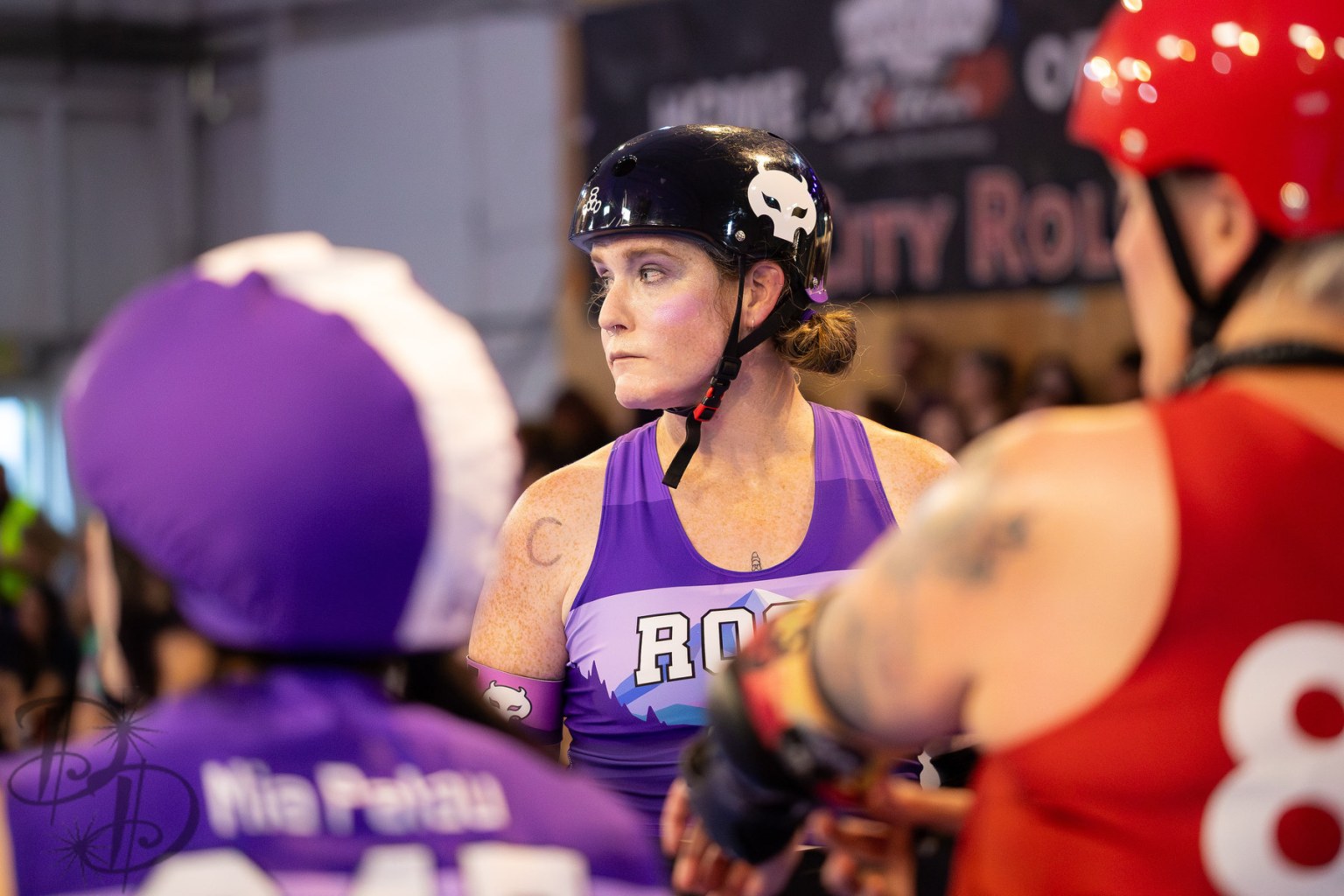
Today, both skate for the Rose City Rollers Wheels of Justice.
More work to be done
Of course, derby is far from ideal. Flowers, Simonis and Nederlander have all faced substantial challenges as trans people in the sport.
Donita Green, known as Blaxyl Rose on the track, said that gender-diverse skaters regularly report facing harsher penalties from referees. It’s even more pronounced for Black skaters like Green, who plays for Angel City Derby in Los Angeles.
“I’ve seen firsthand how much worse some of these microaggressions and problems happen when you are a dark-skinned Black skater. … You add knowledge of trans identity, and it’s just it tends to be even worse,” Green said. “We talk often about skating while Black. It just happens.”
Simonis said she has been assaulted by other players because she is transgender.
A way forward
But for all of its shortcomings, derby has at least attempted something most sports have not: It has prioritized inclusion above its perceived legitimacy.
That’s not because roller derby is not a serious sport. For several Olympic cycles, derby was on the consideration list for inclusion, but WFTDA skaters had reservations. For one, the Olympic Committee recognized USA Roller Sports as the official governing body, not WFTDA, even though WFTDA housed the lion’s share of teams and players. But more importantly, roller derby players were reluctant to engage in international games that parachuted into host countries and imposed strict gender rules on athletes. Eventually, they abandoned the idea.
Related: Ellison files preemptive lawsuit against Trump on transgender sports ban
Nederlander wants it to be OK for athletes to talk openly about how cisgender men and cisgender women might have different advantages or disadvantages in sports.
It doesn’t have to mean transgender women aren’t women or don’t deserve safe places to play or that they represent a threat to their teammates.
“I want to arrive at the same conclusion, but with honesty about it,” she said, adding that trans women should still get to compete even if some are taller than some cisgender women. “In roller derby, there doesn’t seem to be an important difference. We really don’t have any complaints about trans skaters. So that’s awesome. … And I think that that’s just a more honest, accepting way, and it keeps the other side from using that stuff against us.”
Many argue that including transgender women in sports would compromise fairness and safety. Johnston said that years of derby have proven otherwise.
“I think that people who are concerned about people getting hurt are missing the fact that we’re playing a full contact sport. You’re going to get hurt no matter what,” she said. “You know, life isn’t fair, and sports most certainly are not fair.”
Related