Best Buy just cut the price of one of my favorite TCL TVs – up to $1,000 off


evergreen-deals-imagery

TCL/ZDNet

Editor’s Note: ZDNET’s Deal of the Week is an editorially selected deal we feel is deserving of reader attention due to its high rating and value.


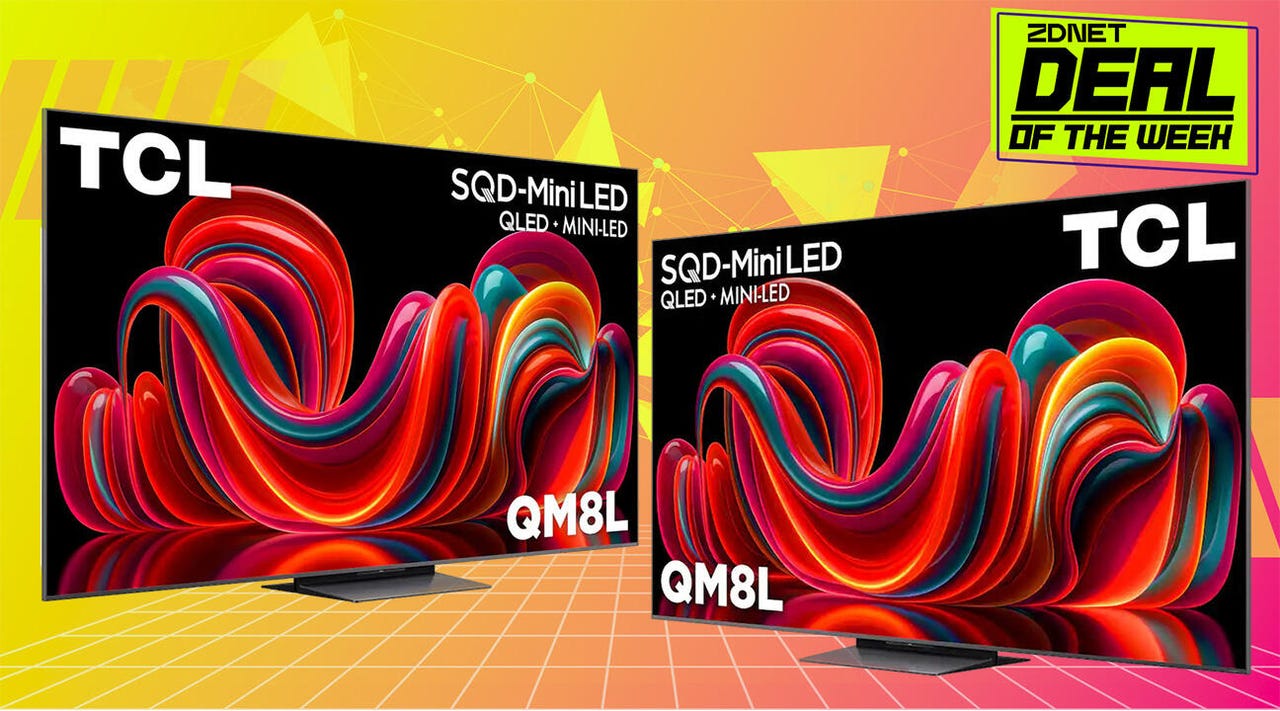
One of my favorite TCL TVs got a major refresh this year with the QM8L. It features an updated SQD-Mini LED panel for better color accuracy and contrast, as well as speakers designed by luxury audio masters Bang & Olufsen for sound to match. 

And if you’ve been looking to upgrade your main TV, it’s a great time to buy: Best Buy is offering up to $1,000 off the TCL QM8L, with every size on sale. This brings the price of the 75-inch version to just under $2,000. And if you’re looking to spend a little less, the 65-inch model is $1,799 (with a slightly smaller discount of $700). If you’d rather buy from Amazon, the site is offering the same deal.

Also: The best early Prime Day TV deals actually worth your time 

The new SDQ-Mini LED panel can produce up to 100% of the BT.2020 color spectrum, which means you’ll get rich, bold colors with less bleed and bloom thanks to the redesigned LED lenses, which are better at focusing light. It also uses up to 4,000 local dimming zones to create razor-sharp contrast that rivals high-end OLED and MicroRGB rivals from more premium brands like Sony and LG. And with a peak brightness of 6,000 nits, you’ll get consistent visibility in almost any lighting.

Review: TCL QM8 

The Bang & Olufsen speakers work with Dolby Atmos virtual surround sound as well as IMAX Enhanced technology to give you a more immersive listening experience while streaming music, movies, and shows. But if you want a truly custom home audio system to complement your new TV, you can connect soundbars, speakers, and subwoofers via HDMI eARC inputs or Bluetooth if you prefer a wireless connection. Console gamers can also take advantage of the AMD FreeSync Premium VRR support and a 144Hz refresh rate for smoother gameplay and cutscenes.

If you’re considering a TCL TV (which I would often recommend over Hisense models, based on my testing), consider this deal on the QM8L.

How I rated this deal 

While a sizeable discount, the $1,000 maximum gives you diminishing returns on the larger screen sizes. However, it still provides a better balance between price, quality, and features. You’ll get excellent picture quality with enhanced color accuracy, sharper contrast, and fine detailing over previous iterations of the TCL QM8. And with speakers by Bang & Olufsen, you’ll get rich, clean audio to match and create a more cinematic experience at home. That’s why I gave this deal a 4/5 Editor’s rating.

Deals are subject to sell out or expire anytime, though ZDNET remains committed to finding, sharing, and updating the best product deals for you to score the best savings. Our team of experts regularly checks in on the deals we share to ensure they are still live and obtainable. We’re sorry if you’ve missed out on this deal, but don’t fret — we’re constantly finding new chances to save and sharing them with you at ZDNET.com


Show more

We aim to deliver the most accurate advice to help you shop smarter. ZDNET offers 33 years of experience, 30 hands-on product reviewers, and 10,000 square feet of lab space to ensure we bring you the best of tech. 

In 2025, we refined our approach to deals, developing a measurable system for sharing savings with readers like you. Our editor’s deal rating badges are affixed to most of our deal content, making it easy to interpret our expertise to help you make the best purchase decision.

At the core of this approach is a percentage-off-based system to classify savings offered on top-tech products, combined with a sliding-scale system based on our team members’ expertise and several factors like frequency, brand or product recognition, and more. The result? Hand-crafted deals chosen specifically for ZDNET readers like you, fully backed by our experts. 

Also: How we rate deals at ZDNET in 2026


Show more


Source link

Leave a Reply

Subscribe to Our Newsletter

Get our latest articles delivered straight to your inbox. No spam, we promise.

Recent Reviews


Today, when one pictures a “classic Dodge Charger”, the first image that pops up is almost certainly one of the highly desirable Charger models from the late 1960s or early ’70s. Indeed, those early muscle car Chargers are iconic, playing a starring role in the “Dukes of Hazzard” television show and, somewhat more recently, “The Fast and the Furious” films. But as time ticks on, is it time to start appreciating the modern version of the Charger as a potential modern classic?

It’s now been over 20 years since Dodge brought back the Charger nameplate for a spacious four-door sedan with an optional HEMI V8 engine. While the basic Charger R/T was a potent machine for its time, Dodge really took the Charger’s game to the next level for the 2006 model year with the debut of the Charger SRT8. 

The SRT8 model used a larger version of the third-gen HEMI V8 that, combined with other performance upgrades, transformed the sedan into a serious performance car capable of running with its 1960s HEMI ancestors at the drag strip — to say nothing of its vastly superior handling and refinement. In the years that followed, Dodge would continue to improve the Charger’s performance with larger and more powerful HEMI engines, but the significance of the original Charger SRT8 is not to be overlooked.

A muscle car legend reborn for the 2000s

Today, with the modern Charger being such an established part of the car enthusiast world, it’s easy to forget some of the controversy that surrounded its mid-2000s return. Most of it focused on the fact that the beloved muscle car nameplate had been brought back for a four-door sedan rather than a retro-styled coupe. Fortunately, those people looking for that retro coupe would be satisfied by the reborn Dodge Challenger when it arrived a few years later, while the Charger went on to become a highly popular muscle sedan in its own right.

The addition of the SRT8 model to the lineup certainly helped, of course. Under the hood was the larger 6.1-liter HEMI V8, which differed from the standard 5.7-liter HEMI in several ways, not least the displacement. With the 6.1 under the hood, the SRT8 made 425 hp and 420 lb-ft of torque, easily laying down a mid-13-second quarter-mile time in Motor Trend’s hands. This was very quick by mid-2000s standards, especially considering the now-outdated five-speed automatic transmission.

But the SRT8’s performance went beyond just the drag strip. As part of the SRT transformation, Dodge also gave the car larger wheels and tires, a retuned suspension setup, and large Brembo brakes. While this didn’t necessarily make the car an agile road course weapon, it did give the SRT8 an athleticism that belied the Charger’s weight and size. 

The evolution of modern Dodge muscle

What’s even cooler about this era in Chrysler/Dodge performance history is that the Charger was just one of the four-door LX platform cars that the automaker offered with SRT badges and a powerful HEMI engine under the hood. Apart from the Charger, buyers could also choose from the more upscale, but ultimately short-lived SRT version of the Chrysler 300C sedan or the Dodge Magnum SRT8 station wagon.

The original Charger SRT8 marked the beginning of a long run of increasingly powerful, high-performance models. In the early 2010s, the Charger SRT8’s 6.1 HEMI was replaced by the larger and more powerful 6.4/392 HEMI, with that motor eventually becoming available in the less expensive Charger R/T Scat Pack. Then, of course, came the Charger SRT Hellcat, with a 707-hp, supercharged 6.2-liter that turned the car into a genuine super sedan.

So is the original Charger SRT8 a guaranteed future classic? Classified listings show that clean examples still bring decent money today, but the fact that it was followed by improved models may ultimately limit its potential for becoming a true, mega-desirable collector car. Regardless, though, the Charger SRT8’s accomplishments in modern muscle car history are not to be taken lightly.


Source link