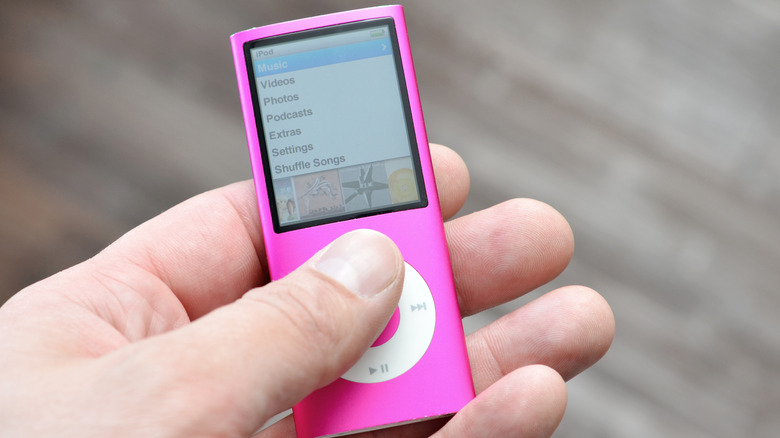
Gen-Z Is Buying Up Old-School iPods, And It’s Not Hard To See Why


Trend cycles can certainly get stuck on repeat, and technology is no exception. One of the latest examples of retro tech getting caught in the shuffle is the Apple iPod. Pre-iPod Touch devices are getting a new lease of life across social media, with older devices like the iPod Classic selling for surprising amounts. Despite Apple declaring the iPod Nano dead and obsolete back in 2024, the hunger for reclaiming older media devices seems to only be growing. According to data shared by Back Market, refurbished iPod sales increased by an average of over 15% per year between 2022 and 2024 alone.

Once you’ve noticed it, it’s easy to see the trend popping up across the internet. Over on TikTok, #iPod is home to more than 100,000 posts alone. Meanwhile, the r/iPod subreddit sees close to 100,000 weekly visitors at the time of writing. You could easily write this all off as another nostalgia-oriented trend, based less on practicality and more on aesthetics — especially the wider desire for Y2K fashion, Frutiger Aero design principles, and other almost-forgotten things from the not-so-distant past. However, it’s clear that fashion and aesthetics aren’t the only reasons why iPods are back in style. 

In a way, iPods give you the option of unplugging. Not from tech altogether, of course — but from the internet. Listening to music on your smartphone makes it tough to disconnect, even if you use your streaming platform’s offline listening options. You can still access apps, messages, and anything else that might distract you. Meanwhile, older-generation iPods take that off the table altogether, leaving you with just the music.

You can trade ads and pop-ups for lower screen time and wired headphones
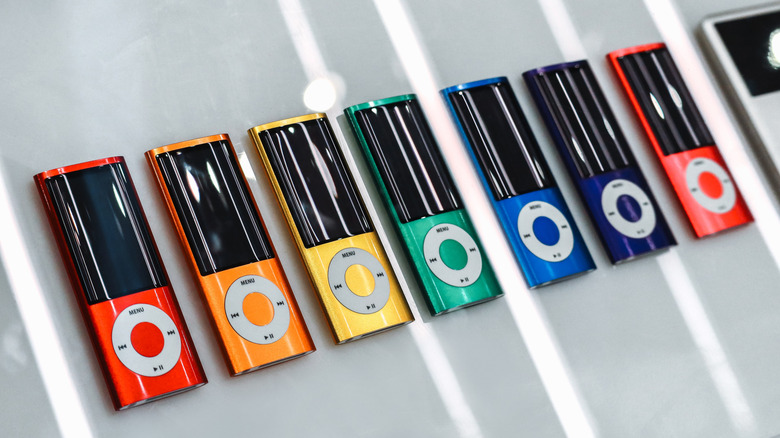
Gen Z turning to old-school iPods is in part reflective of a larger desire for digital minimalism: less screen time, with less stimulating activities away from ads, visuals, or distractions. When you opt for a media player over a smartphone, you don’t have to deal with a deluge of applications and ads just to listen to your favorite album.

Some iPods have screens, of course — the Classic and Nano each have small displays for navigating your library or watching videos on, but they’re quite limited in their functionality. You wouldn’t expect to see intrusive push notifications, pop-ups, or any other apps on these devices. With that in mind, there are far fewer reasons to gaze at your iPod, making it easier to switch off and shift your focus elsewhere without worrying about any intrusions or temptations. That’s perfect if you want to cut down on the time you spend scrolling on social media.

A shift toward old iPods could also reflect other tech trends, like Gen Z’s desire to move back toward using wired headphones over their wireless counterparts. After all, you can’t easily connect wired headphones to most modern smartphones without relying on other equipment, like a USB-C to auxiliary adapter, since auxiliary ports have gradually fallen out of fashion. On the other hand, iPods are a different story thanks to their built-in headphone jacks. It all fits together rather well if you’re aiming to turn back the clock a little when it comes to your day-to-day tech choices.

Media ownership gives relief from subscription fatigue
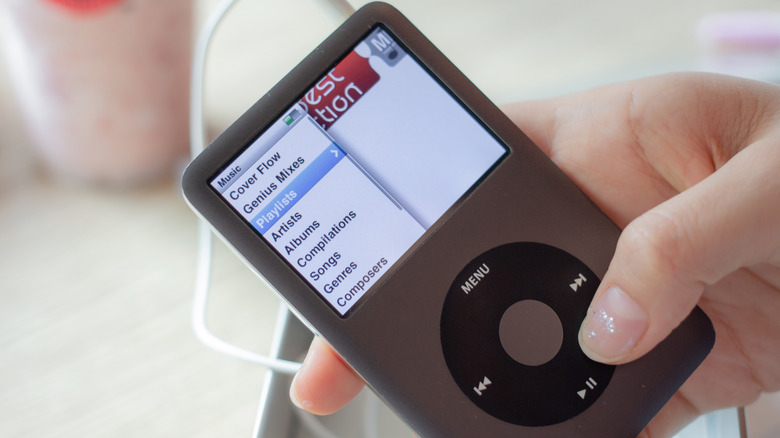
Using an iPod takes your music offline and puts it directly back into your pocket. That’s an appealing option for some as music streaming service prices soar, and a collective desire for media ownership grows. When you stream music, there’s always a risk that what you want to hear could suddenly be pulled or become unavailable. That isn’t the case with offline file storage — whatever ripped CDs and MP3s you load onto your iPod stay there until you delete them, or until the data corrupts. Knowing that you’ll always have access to what you want, paired with not having to pay a monthly fee to do so, is certainly alluring. 

There’s data out there to back up the idea that people are turning back to iPods to replace (or supplement) streaming, too. Musician Emily White surveyed current MP3 player users to find out more about the trend, yielding some interesting results. 40% of respondents only started using an iPod within the past year, while more than a quarter use it as a replacement for streaming services altogether. And, 32% of all respondents were also Gen Z.

This shift could be reflective of a sense of “subscription fatigue” — feeling overwhelmed, frustrated, and financially stretched by the payment model — among the generation. According to research shared by Civic Science, 66% of those aged 18 to 29 surveyed are planning to cancel or have already canceled streaming memberships within the past year, explicitly citing subscription fatigue as the reason why. If you feel that way, then it’s not hard to imagine why you might want to pivot away from paying to access a streaming catalog toward an intentionally curated library of music you own forever instead.


Source link

Leave a Reply

Subscribe to Our Newsletter

Get our latest articles delivered straight to your inbox. No spam, we promise.

Recent Reviews


Another day, another politically motivated attack in the United States.

This morning’s shooting at a Dallas ICE detention facility – where a sniper killed two detainees and wounded another before taking his own life prompted me to revisit a question that’s been troubling me: Is political violence actually increasing in America, or does it just feel that way?

To explore this, I’ve conducted what I’ll call a methodological experiment.

Rather than relying on traditional datasets, I’ve used ChatGPT and Claude to construct a synthetic index of political violence in the US since 1945. Let me be absolutely clear: this isn’t conventional data. It’s data generated through language models, with all the limitations that implies.

The Methodology (and Its Limitations)

Here’s what I did: I asked both ChatGPT and Claude to generate lists of politically motivated violent incidents since 1945, then had them score each incident’s severity on a scale where 50 represents a “normal” level.

The models assessed both casualties and symbolic significance, and I used them to cross-check each other’s work. I then quality-checked the output myself and categorised perpetrators by political affiliation where this was clearly established.

This approach is, admittedly, unorthodox. Language models are trained on existing texts and may reflect biases in their training data. They might overweight highly publicised events or recent incidents that featured prominently in their training corpus.

The “data” we’re looking at is essentially a structured synthesis of what these models have absorbed about American political violence.

Yet there’s something intriguing here. These models have processed vast amounts of information about political violence – news reports, academic studies, government documents. Their output might capture patterns that traditional datasets miss, though it might also amplify certain narratives or blind spots.

What the Synthetic Data Reveal

With those caveats firmly in mind, the patterns that emerge from this exercise are concerning. The model-generated index shows a clear upward trend in political violence over the past decade.

Looking at the breakdown by perpetrator ideology (where clearly established), the data suggest that right-wing extremist groups have been responsible for the majority of incidents in recent years, though we cannot draw conclusions about today’s attack whilst investigations are ongoing.

The synthetic data align with some empirical observations. Princeton’s Bridging Divides Initiative recorded over 600 incidents of threats and harassment against local officials in 2024 – a 74% increase from 2022. The University of Maryland found that in the first half of 2025, 35% of violent events targeted U.S. government personnel or facilities – more than twice the rate in 2024.

The Charlie Kirk Assassination and Recent Patterns

The September assassination of conservative activist Charlie Kirk marked a particularly dark moment.

The incident followed numerous recent acts of political violence, including the murder of Minnesota Democratic state Rep. Melissa Hortman and her husband, and two assassination attempts on President Trump in 2024.

What the synthetic data reveal is not just increased frequency but a shift in patterns. While overall levels of physical political violence remained low in 2024 compared to years prior, acts of vigilante violence grew as a proportion of all reported incidents.

We’re seeing less organised group violence and more lone-wolf attacks – a pattern that’s harder to predict and prevent.

The Epistemological Challenge

When we use language models to generate “data” about social phenomena, what exactly are we measuring? We’re essentially extracting structured information from the collective corpus of human writing about these events. It’s aggregating distributed information, but through an AI intermediary rather than traditional data collection methods.

This raises fascinating questions.

The models suggest that right-wing extremist violence has been responsible for a fairly large majority of U.S. domestic terrorism deaths since 2001. But how much of this reflects actual patterns versus the way these events are covered and discussed in the sources the models were trained on?

The synthetic data are, in a sense, a mirror of our collective discourse about political violence. They reflect not just what happened, but how we’ve talked about what happened. That’s both a limitation and, potentially, a feature – understanding the narrative landscape around political violence might be as important as counting incidents.

An Experimental Tool

I’ve built an interactive app (using the AI coding tool Lovable) based on this language model-generated violence index.

Users can explore the synthetic data, examine patterns across different time periods and perpetrator groups, and understand the methodology behind it. Think of it as an experiment in using AI to structure historical information rather than a definitive dataset.

The value isn’t in treating this as gospel truth, but in what it reveals about how these events are recorded, remembered, and synthesised in our collective digital memory.

When language models trained on our civilisation’s text output show rising political violence, it tells us something – even if that something is as much about narrative as about underlying reality.

This morning’s tragedy in Dallas reminds us that behind every data point – whether traditionally collected or AI-generated – there are real victims and real consequences. Understanding the patterns, however imperfectly, is the first step toward addressing them.

Try the tool here.


Source link