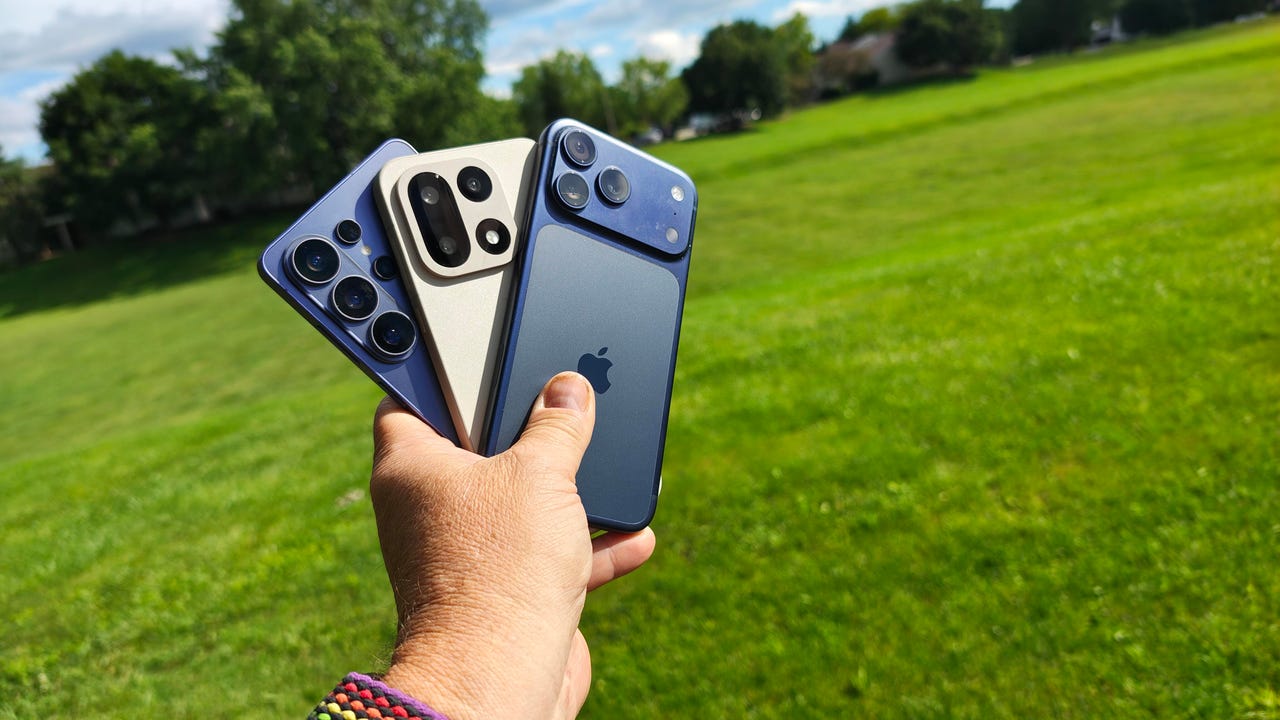
I tested fast chargers with the best iPhone, Samsung, and OnePlus phones – and two surprised me


charging-leader

Man holding three phones.

Adam Doud/ZDNET

Follow ZDNET: Add us as a preferred source on Google.


ZDNET’s key takeaways

  • I tested three fast-charging smartphones.
  • I used OEM and third-party chargers.
  • Two phones beat their rated speeds; one fell short.

Charging speed is one of those numbers that marketing people love to toss around. That’s especially true when it comes to OnePlus. It can be a throwaway line, but when new phones launch, you’ll often hear about advertised charging speeds. From 25 watts all the way up to 120 watts, how fast your phone can charge might matter to you. It also matters how fast the plug you buy is, too, because two of our three competitors don’t come with a wall plug.

Also: I cracked open a ‘1,000W’ portable charger after it failed me in minutes – and wished I hadn’t

It’s a little-known fact that, just because a phone can charge at 60W, that won’t be the charging speed for most of its charge time. It’s not even close. But you may be wondering how close it gets. To find out, I charged up a Samsung Galaxy S26 Ultra, an iPhone 17 Pro Max, and a OnePlus 15 and recorded the results. I learned a few things and uncovered a few surprises along the way.

The candidates

The iPhone 17 Pro Max and the Samsung Galaxy S26 Ultra both represent the flagships of the two major phone makers in the US. Chances are, if you’re reading this, you own a phone with the word Samsung or a bitten apple on the back of it. The OnePlus 15 stands tall as what should be possible in the US, but just isn’t. At least it should represent that, but we’ll discuss that in a bit.

Also: I’ve used adaptive chargers with my iPhone and Android for a year – but should you?  

The iPhone 17 Pro Max ships with a 5,088 mAh lithium-ion battery capable of 40W of wired charging. The Samsung Galaxy S26 Ultra ships with a 5,000 mAh lithium-ion battery that charges at 60W. Finally, the OnePlus 15 ships with a 7,300 mAh silicon carbon battery with an advertised charging speed of 120W. I phrased that last one very carefully, as you’ll soon learn.

charging-plugs

Charging plugs from OnePlus, Anker, Apple, and Samsung

Adam Doud / ZDNET

The OnePlus 15 ships with a power plug and cable, while the other two ship only with a cable. Apple sells a 40 W Dynamic Power adapter for $39. Samsung sells a 45W travel adapter with a magnetic wireless charging puck included for $71.25. But if you’re going to buy a charger anyway, why not try a third-party option? I went with Anker in this case since the brand is synonymous with charging. I grabbed an Anker Prime GaN charger and Anker bio cable for $59.99 and $21.83, respectively, on Amazon.

Also: I spent 2 years charging my phone exactly how Apple suggests – here’s where it’s at now  

To test charging speeds, I picked up a Mecheer power meter that displays how much power is flowing through the outlet in real time. For each phone, I ran the test twice — once with the OEM cable and plug and the second time with my Anker setup. Here’s what happened.

The results

Of the data I collected, a couple of things stand out. First, OnePlus’ charger isn’t even close to its advertised 120W speed. In fact, it spent its entire charge time in the 20% to 40% range, maxing out at just 46W on its homegrown charger. The Anker pairing charged the OnePlus and Samsung phones faster than their own chargers, which I find to be simply funny. 

Also: I cracked open cheap charging gadgets from Temu – and it was worse than I expected

In another interesting bit, the S26 Ultra, which is rated at 60W, actually peaked at 61W. Similarly, the iPhone, which is rated at a maximum of 40W, spent its first five minutes exceeding that mark.

charging-percent.png

Four graphs showing percentage over time.

Adam Doud / ZDNET

Total charge times ended up like this:

charging-times-total.png

Charging times for the phones

Adam Doud / ZDNET

Samsung was surprisingly agile, going from dead to fully loaded in under an hour. OnePlus stayed in the middle of the pack with just over an hour, and the iPhone brought up the rear with over 90 minutes for a full top-off. This is why I usually charge my iPhone overnight. But of all those results, I found Samsung to be the most pleasant surprise and the OnePlus 15 the biggest disappointment. 

Also: A common charging habit was quietly killing my iPhone’s battery – here’s the fix

OnePlus’ days of charging dominance seem to be over, and that’s frankly a shame.

charging-wattage.png

Four graphs showing wattage over time

Adam Doud / ZDNET

Here are some fun facts for you. If you have to buy a charger, go ahead and get a third-party option. A Samsung phone charges at about 3% per minute for the first 60% and only slows down after that. The other two phones go at about 2% per minute for the first 50%.

speed-percent.png

The amount of time each charger spent at each level of charging

Adam Doud / ZDNET

Also: I used the ‘Plus Five’ rule to fix my iPhone’s slow wireless charging – here’s how it works

So, at the end of the day, charging speeds are largely overrated. Aside from OnePlus, which sat below 40% of its advertised charging threshold the entire time, the other two phones spent most of their time hovering between 20% and 60% of capacity. I find this to be not surprising, but incredibly disingenuous, to say the least. It’s almost to the point where I’d rather just not know what the charging capabilities are — I’d rather not know than know something incorrect. But that’s me.




Source link

Leave a Reply

Subscribe to Our Newsletter

Get our latest articles delivered straight to your inbox. No spam, we promise.

Recent Reviews


When you envision a tropical getaway in the Philippines, Bohol is often associated with the Chocolate Hills and the large, lively beaches of Panglao Island. For most tourists, the adventure begins the moment they step off the Cebu to Bohol ferry, eager to immerse themselves in the island’s legendary beach lifestyle. 

However, there is a secret that only experienced island-hoppers and natives know: the best beach in Bohol is actually not where all the action is.

Have you ever been to Bohol and found yourself dodging selfie sticks or competing for a square inch of sand? Then you know that the magic doesn’t happen where the crowds are, but when you get off the beaten path. But what is it about these less-visited shores that are stealing the hearts of those who know where to look? Let’s find out. 

The Psychology of Paradise: Why Less is Truly More?

There is a particular type of peace that can only be achieved when the loudest sound you can hear is the retreat of the tide over broken coral. In the more popular areas of the island, the beach experience is almost like a show with music from bars, street vendors selling sunglasses, and the ever-present sound of motorized boats. While this is exciting for a night out, it does not have the heart of a real island vacation.

The best beach is more than just the brightness of the sand and the clarity of the water; it is about the sense of being a part of something small and special. 

When you discover a beach that is not on every Top 10 list, you are not just a visitor; you are a guest of the land. You get to witness the local fishermen unloading their morning catch instead of a jet ski line. You get to witness the stars without the neon lights of a bar. 

This is the main reason why travelers are now beginning to seek out something new, something different from the popular Alona Beach.

The Problem with Popularity

Let’s not forget that beaches like Alona are popular for a reason. They are stunning. However, with popularity comes development, and development can lead to the degradation of the very thing that drew visitors in the first place. Overcrowded beaches deal with problems like light pollution (which affects sea turtles), noise that chases away native birds, and the inevitable tourist tax on everything from coconuts to cocktails.

On the other hand, quiet and secluded beaches boast of finer sand and more vibrant reefs because they have not faced the same level of foot traffic and boat anchors. 

So, Where are These Hidden Gems?

If you’re ready to trade the crowds for a bit of solitude, here are the beaches that truly define the beauty of Bohol:

1. Dumaluan Beach

Technically still on Panglao Island but lightyears away from the hustle and bustle of Alona, Dumaluan has a much wider shoreline and shallower waters. It’s a favorite among locals, which makes it have a much more down-to-earth and authentic feel. The resorts are also not as packed, which means you get to breathe.

2. Anda White Beach (Quinale Beach)

Anda is situated on the eastern tip of the island and is also known as the next Boracay, minus the high-rise buildings. The beach is famous for its white and fine sand, which stretches for kilometers. It is also a peaceful haven since it is a few hours away from the nearest port. It is one of those places where you can walk for twenty minutes without seeing anyone.

3. Doljo Beach

Hidden away in the northwest corner of Panglao, Doljo is the best spot to watch the sunset. It is renowned for its untouched coral reefs and historic coconut trees that stretch towards the water. There are hardly any commercial developments in this area, which makes it ideal for a long walk while the sun sets.

4. Pamilacan Island

Although you have to take a short boat ride to get there, the beaches of Pamilacan are famous. This small island used to be a whaling ground but is now a protected marine sanctuary. The water is so clear that it is like glass, and the sand is soft white sand and sun-bleached shells. It is the epitome of an off-the-beaten-path paradise.

5. Momo Beach

If you are looking for a rustic experience, Momo is the place to be. It is a shallow beach that is largely occupied by locals, so it is a peaceful and unpretentious destination that is free from all the usual tourist trappings. It is a good place to sit back and watch the colors of the sky change or to read a book under a palm tree.

How to Get to Your Slice of Quiet?

Does it require more work to reach these destinations? A little bit. But that is the filter that makes these destinations unique. The majority of tourists go with the flow. They alight from the ferry, ride a tricycle to the closest resort, and stay there.

If you want a better experience, you have to plan ahead. Come to Bohol via the Cebu to Bohol ferry, which docks in Tagbilaran City. From there, instead of going with the majority to the southwest, you can rent a scooter or a private car to go east to Anda or north to the less crowded areas of Panglao.

The Verdict: Is it Worth the Journey?

Ask anyone who has ever spent a morning alone on the deserted shores of Anda or a sunset alone at Doljo, and the answer is always a resounding yes.

The best beach in Bohol is not a destination where you go to be noticed. It’s a destination where you go to be forgotten for a little while. It’s all about the indulgence of emptiness, the richness of local culture, and the possibility of reconnecting with nature without the filter. When you move away from the masses, you’re not just viewing a beach; you’re living the essence of the island.

The next time you find yourself planning a trip to the Visayas, remember that the most beautiful sights are sometimes only a few miles beyond where everyone else stops. Are you ready to discover your own hidden shore?

Hi! We are Jenn and Ed Coleman aka Coleman Concierge. In a nutshell, we are a Huntsville-based Gen X couple sharing our stories of amazing adventures through activity-driven transformational and experiential travel.


Source link


