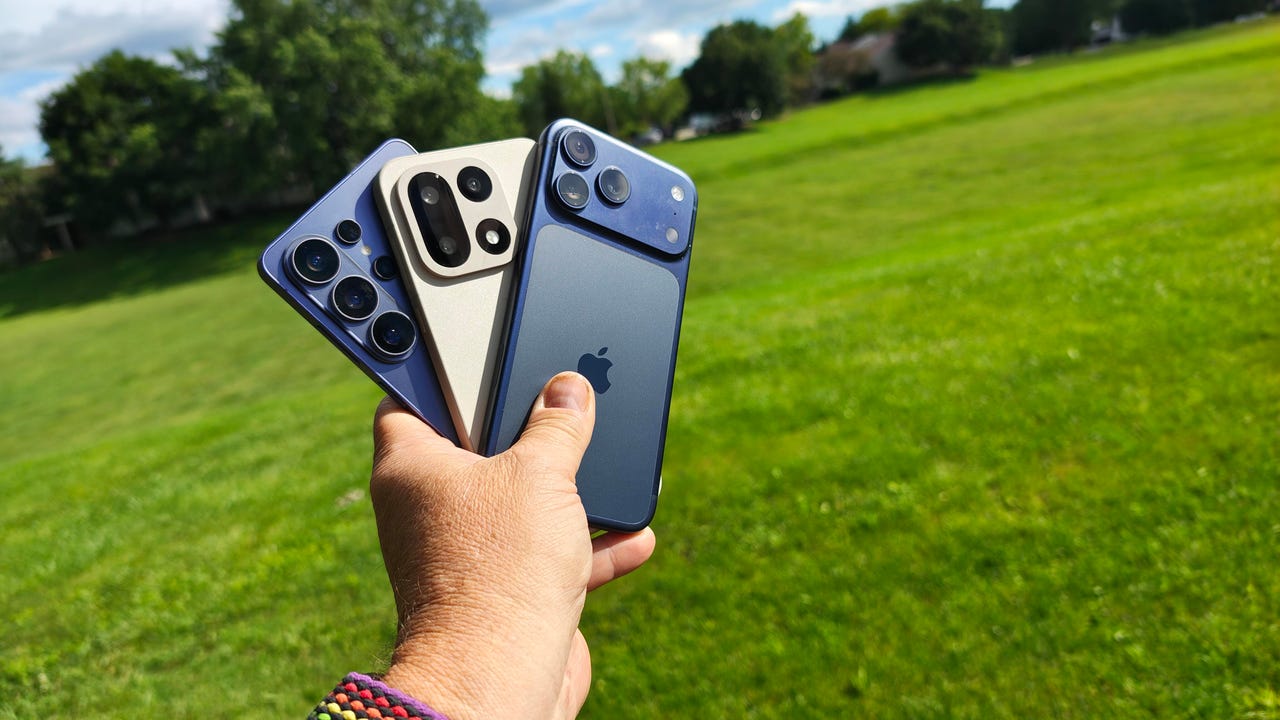

Man holding three phones.
Adam Doud/ZDNET
Follow ZDNET: Add us as a preferred source on Google.
ZDNET’s key takeaways
- I tested three fast-charging smartphones.
- I used OEM and third-party chargers.
- Two phones beat their rated speeds; one fell short.
Charging speed is one of those numbers that marketing people love to toss around. That’s especially true when it comes to OnePlus. It can be a throwaway line, but when new phones launch, you’ll often hear about advertised charging speeds. From 25 watts all the way up to 120 watts, how fast your phone can charge might matter to you. It also matters how fast the plug you buy is, too, because two of our three competitors don’t come with a wall plug.
Also: I cracked open a ‘1,000W’ portable charger after it failed me in minutes – and wished I hadn’t
It’s a little-known fact that, just because a phone can charge at 60W, that won’t be the charging speed for most of its charge time. It’s not even close. But you may be wondering how close it gets. To find out, I charged up a Samsung Galaxy S26 Ultra, an iPhone 17 Pro Max, and a OnePlus 15 and recorded the results. I learned a few things and uncovered a few surprises along the way.
The candidates
The iPhone 17 Pro Max and the Samsung Galaxy S26 Ultra both represent the flagships of the two major phone makers in the US. Chances are, if you’re reading this, you own a phone with the word Samsung or a bitten apple on the back of it. The OnePlus 15 stands tall as what should be possible in the US, but just isn’t. At least it should represent that, but we’ll discuss that in a bit.
Also: I’ve used adaptive chargers with my iPhone and Android for a year – but should you?
The iPhone 17 Pro Max ships with a 5,088 mAh lithium-ion battery capable of 40W of wired charging. The Samsung Galaxy S26 Ultra ships with a 5,000 mAh lithium-ion battery that charges at 60W. Finally, the OnePlus 15 ships with a 7,300 mAh silicon carbon battery with an advertised charging speed of 120W. I phrased that last one very carefully, as you’ll soon learn.
Charging plugs from OnePlus, Anker, Apple, and Samsung
Adam Doud / ZDNET
The OnePlus 15 ships with a power plug and cable, while the other two ship only with a cable. Apple sells a 40 W Dynamic Power adapter for $39. Samsung sells a 45W travel adapter with a magnetic wireless charging puck included for $71.25. But if you’re going to buy a charger anyway, why not try a third-party option? I went with Anker in this case since the brand is synonymous with charging. I grabbed an Anker Prime GaN charger and Anker bio cable for $59.99 and $21.83, respectively, on Amazon.
Also: I spent 2 years charging my phone exactly how Apple suggests – here’s where it’s at now
To test charging speeds, I picked up a Mecheer power meter that displays how much power is flowing through the outlet in real time. For each phone, I ran the test twice — once with the OEM cable and plug and the second time with my Anker setup. Here’s what happened.
The results
Of the data I collected, a couple of things stand out. First, OnePlus’ charger isn’t even close to its advertised 120W speed. In fact, it spent its entire charge time in the 20% to 40% range, maxing out at just 46W on its homegrown charger. The Anker pairing charged the OnePlus and Samsung phones faster than their own chargers, which I find to be simply funny.
Also: I cracked open cheap charging gadgets from Temu – and it was worse than I expected
In another interesting bit, the S26 Ultra, which is rated at 60W, actually peaked at 61W. Similarly, the iPhone, which is rated at a maximum of 40W, spent its first five minutes exceeding that mark.
Four graphs showing percentage over time.
Adam Doud / ZDNET
Total charge times ended up like this:
Charging times for the phones
Adam Doud / ZDNET
Samsung was surprisingly agile, going from dead to fully loaded in under an hour. OnePlus stayed in the middle of the pack with just over an hour, and the iPhone brought up the rear with over 90 minutes for a full top-off. This is why I usually charge my iPhone overnight. But of all those results, I found Samsung to be the most pleasant surprise and the OnePlus 15 the biggest disappointment.
Also: A common charging habit was quietly killing my iPhone’s battery – here’s the fix
OnePlus’ days of charging dominance seem to be over, and that’s frankly a shame.
Four graphs showing wattage over time
Adam Doud / ZDNET
Here are some fun facts for you. If you have to buy a charger, go ahead and get a third-party option. A Samsung phone charges at about 3% per minute for the first 60% and only slows down after that. The other two phones go at about 2% per minute for the first 50%.
The amount of time each charger spent at each level of charging
Adam Doud / ZDNET
Also: I used the ‘Plus Five’ rule to fix my iPhone’s slow wireless charging – here’s how it works
So, at the end of the day, charging speeds are largely overrated. Aside from OnePlus, which sat below 40% of its advertised charging threshold the entire time, the other two phones spent most of their time hovering between 20% and 60% of capacity. I find this to be not surprising, but incredibly disingenuous, to say the least. It’s almost to the point where I’d rather just not know what the charging capabilities are — I’d rather not know than know something incorrect. But that’s me.