
Portland, Oregon-based Leatherman is known for its multitools, which feature a plier-based design built around an iconic butterfly mechanism — unlike the iconic Swiss Army Knife. One would imagine the pricing hierarchy for its lineup would be defined by the number of tools, the materials, and the build quality; while that’s generally the case, it’s not for the pliers. Instead, the blade is how you gauge whether your Leatherman multitool is cheap or expensive.
Except for the military and law-enforcement-specific MUT models that retail at $230, all inexpensive (relatively speaking, of course) Leatherman multitools bearing unmarked knife blades are made from 420HC steel. The $100 Skeletool CX and RX variants charge a $10 premium over the base Skeletool to incorporate premium 154CM steel. However, the flagship Leatherman Arc ($250) and Wave Alpha ($200) are equipped with a knife fashioned from an exotic made-in-USA steel branded as CPM MagnaCut. This steel is usually found in high-end pocket knives priced around $300, and it isn’t uncommon for some MagnaCut knives to hit the $500 mark.
Knife steels are designed to strike an optimal balance between three mutually exclusive traits: toughness, edge retention, and corrosion resistance. MagnaCut is a super steel engineered to significantly outperform both 420HC and 154CM in all three aforementioned parameters. The super steel’s improved toughness allows the knife to be ground thinner, with a blade geometry that cuts effortlessly. Meanwhile, its elevated hardness means it stays sharper for longer and resists corrosion better.
What makes CPM MagnaCut steel so special?
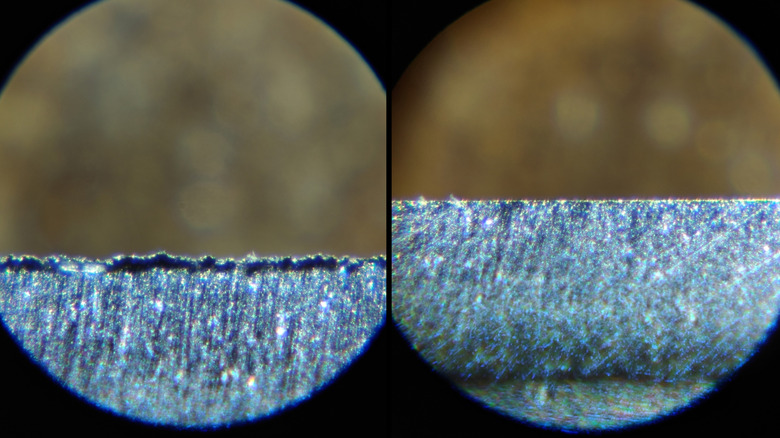
CPM stands for Crucible Particle Metallurgy, a fancy trademark for Crucible Industries’ proprietary technique for manufacturing sintered steel. This process atomizes individual alloying elements into tiny, uniformly shaped balls. These powdered elements are then combined in precise ratios under extreme heat and uniform pressure to form an unnaturally dense metal with a perfect grain microstructure and perfect distribution of alloying elements.
This matters because the complex metallurgy underpinning knife steels essentially boils down to finding the sweet spot between hardness, toughness, and corrosion resistance. For example, increasing the carbon content of steel improves hardness and edge retention, but it also reduces toughness. Adding elements such as chromium, vanadium, and niobium to form carbides improves corrosion and wear resistance but makes the blade edge prone to chipping. Steels manufactured using the CPM process allow metallurgists to fine-tune these blends to nail the performance sweet spot.
That’s basically how MagnaCut manages to hit the Goldilocks zone of chromium content, improving corrosion resistance while inhibiting the formation of chromium carbides. Instead, it has harder and smaller vanadium and niobium carbides throughout, which improve wear resistance and significantly reduce chipping compared to other so-called super steels like CPM Rex 121 – even if it retains edges better than MagnaCut. CPM MagnaCut might not be the absolute best at any single metric, but it is an excellent all-rounder, and that’s precisely why Leatherman uses it on its priciest multitools.

Stephan is the sports journalist for the Maple Grove Report.