
Next week the composition of the Dow Jones Industrial Average will again change.
First, let’s do some history, and then we’ll take a look.
The Dow Jones Industrial Average
Charlie Dow and Eddie Jones
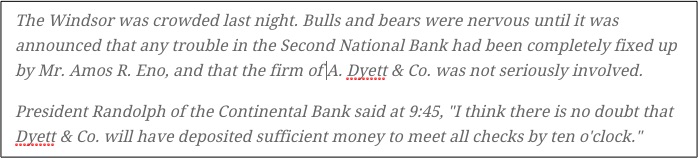
In 1882, three friends started Dow Jones & Company. During every business day, six or seven 14-to-16 year-olds continuously delivered Dow Jones news bulletins created by Charlie Dow, Eddie Jones, and Charlie Bergstresser. They had the facts and the gossip.
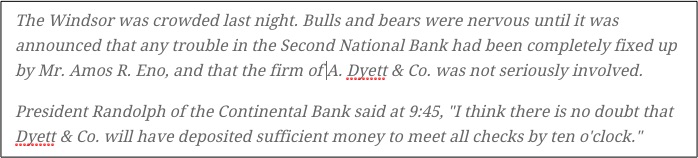
A typical Dow Jones letter might say:
In 1884, they began to publish average closing prices for a group of representative stocks. Reflecting market trends, the first Dow index was composed of 11 companies, dominated by railroads (like the New York Central and Union Pacific) and called the Dow Jones Railroad Average.
The First Dow Industrial Average
Twelve years later, the Dow Industrial Average was created:

Dow Jones Industrial Average, S&P Global
The 1916 average reflected the role played by a young auto industry. You can see that it expanded to 20 companies:

Dow Jones Industrial Average, S&P Global
Finally, during the 1920s, the consumer and the Dow 30 arrived with Sears , Woolworth (a 5 & 10 cent store) and more car companies:

Dow Jones Industrial Average, S&P Global
On Monday, 06/29/26, the Dow will welcome Alphabet. To make room in the 30-company list Verizon will depart:

On Friday, 11/8/24, the Dow added “AI superstar” Nvidia and paint maker Sherwin-Williams. To make room in the 30-company list (previously tweaked with Amazon replacing Walgreens in February 2024), Intel and Dow departed.
To signal the direction of the U.S. economy, the Dow, made the change to more tech. Now, with Alphabet added, it will include five of the six-trillion-dollar tech companies. Only Meta remains the outlier.
Our Bottom Line: Impact on the Dow
We can ask how Alphabet will impact the Dow. Since the Dow is a price-weighted index, share price is what counts. Because, Alphabet’s $349 (or so) share price far exceeds Verizon’s $47.00 (approximate), the Alphabet Verizon switch will bring a new stock that has considerably more impact of the average’s movement than Verizon did at .5%.
Looking back, from the railroads in 1884, and the “smokestack” industries in the 1896 Dow, to its focus on car companies in the 1920s, to the current tech tilt, the Dow is also a history of the industries that fueled our economy. And finally, for a visual history, do enjoy these wonderful CNN pictures of the Dow and the NYSE.
My sources and more: One possibility of many, WSJ had the basic facts on the Alphabet addition to the Dow. However, CNBC had the perfect explanation of the math. Then, for some Dow history, the Library of Congress is a possibility here. Please note that today’s post is an updated version of our past Dow histories.

Nicole Byers is an entertainment enthusiast! Nicole is an entertainment journalist for the Maple Grove Report.