
We may receive a commission on purchases made from links.
Tool users will encounter a dizzying array of brand options when searching for new equipment to support their home improvement projects. Some of the best tool brands on the market share a few commonalities in their approach: most offer a wide-ranging catalog, and many seek to strike the right balance between feature-rich user experiences and cost-effective options. Ryobi is a brand that straddles this divide nicely. The tool brand does deliver some high-powered options that can even outpace more ‘luxury’ brands like Milwaukee. Ryobi is known for its low-cost tools, but even with reduced price tags, users tend to heap high praise on the brand’s equipment.
Throughout the Ryobi catalog, you’ll find good tools at competitive or even steal pricing levels. The toolmaker also sells directly on its own website and at Home Depot (you’ll also find Ryobi gear in other venues at times). This means buyers can easily consider their options online or use a tool in person before making their buying decision. These 14 Ryobi tools are highly rated by owners and cover a wide range of jobs that home improvers often tackle on a typical to-do list.
18V ONE+ Compact Workshop Blower
The 18V ONE+ Compact Workshop Blower is listed on Ryobi’s website for $65 as a bare tool, but it also carries the same price when purchased as a kit with a charger and a 2.0Ah battery. It offers three speed settings to cover a variety of cleanup and clearance tasks. It tops out at 160 MPH, delivering extreme velocity when the job requires a flash of power. The tool is surprisingly small, given the amount of force it generates, weighing just 2.5 pounds. The tool also features a variable speed trigger for enhanced control over its output at a moment’s notice.
The tool has been reviewed by over 700 Ryobi buyers, resulting in excellent ratings. It’s an ideal piece of equipment for cleaning up in a workshop or even around the house. The blower can quickly condense messes for easy scooping with a shovel or further suctioning with your shop vac once you’ve created a pile.
Whole Stud Finder
Ryobi’s Whole Stud Finder is an accessory tool available at Home Depot for $35 and is widely praised by most reviewers. It features a row of LED lights across the top that light up as you move the tool across a wall. The result is an ability to find the entire width of a stud hidden beneath the drywall. This all can be used with one hand and features a built-in stud marker, allowing you to hold accessory equipment in the other hand as you search for and mark studs during a project.
The stud finder can also identify studs in wall elements up to 1-1/2 inches thick and works with both wood and metal. This is a great addition to a home improvement kit because it lets you quickly identify where support studs are hidden. Installing any kind of heavy wall-mounted equipment often requires connecting it to these solid elements, so taking the guesswork out of locating them can speed up many home improvement projects.
18V ONE+ 3/8-Inch Impact Wrench
The 18V ONE+ 3/8-Inch Impact Wrench is a high-intensity power tool that feels like it should cost more than $100, and yet it’s available directly from Ryobi for $99. The impact wrench produces 220 ft.-lbs. of maximum torque while weighing in at just 2.6 pounds itself. The tool delivers a maximum rotational speed of 3,200 RPM and an impact rate of 3,400 IPM. All of these specifications combine to produce a versatile and valuable impact wrench that can help support a growing tool collection.
The impact wrench features three selectable speeds and runs with a trio of LED lights built into the front end of the tool. This delivers solid control over the power tool’s output to cover a variety of job requirements as well as a burst of illumination to handle challenging lighting conditions or work in recessed areas. This is another Ryobi tool with a very high average rating from buyers, indicating its quality performance standards.
18V ONE+ 45W Hybrid Soldering Station
The 18V ONE+ 45W Hybrid Soldering Station stands among some of the best soldering tools you can find for tackling electronics repair and installation tasks. It features hybrid power support, operating with either an 18V ONE+ battery or by plugging directly into a wall outlet for even longer runtime when used in a stationary workspace. The soldering station can be purchased directly from Ryobi for $63. Although it doesn’t come with a battery, it delivers over 4 hours of runtime when paired with a 6.0 Ah HP battery. The station heats up to 900 degrees Fahrenheit, with an adjustable range reaching down to 300 degrees Fahrenheit to cover more delicate operations.
The soldering station offers a 3-foot cord for the iron as well as an iron holder attached to the tool to support good reach and a safe working environment. It includes onboard storage for soldering tips and other accessories while delivering a 45W power output. The station itself also weighs just 2.5 pounds, making it an ideal option for a mobile setup that can be quickly taken on the go when the moment calls for it.
18V ONE+ Airstrike 18 Gauge Brad Nailer
A brad nailer is a middle-of-the-road fastening tool that can be used to meet a range of light- and heavy-duty nailing requirements. This is a tool that can be used in coordination with wood glue and other fastening methods, or as a standalone tool to secure all manner of workpieces to their respective target positions. The brad nailer is a versatile option, and yet the 18V ONE+ Airstrike 18 Gauge Brad Nailer is offered as a bare tool direct from Ryobi for just $99, bringing it right in under the three-figure mark. The tool can also be found in a kit format, but this will naturally raise the price (up to $229 for a charger and 4.0Ah battery).
The Ryobi nailer features Airstrike technology that delivers enough power to drive 2-inch nails into hardwood workpieces. This is also the lightest cordless brad nailer in its class, weighing in at 5.5 pounds. The tool can drive up to 1,900 nails on a single battery charge, though Ryobi doesn’t specify which power pack is required to run that many fasteners. The tool also features a reduced-size nosepiece, allowing greater access to tight spaces and better visibility as you line up the tool to sink a fastener.
6-Inch Bench Grinder
Most power tools a home improver will work with are mobile tools brought to a workpiece or fastener. But this isn’t a hard-and-fast rule, and there is certainly room in any home improver’s collection for a few crucial pieces of shop equipment. The 6-Inch Bench Grinder is a unit that can make a huge difference in keeping a wide range of other tools and accessories in good working order. It’s available directly from Ryobi for $79 and features excellent reviews from past buyers. The grinder is powered by a 2.1-amp induction motor and features a steel base to reduce vibration, and it can be mounted securely to your workbench for firm support.
A bench grinder delivers fast, efficient material shaping and surface preparation. This is a tool you can use to quickly and efficiently sharpen lawnmower blades, resurface a wide range of specialty drill bits and other accessories, and keep tools like chisels and knife blades sharp. The tool comes with two wheels, one in 36-grit and the other in 60-grit specifications, but if you swap one out for a wire wheel or buffing disc, you can also polish up metal components and tool blades, too.
18V ONE+ ½-Inch by 18-Inch Belt Sander
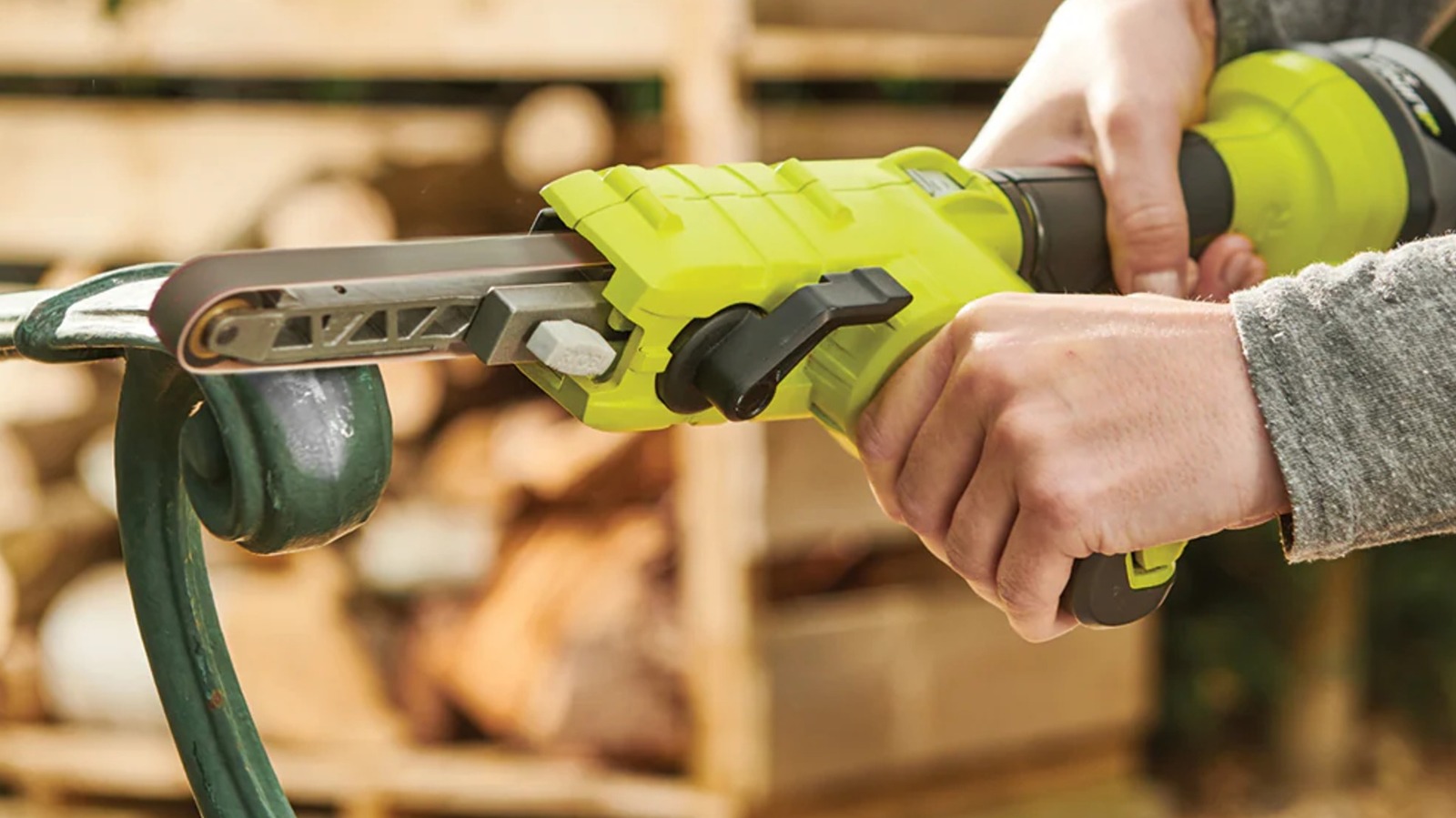
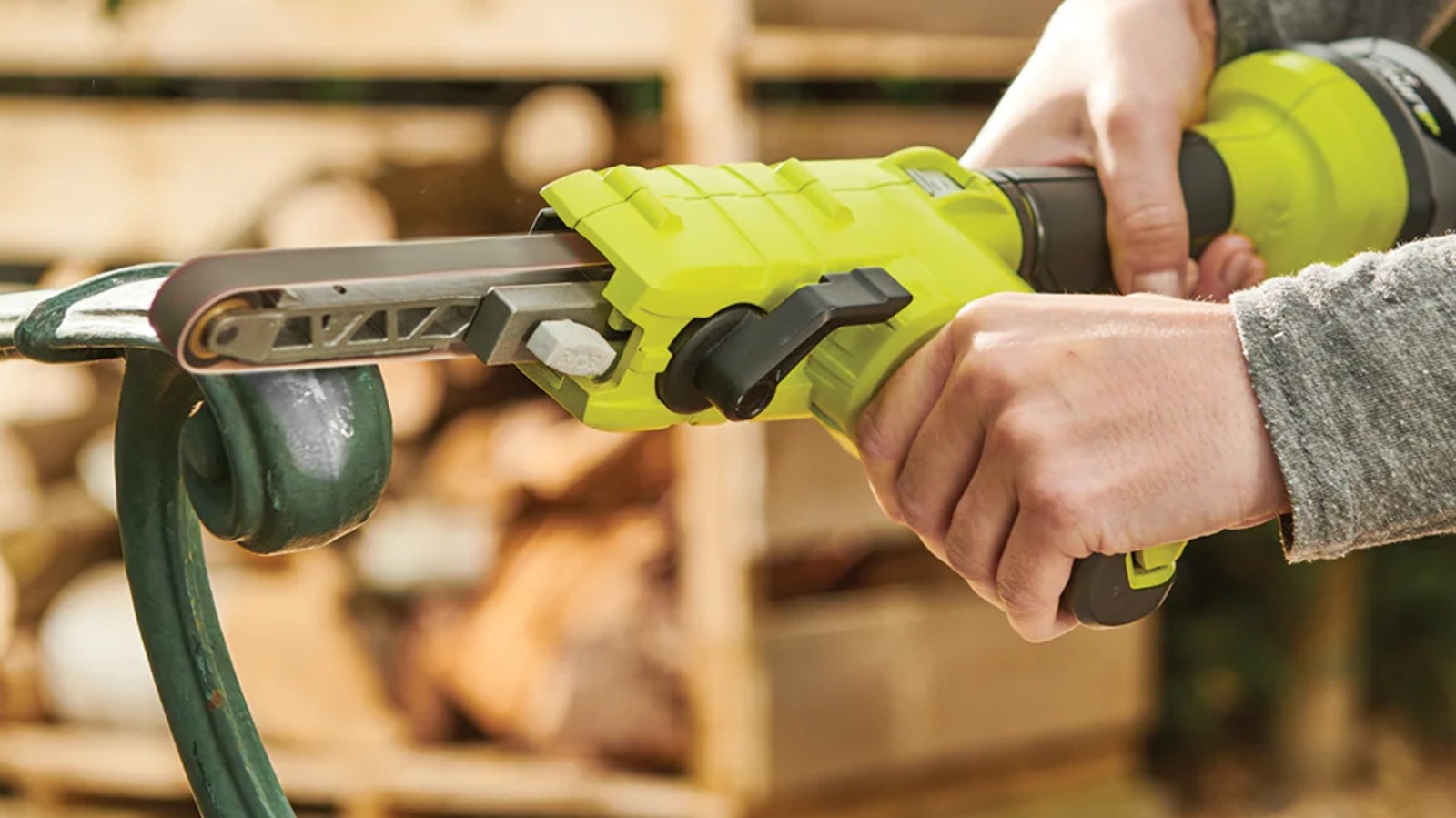
Across the catalog of sanding tools available from Ryobi and other builders, you’ll often encounter some common themes. Detail and orbital sanders are among the most visible options, yet more specialized equipment, such as a belt sander, often remains in the background. This doesn’t make them any less valuable, however, and the 18V ONE+ ½-Inch by 18-Inch Belt Sander is a great option for handling sanding requirements in tight spaces or as a targeted solution for rust removal and other restoration projects. It’s available directly from Ryobi for $99 and features an ergonomic body design that’s easy to grip and maneuver. This allows for great control throughout the sanding process.
The tool offers up to 90 minutes of runtime and weighs just 3.2 pounds. It features a thin belt just half an inch wide, but the 18-inch length is more than capable of delivering extreme sanding speeds when required. It delivers a range of 880 to 2,065 sanding feet per minute. This tool can easily reach recessed areas and other hard-to-access points, providing comprehensive sanding coverage that can significantly reduce the amount of hand sanding you need to finish a job.
65-foot Laser Distance Measurer
The 65-foot Laser Distance Measurer is available at Home Depot for $42 but retails for $30 directly from Ryobi. Buyers across the board give it high praise, and the tool offers an accuracy of +/- 5/64 of an inch at its full 65-foot laser range. The tool features onboard memory to store your last reading and offers five different units of measurement to support a range of specific needs. The tool features continuous measurement that calculates distance in real time and provides instant results as you move it. It uses a simple one-button control to make using the measurement tool as easy as possible.
This is a great option for renovators working outdoors or installing whole-room built-in units. Measuring distances that go beyond what your tape can handle without a helper can be tricky without a tool like this. As a result, this can be a solid augmentation to your toolkit that makes numerous layout and measurement tasks easier to complete.
18V ONE+ Compact Router
The router is a tool that can help you continue your journey as a woodworker or renovator by adding the ability to cut detailed edges or recesses in workpieces. A router offers an extreme level of customization and can smooth out sharp-edged details with ease. This is a rapidly spinning cutting tool, and if you aren’t prepared to handle it, it can easily be counted among potentially dangerous pieces of equipment. However, that shouldn’t dissuade users from investing in one. Giving the tool the respect it deserves will keep you safe while opening up a new world of finer detail work in your projects.
Ryobi’s 18V ONE+ Compact Router is available as a bare tool for $79 directly from the outlet, and it can also be found in a kit format for $124, pushing the price just over the three-figure barrier. The router offers up to 30,000 RPM cutting speeds and features a variable speed dial that lets you rein it in, bringing the speed down to 20,000 RPM. It uses a ¼-inch collet and features an ergonomic design for a solid grip on the tool. As well, this tool features a more compact design, with a 20% reduction in size compared to Ryobi’s standard model. This makes it easier to hold on to and delivers a more enjoyable operating experience overall.
18V ONE+ Jig Saw
The 18V ONE+ Jig Saw is a classic tool that belongs in every renovator’s toolkit. If you aren’t already working with a jigsaw, adding one to your collection should be near the top of your priority list. Jig saws allow you to make sweeping cuts that curve along their trajectory, which is not something that really any other powered cutting tool can reproduce. Importantly, this Ryobi model is listed at $79 as a bare tool direct from the outlet, offering an incredibly cost-effective way to add one to your kit. The tool features a variable-speed trigger with four orbital settings, a 1-inch stroke length, and a maximum cutting speed of 3,000 SPM.
The tool features a non-marring shoe and bevels to both the left and right sides for solid coverage across the spectrum of demands you might ultimately place upon it. It uses T-shank cutting blades and a tool-free blade release system for easy swaps, so you can get right back into the action when your blade goes dull.
11-in-1 Multibit Screwdriver with Cushion Grip Handle
The 11-in-1 Multibit Screwdriver with Cushion Grip Handle is less expensive than the average tool on this list, but that doesn’t make it any less impressive or valuable as a workshop addition worth considering for your kit. Multibit screwdrivers are available in a wide range of layouts and varieties. This option features a cushion-grip handle and a double-ended shank that allows use with both screw-driving bits and nut drivers. The screwdriver comes with eight bits and three nut-driving bits, along with the typical accessories you’d expect, plus two square bits and two TORX bits to support a wide range of fastening needs.
The screwdriver can be found at Home Depot for $15 in this format, and it has been reviewed by over 350 buyers, with great praise in their collective feedback. Having a multibit screwdriver on hand allows you to cut down on the number of individual implements you have to keep track of and organize. Even if you lose or break a bit, which will happen as a natural byproduct of any kind of renovation work, it’s far simpler to buy a new set of fastening accessories than replace a full screwdriver missing from your setup.
USB Lithium Screwdriver Kit
Another screwdriving tool worth investing in is the USB Lithium Screwdriver Kit. This is a powered screwdriver that takes most hand fastening requirements out of the picture. It’s part of Ryobi’s USB Lithium lineup, delivering a scaled-down size with still-worthy performance and USB-C recharging capabilities.
The tool operates with a pivoting head and a long trigger that’s easy to grip in whatever configuration your job requires. The tool can be used either in a pistol-grip-style layout or as an inline, screwdriver-like configuration. It also utilizes dual LED work lights and an onboard bit storage element just beneath the screwdriver’s ¼-inch collet.
This isn’t a heavy-duty installation tool, obviously, but it does offer 55 in.-lbs of maximum torque and a 200 RPM top speed, providing more than enough driving force for a wide range of installation and basic repair tasks. The tool can be found at Home Depot for $50 with its battery and a charging cable included.
18V ONE+ 10 oz. Caulk and Adhesive Gun
Ryobi’s 18V ONE+ 10 oz. Caulk and Adhesive Gun is a tool that can take a heap of pain and frustration away from even an experienced renovator. The tool delivers up to 500 pounds of push force, virtually eliminating the fatigue that comes into play after both limited and extensive use of a standard skeleton gun to apply adhesive or caulk. The tool features a variable-speed dial to control output more precisely, and it retracts the plunge rod when you depress the trigger, thanks to its anti-drip technology that keeps messes and wasted material to a minimum.
The tool is available directly from Ryobi for $84 or as a kit with a charger and 1.5 Ah battery for $129. It can work through over 200 10-oz. tubes of adhesive on a single battery charge. It also includes a puncture tool built into the unit, allowing users to prep and apply caulk and other tubed materials, all without reaching for any support elements.
18V ONE+ Belt Sander
It’s common to have multiple sanding tools in your arsenal to handle a variety of different needs. The 18V ONE+ Belt Sander builds on what virtually all other sanders can do with a 3-inch-wide belt that offers significant coverage for swift material removal.
The sander delivers up to 850 FPM belt speeds and features a front pommel handle that adjusts to five positions to support user comfort and access needs. The front of the belt is also not covered by the tool’s body, allowing you to push it right up against a workpiece for greater access along the curvature of its track. The tool weighs 7.6 pounds and operates as a cordless tool, but delivers corded-equivalent output for a consistent, high-powered finish.
A full-sized belt sander is a great addition to any kit, and with the extreme sanding volume it brings to the table, you might expect one of these tools to be fairly expensive. Yet the sander can be found directly from Ryobi for just $83. Naturally, it also features high overall ratings from buyers, with nearly 300 reviewers providing feedback.
Methodology
All of these tools have received at least a 4-star average rating from 100 or more buyer reviews. Many of them have well over 1,000 customer ratings. Each one can make a big difference in adding versatility to a toolkit, with a range of tools included for consideration.

Stephan is the sports journalist for the Maple Grove Report.