How Does The Modern Dodge Demon Logo Differ From What Was Used In The ’70s?


Even if it wasn’t the first production car to break the 1,000-hp barrier, the modern Dodge Challenger SRT Demon is a heavyweight of the contemporary muscle car era. When it arrived in 2018, the Dodge Demon took what was already the mega-powerful Dodge Challenger SRT Hellcat and amped up its performance in a big way. Power climbed to 808 hp and eventually hit 1,025 hp with the ultra-limited 2023 SRT Demon 170. 

What longtime Mopar fans and auto historians know, though, is that 2018 wasn’t actually the start of the Dodge Demon story. The Demon model name stretches back over 50 years of Dodge history to the early 1970s. Along with its massive jump in horsepower, technological advancements, and higher price point, the Demon’s logo also changed significantly during its long hiatus. 

For Dodge, updating the Demon’s logo for the 21st century was not a quick process, nor was it taken lightly. As with the original muscle cars of the ’60s and ’70s, marketing is a big part of the formula for their modern equivalents, and the SRT Demon was a brilliant example.  For the new car, the Dodge marketing team went with a more modern, Hellcat-influenced, and, most would say, more evil Demon logo compared to the cartoonish version used on the 1970s car.

From the 1970s to the 2020s
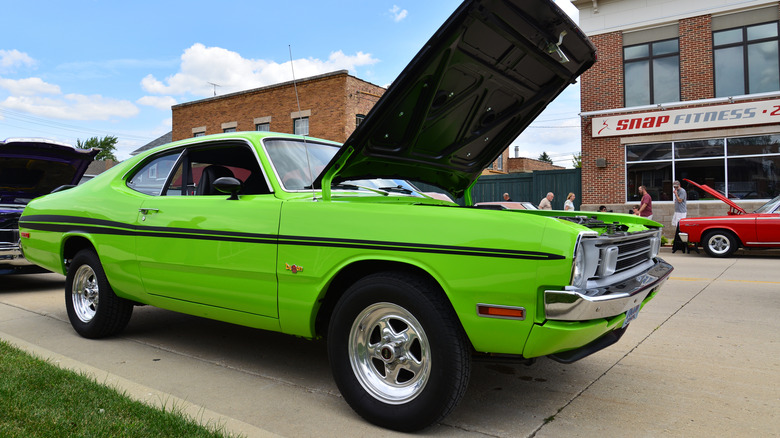
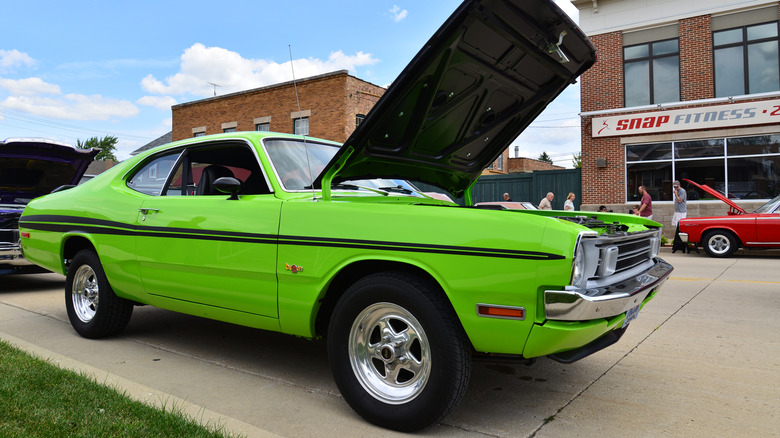
Before we get into the details of the modern SRT Demon’s logo, it’s time for a quick history lesson on the short-lived, original Dodge Demon. While the name might bring to mind images of a wild, HEMI-powered monster muscle machine, the 1971 Dodge Demon was actually a smaller, affordable two-door coupe for the Dodge brand. Dodge based it on the popular but now oft-forgotten Plymouth Duster, which had arrived one model year earlier. 

The ’71 Demon essentially just took the Dodge Dart’s front end and put it on the Duster’s body. With the new model name came a new logo, featuring a very 1970s-looking cartoon devil character holding an upside-down pitchfork, inspired by the Little Devil comic book character. The Demon’s logo fit right with Chrysler’s muscle-car iconography of the era, which included Plymouth’s Road Runner character, the Dodge Super Bee, and the Duster’s own tornado cartoon motif. 

While it may seem cute and innocent now, the Demon’s name and logo proved controversial with religious groups of the time. Dodge eventually renamed it the Dodge Dart Sport for the 1973 model year, by which point the outlandish marketing trends of the original muscle car era had already begun to subside. The Dodge Demon name then returned briefly in 2007, but only on a small sports-car concept that never reached production. 

A bigger and badder Demon

Fast forward to the late 2010s, and Dodge fully revives the Demon nameplate on a more powerful, drag-focused variant of the Dodge Challenger SRT Hellcat. When designing a logo for the new Demon, Dodge’s design team drew inspiration from the original early ’70s Demon cartoon character, but moved things in a more modern direction. Ultimately, the team settled on a design that blended elements of the original logo with the modern SRT Hellcat logo. It was meaner and more sinister-looking, while still paying homage to the original.

Of course, the new Demon logo wasn’t just an emblem on the side of the car; it would become a key part of the car’s launch and marketing blitz and, ideally for the Dodge team, a big part of the SRT Demon’s personality. The logo received some updates with the subsequent release of the even more powerful Demon 170 model, including yellow eyes and a “170” neck tattoo. 

Both the evolution of the Demon logo and the lack of modern controversy surrounding the name show just how much things have changed since the original Demon’s early 1970s debut. That’s only fitting, really, given how much faster and more extreme the modern version of this muscle car is compared to its predecessor.


Source link

Leave a Reply

Subscribe to Our Newsletter

Get our latest articles delivered straight to your inbox. No spam, we promise.

Recent Reviews


Managing a small business is a balancing act, and staying on top of SARS requirements is a non-negotiable part of the journey. As we enter the 2026/27 financial year, this guide provides the essential dates and updated thresholds you need to keep your compliance on track and your cash flow healthy.

The 2026 Budget Speech introduced significant shifts (most notably a major change to VAT registration) designed to reduce red tape for entrepreneurs. Here is how those changes translate into your key tax moments.

1. Value-Added Tax (VAT): The VAT201 Return

VAT is the 15% you add to your sales. Think of yourself as a collection agent for SARS; this money isn’t yours, you’re just holding it for them. A VAT201 is the form where you declare how much VAT you collected from customers minus the VAT you paid to your suppliers.

  • The Current VAT Rate: Remains unchanged at 15%.
  • What’s changed? As of 1 April 2026, the compulsory VAT registration threshold has more than doubled, increasing to R2.3 million (up from R1 million). This means small businesses earning less than R2.3 million per year are no longer required to register as a VAT vendor.
  • Voluntary Registration: The minimum turnover threshold required to voluntarily register for VAT has increased to R120 000 (up from R50 000) (up from R50,000).
  • Deadline: For eFiling, returns and payments are due by the last business day of the month following your tax period.

Impact: Businesses with taxable income lower than the registration threshold of R2.3 million may deregister for VAT if they do not want to be registered under voluntary registration.

2. Monthly Payroll: The EMP201 Return

If you have employees, you must deduct tax from their pay and send it to SARS. The EMP201 is a monthly declaration that combines PAYE (employee income tax), SDL (skills levy), and UIF (unemployment insurance). What’s changed for your staff? The 2026 Budget increased Medical Scheme Tax Credits to R376 per month for the main member and first dependent.

  • Additional dependents increased to R254 per month. Ensure your payroll reflects this so staff receive the correct take-home pay.
  • The bottom line on tax brackets: Personal income tax brackets were adjusted by 3.4% for inflation. This helps prevent “bracket creep,” so your team isn’t taxed more simply because their salaries rose to keep up with the cost of living.
  • Deadline: The 7th of every month. (If the 7th is a weekend, pay by the Friday before).

3. Provisional Tax: The IRP6 Return

Provisional tax is just a way for business owners to pay their Income Tax in “pay-as-you-go” installments. An IRP6 is the form you use to estimate your profit and pay the tax on it in advance.

  • 31 August 2026 (First Period): Pay 50% of your estimated total tax for the 2027 year.
  • 26 February 2027 (Second Period): Your final estimate and payment for the year.
  • 30 September 2026 (Third ‘Top-Up’ for 2025/26): If you under-calculated for the 2025/26 year, paying by this date helps you avoid backdated interest.

4. Filing Seasons: Employer Reconciliations (EMP501)

Twice a year, SARS asks you to prove that the monthly amounts you paid (the EMP201s) match the actual tax certificates (IRP5s) you gave your employees. The EMP501 is this final “check-up” form.

  • 1 April – 31 May 2026 (Annual Filing): Covers the full year just ended (March 2025 – Feb 2026).
  • September – October 2026 (Interim Filing): The half-year check for the current 2027 year.

Compliance Note: SARS now strictly validates Employee Tax Reference Numbers. Submissions with “dummy” numbers will be rejected. Make sure you avoid this mistake to avoid potential penalties. 

5. Your 2026/27 Strategic Checklist

Think of this as your business “health check.” It’s about ensuring your books reflect reality so you can make better decisions for the year ahead.

[ ] Claim your Small Business Corporation (SBC) relief: If you qualify, the first R99,000 of your taxable income  is now tax-free. Check with your accountant if you meet the criteria to save on the flat corporate tax rate.

[ ] Offset your “Bad Debts”: Run an Aged Receivables report in Xero. If invoices are unlikely to be paid, write them off. This lowers your taxable profit by telling SARS you never actually received that income.

[ ] Leverage the Asset Write-off: Ensure your Fixed Asset Register is updated in Xero. SARS allows “wear and tear” deductions for equipment like laptops or machinery, which reduces your tax bill.

[ ] Audit your VAT Status: Check your turnover against the new R2.3 million threshold. If you’re below the new limit, discuss with your advisor whether staying registered is still the right move for your business.

Was this article helpful?

YesNo


Source link