
Every outdoor athlete knows the moment — the canopy breaks, a tunnel mouth opens, a ridge crests into direct sun, and for a handful of heartbeats the road ahead simply disappears into white light, with the eyes scrambling to catch up while the body is still moving at full speed.
That split-second blindness has a name among cyclists: the blind second, and it is the problem that POVEC co-founder Alexis set out to solve after a ride in the French Alps ended with a hidden rock, a sudden crash, and the realisation that decades of eyewear technology had quietly accepted a safety gap it had no tools to close.
Traditional solutions fall short in predictable ways, with photochromic lenses taking anywhere from 30 to 60 seconds to transition fully, a timescale that renders them largely useless for high-speed sport, while fixed tints demand a choice between too dark for shadows and too light for glare, with no middle ground available mid-ride.
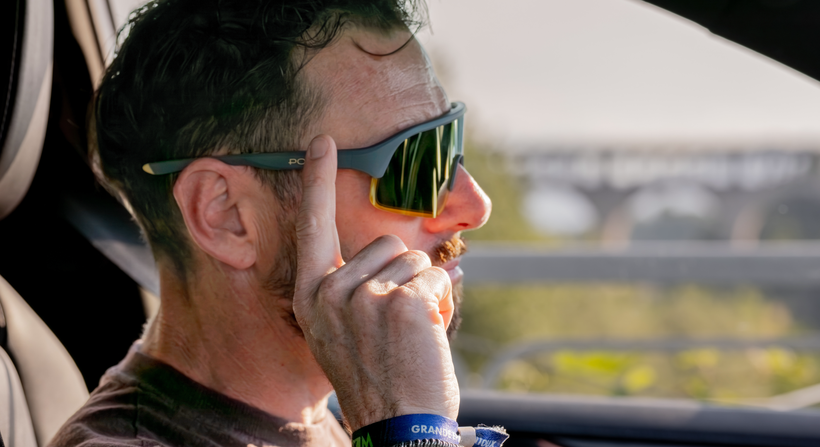
The POVEC C1 addresses that gap with a solid-state electrochromic lens system that switches between three tint modes; Clear, Dark, spanning Category 2 to Category 3 on the European lens classification scale — in approximately one second via a single swipe gesture on the frame.

The technology behind the lens
The credibility behind that claim rests on automotive-grade foundations, with the electrochromic materials supplied by Ambilight, a materials science company whose core research team includes 15 PhDs from Stanford and Purdue University and whose solid-state electrochromic technology is already deployed across 200,000-plus vehicles worldwide, including the Audi E5 Sportback, earning the company a place on MIT Technology Review’s TR50 list of the world’s 50 smartest companies in 2025.
What separates solid-state electrochromics from the liquid crystal dimming systems found in competing smart eyewear is the complete absence of fluids, moving particles, and polarisation layers, which means zero optical distortion under physical pressure, a property that matters considerably when a pair of glasses is absorbing trail vibration, sweat, and the occasional impact at speed.
The C1 draws power only during the one-second transition itself, holding its tint state without any continuous current draw, which contributes to a claimed battery life of up to 28 days based on four hours of daily use, with recharging handled via USB-C, and the full package arrives at 36 grams, competitive with high-end conventional sport frames and well within the weight threshold where eyewear stops registering on the face.

Built for performance, validated in the field
POVEC debuted the C1 at CES 2026, where it drew coverage from Forbes, Mashable, and Interesting Engineering, with Mashable naming it the best sports glasses at the show, before bringing production-ready units to the Sea Otter Classic in April 2026, where professional and amateur cyclists tested the glasses on actual trails and returned consistent feedback that the switching speed performed exactly as advertised.
More than 200 athletes have now tested the C1 across cycling, skiing, and hiking conditions, with the reported experience centering on a quality that is arguably the highest compliment performance gear can receive: that the technology disappears entirely into the activity, reducing lens management to an instinctive swipe rather than a conscious decision.
The frame itself is constructed from TR90 nylon, a material standard in performance eyewear for its balance of lightness and flexibility, with three interchangeable nose pads for fit customisation, an IP65 water-resistance rating covering sweat, rain, and trail spray, and impact resistance validated through high-velocity drop ball testing, giving the C1 the structural credentials to accompany the lens technology it houses.
The POVEC C1 is scheduled for global launch at the end of June 2026 and will be available to order at povecoptics.com. The launch will coincide with POVEC’s presence at EUROBIKE 2026 in Frankfurt, Germany, from June 24–27, where the brand will showcase the product to international media, KOLs, and cycling industry partners.

Stephan is the sports journalist for the Maple Grove Report.