
Follow ZDNET: Add us as a preferred source on Google.
ZDNET’s key takeaways
- Proton debuts Lumo 2.0, overhauling the chatbot for increased security and responsiveness.
- The maker of ProtonMail and ProtonVPN says its AI bot is never trained on user data.
- The latest Lumo targets consumers and businesses that want to keep conversations private.
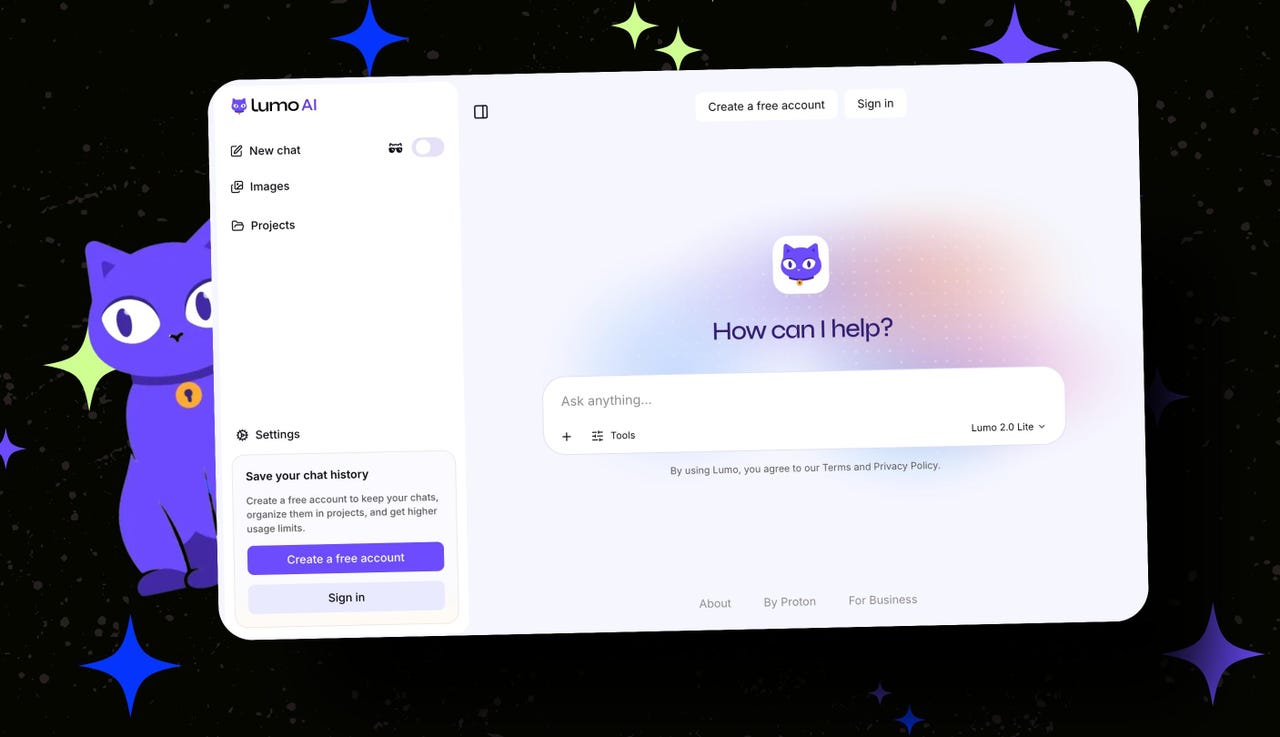
Proton, best known for its ProtonMailVPN and encrypted email service ProtonMail, has announced Lumo 2.0, the second iteration of its ‘privacy-first’ AI chatbot, featuring “the most significant change since launch.”
First announced in 2025, Lumo arrived as a privacy-preserving alternative to popular AI models such as OpenAI’s ChatGPT and Anthropic’s Claude. While able to perform many of the same tasks — answering user queries, searching the web, generating content including text and images, and analyzing uploaded files — Proton emphasizes security and privacy features that other AI models don’t prioritize.
Also: Privacy in the AI era is possible, says Proton’s CEO, but one thing keeps him up at night
To date, over 10 million people have used the open source chatbot.
What’s new in Lumo 2.0?
According to Proton, the AI chatbot’s capabilities are steadily growing.
On the independent Artificial Analysis Intelligence Index, which measures AI across 10 benchmarks, Lumo 2.0 has recorded a 127% improvement in functions, including speed, reasoning, and knowledge, compared to Lumo 1.4.
Other upgrades include:
Also: Chrome vs. Edge vs. Firefox: I tested each browser’s AI, but I’m only sticking with one
- Modes: Two new modes are now available, which give you the option between rapid responses for generic and basic queries (“fast” mode) or more in-depth answers that require multi-step reasoning (“reasoning” mode).
- Images: Lumo can now process both text and images in the same conversation, and the same encryption standards apply to images as well. Image generation based on prompts has also improved.
- Web search: Proton has also improved Lumo’s web search functionality. In Lumo 2.0, you can pull live results and view citations, which should reduce the risk of error. The model now stays up to date on recent news, events, finance, and weather, which Proton says will provide “more accurate, more complete answers with fewer hallucinations.”
- Memory: An improvement that business users in particular may appreciate is deeper contextual memory functions. You can choose how much information is retained about you and your preferences, which can improve the quality of future conversations and work tasks — such as managing documents and datasets.
- Projects: Dedicated, secure workspaces are now available to store conversations, files, and instructions.
- Custom personas: You can also develop Lumo to work to your preferences and to create a persona that is most beneficial to you. For example, you can instruct Lumo to act as a trainer, teacher, or personal assistant.
How does Lumo 2.0 protect my privacy?
In the second version of Lumo, the AI assistant’s architecture has been overhauled, and it runs entirely on Proton’s European infrastructure — which keeps the technology and any associated data outside areas with weak or non-existent data protection laws.
Proton is based in Geneva, which means its software and solutions are protected by Swiss privacy laws, among the most stringent in the world. Swiss laws align with many of the principles enshrined in the EU’s GDPR protections, but tend to go further, with a guaranteed right to privacy and strict requirements for foreign data requests.
Also: How to troubleshoot your PC problems with Copilot or ChatGPT – effectively
Another significant privacy measure is Proton’s use of zero-access encryption. Messages are encrypted, and once a response has been generated, this information is stored locally so only the user can access and decrypt it, meaning that even Proton can’t read or use your data.
“Your messages are encrypted across the entire network, including Proton’s internal pipeline, until they reach the LLM, which keeps no logs of your chats,” Proton says. “On the way back, the reply is secured with the same encryption strategy, ensuring your message never crosses any network boundary unencrypted.”
There’s also a Ghost mode, which users can enable to ensure chats disappear once conversations are over, and your conversations, data, and inputs are not used to train the AI model. Proton also doesn’t store logs or share or sell user information across its security suite, which now includes its LLM.
How to try Lumo 2.0
Anyone can try out Lumo for free. You will need to sign up for an account, but an optional subscription is not required.
Also: The new enterprise AI expert every company needs – and why
However, those who intend to use Lumo daily or businesses that require more than just a private AI window will want to explore Lumo Plus and Lumo Professional. Available for $9.99/month, Lumo Plus offers unlimited daily chats and history, web search, the option to upload and analyze large files, access to advanced AI models, and priority support.
Lumo Professional is the most appropriate option for business use, with features available including secure collaborative tools, cloud storage, email aliases, and additional Proton security features. Plans start at $11.99/month.