Winners from the 2026 iPhone Photography Awards


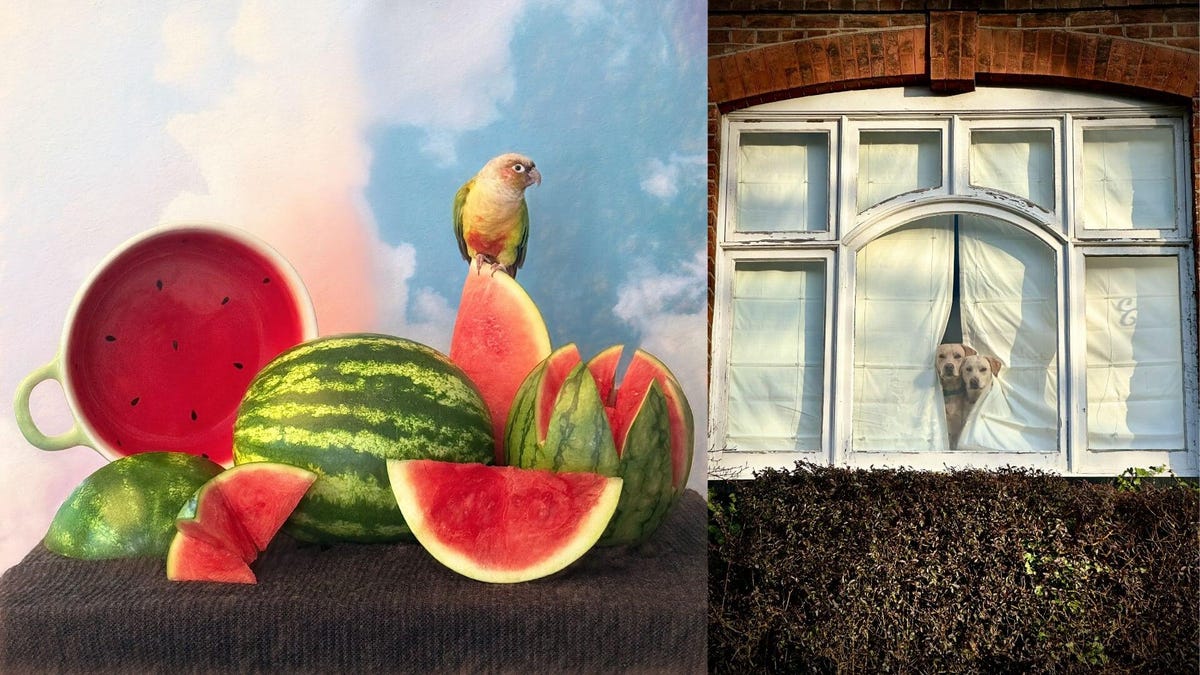
Two photos: a bird on sliced watermelons and two dogs looking out a window.

1 of 14IPPAwards

The 2026 iPhone Photography Awards are in their 19th year of finding the best images captured using iPhone cameras. I’ve collected a few favorites from the winning images, but be sure to view all of the winners at the IPPAwards site

A volcano erupts at night.

2 of 14Robyn Jensen/IPPAwards

Grand Prix: Robyn Jensen

Robyn Jenson’s photo of an erupting volcano in Guatemala at night is a challenge for an iPhone’s cameras.

Shot on iPhone 15 Pro, 6.765mm (24mm equiv), f/1.8, 1s, ISO 12500

Two children in the sun with a badminton racket shadow across them.

3 of 14Gellert Gombai/IPPAwards

First Place: Gellert Gombai

This photo by Gellert Gombai was made using an iPhone X, a phone likely older than the two children who are the subjects.

Shot on iPhone X, 4mm (28mm equiv), f/1.8, 1/1500s, ISO 20

Black and white photo of a black cat against a white wall and a dark doorway.

4 of 14Arnold Plotnick/IPPAwards

Second Place: Arnold Plotnick

If an iPhone photography competition didn’t include a stark photo of a cat, is it even real? US photographer Arnold Plotnick caught this feline’s steady gaze in Amsterdam.

Shot on iPhone 16 Pro, 6.765mm (29mm equiv), f/1.8, 1/60s, ISO 320

04-bronze-145651-21725-81899-1-1-4-catherine-wang-50pct

5 of 14Catherine Wang/IPPAwards

Third Place: Catherine Wang

Catherine Wang of the US turned to a long tradition of still-life photography to compose this scene in Virginia.

Shot on iPhone 16 Pro Max, 6.765mm, f/1.8, 1/40s, ISO 250

A frost-covered car window.

6 of 14Barry Mayes/IPPAwards

Abstract – First Place: Barry Mayes

UK photographer Barry Mayes must’ve warmed to this scene of intricate frost on a car window.

Shot on iPhone 8 Plus, 3.99mm (28mm equiv), f/1.8, 1/120s, ISO 50

Two white dogs peek through a curtain to look out a window.

7 of 14Peter Crome/IPPAwards

Animals – First Place: Peter Crome

Good light and good dogs, all the ingredients for this winning photo in the Animals category by UK photographer Peter Crome.

Shot on iPhone 14 Pro, 9mm (77mm equiv), f/2.8, 1/400s, ISO 32

A bird lifts off from ladder rungs built into a brick tower as seen from below.

8 of 14Leping Cheng/IPPAwards

Animals – Honorable Mention: Leping Cheng

It’s an easy lesson to forget as a photographer: be sure to look up. This mix of perspective and timing garnered an honorable mention in the Animals category.

Shot on iPhone 12 Pro Max, 5.1mm (26mm equiv), f/1.6, 1/2900s

Detail of a white horse's mane against the backdrop of white clouds.

9 of 14Simona Bonanno/IPPAwards

Animals – Honorable Mention: Simona Bonanno

Photography can be as much about concept as it is about capturing a moment. The tuft of mane on this white horse fits with the fluffy clouds in the background.

Shot on iPhone 15 Pro, 6.765mm (24mm equiv), f/1.8, 1/12000s

A young girl runs on a beach carrying a bucket.

10 of 14Krystal Rountree/IPPAwards

Children – First Place: Krystal Rountree

US photographer Krystal Rountree took first place in the Children category with this slice of awareness that a wave is coming soon.

Shot on iPhone 15, 5.96mm (26mm equiv), f/1.6, 1/2500s, ISO 50

A young boy stands in water framed by a tree in the background.

11 of 14Iryna Nemyrovych/IPPAwards

Children – Honorable Mention: Iryna Nemyrovych

This young boy playing in the water is perfectly framed by the arch of the tree behind him. His light skin contrasting with his dark surroundings draws even more attention.

Shot on iPhone 15 Pro, 6.765mm (24mm equiv), f/1.8, 1/4000s

Black and white photo of a break in forest trees with sunlight coming through the gap.

12 of 14Kęstutis Cemnolonskis/IPPAwards

Nature – Honorable Mention: Kęstutis Cemnolonskis

Photography is so often a matter of knowing where the light is and hoping you get lucky. It’s not clear if photographer Kęstutis Cemnolonskis knew the sun would illuminate this break in the grove of trees or if it was an accident, but the capture invites you to wonder.

Shot on iPhone 12 Pro Max, 7.5mm, f/2.2, 1/850s

A table in a train car where the upholstry and curtains are pink.

13 of 14Shan Qin/IPPAwards

Other – Second Place: Shan Qin

Looking almost like the setup for a Wes Anderson film, this composition by Shan Qin evokes a time when train travel was more elegant (or kitschy). 

Shot on iPhone X, f/1.8, 1/950s

A woman in a blue swimsuit, orange swim cap and goggles looks to the side.

14 of 14Carlos Rubin/IPPAwards

Portrait – Second Place: Carlos Rubin

Puerto Rican photographer Carlos Rubin took advantage of this woman’s contrasting blue swimwear and orange cap to make a portrait that goes beyond a snapshot.

Shot on iPhone 12 Pro, 6mm (52mm equiv), f/2, 1/125s, ISO 25


Source link

Leave a Reply

Subscribe to Our Newsletter

Get our latest articles delivered straight to your inbox. No spam, we promise.

Recent Reviews


Today, when one pictures a “classic Dodge Charger”, the first image that pops up is almost certainly one of the highly desirable Charger models from the late 1960s or early ’70s. Indeed, those early muscle car Chargers are iconic, playing a starring role in the “Dukes of Hazzard” television show and, somewhat more recently, “The Fast and the Furious” films. But as time ticks on, is it time to start appreciating the modern version of the Charger as a potential modern classic?

It’s now been over 20 years since Dodge brought back the Charger nameplate for a spacious four-door sedan with an optional HEMI V8 engine. While the basic Charger R/T was a potent machine for its time, Dodge really took the Charger’s game to the next level for the 2006 model year with the debut of the Charger SRT8. 

The SRT8 model used a larger version of the third-gen HEMI V8 that, combined with other performance upgrades, transformed the sedan into a serious performance car capable of running with its 1960s HEMI ancestors at the drag strip — to say nothing of its vastly superior handling and refinement. In the years that followed, Dodge would continue to improve the Charger’s performance with larger and more powerful HEMI engines, but the significance of the original Charger SRT8 is not to be overlooked.

A muscle car legend reborn for the 2000s

Today, with the modern Charger being such an established part of the car enthusiast world, it’s easy to forget some of the controversy that surrounded its mid-2000s return. Most of it focused on the fact that the beloved muscle car nameplate had been brought back for a four-door sedan rather than a retro-styled coupe. Fortunately, those people looking for that retro coupe would be satisfied by the reborn Dodge Challenger when it arrived a few years later, while the Charger went on to become a highly popular muscle sedan in its own right.

The addition of the SRT8 model to the lineup certainly helped, of course. Under the hood was the larger 6.1-liter HEMI V8, which differed from the standard 5.7-liter HEMI in several ways, not least the displacement. With the 6.1 under the hood, the SRT8 made 425 hp and 420 lb-ft of torque, easily laying down a mid-13-second quarter-mile time in Motor Trend’s hands. This was very quick by mid-2000s standards, especially considering the now-outdated five-speed automatic transmission.

But the SRT8’s performance went beyond just the drag strip. As part of the SRT transformation, Dodge also gave the car larger wheels and tires, a retuned suspension setup, and large Brembo brakes. While this didn’t necessarily make the car an agile road course weapon, it did give the SRT8 an athleticism that belied the Charger’s weight and size. 

The evolution of modern Dodge muscle

What’s even cooler about this era in Chrysler/Dodge performance history is that the Charger was just one of the four-door LX platform cars that the automaker offered with SRT badges and a powerful HEMI engine under the hood. Apart from the Charger, buyers could also choose from the more upscale, but ultimately short-lived SRT version of the Chrysler 300C sedan or the Dodge Magnum SRT8 station wagon.

The original Charger SRT8 marked the beginning of a long run of increasingly powerful, high-performance models. In the early 2010s, the Charger SRT8’s 6.1 HEMI was replaced by the larger and more powerful 6.4/392 HEMI, with that motor eventually becoming available in the less expensive Charger R/T Scat Pack. Then, of course, came the Charger SRT Hellcat, with a 707-hp, supercharged 6.2-liter that turned the car into a genuine super sedan.

So is the original Charger SRT8 a guaranteed future classic? Classified listings show that clean examples still bring decent money today, but the fact that it was followed by improved models may ultimately limit its potential for becoming a true, mega-desirable collector car. Regardless, though, the Charger SRT8’s accomplishments in modern muscle car history are not to be taken lightly.


Source link