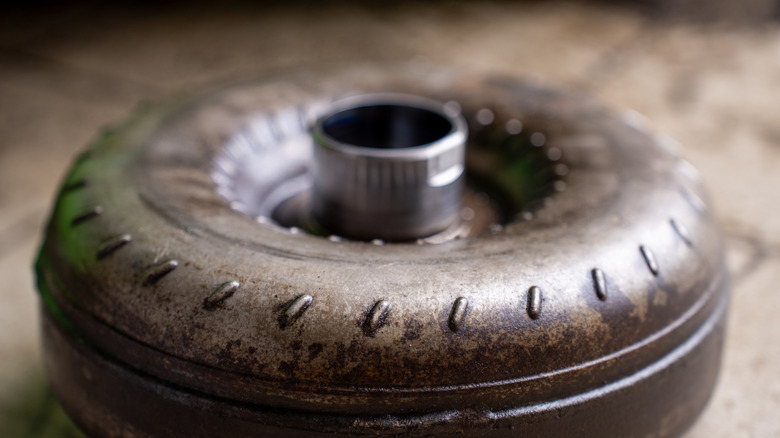

Torque converters serve as the crucial link between traditional automatic transmissions and a car’s engine. If you’re not up to speed on how torque converters work, here are the basics: A torque converter resembles a big metal bagel placed within a transmission’s bellhousing. That bagel is cut in half — the top half is meshed with the transmission, and the bottom with the engine. As the engine spins, it rotates the torque converter’s components, which in turn rotate the transmission fluid inside, like a washing machine. That spinning fluid then spins the parts on the other half, thus spinning the gearbox. In short, a torque converter is a device that uses spinning fluid to transmit power from the engine to the transmission.
But what happens when one fails? There are actually quite a few signs of such a problem, but they all center around odd gearbox behavior. These include gear slippage, loss of throttle response, and inconsistent acceleration, among others. Complete failure will, of course, mean the car has no drive at all, given how the torque converter connects the engine and transmission.
Assuming it is a bad torque converter, expect a pricey repair. Not only are they complex parts that require specialist tools and knowledge to work on, but servicing one requires dropping the transmission — not a quick job. That leaves us with two questions, then: How do torque converters fail in the first place, and what are the warning signs that it’s on its way out?
Symptoms of a failing torque converter
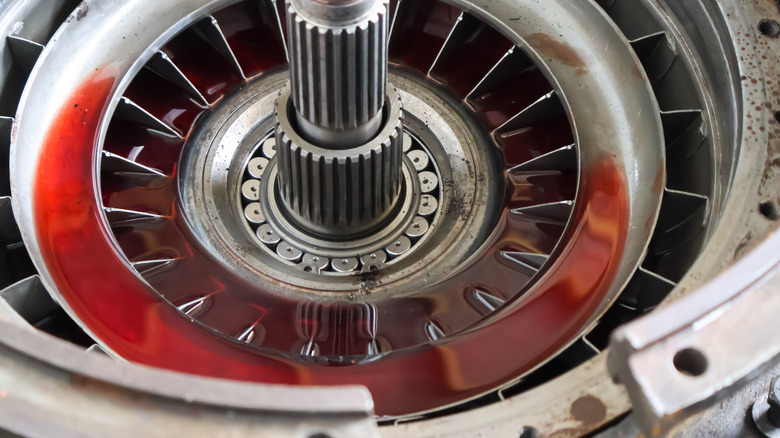
There are a few common symptoms that can occur before a torque converter fails. These include gear slippage and poor throttle control; poor idle performance; an overheating transmission; and discolored automatic transmission fluid (ATF).
These symptoms occur because of how torque converters work. They rely on fluid to transmit power from Point A to B, so issues such as contaminated fluid or problems with the pump that keeps the whole system pressurized will lead to problems. Remember: one end of the torque converter is splined to the engine’s flex plate and the other to the transmission, so faults in any of the torque converter’s vital components can interfere with the operation of one or both. Meaning, if your fluid is bad, you’ll feel it in the power delivery, engine sounding unhappy at idle, and so on.
There are more specific telltale symptoms associated with torque converter failure as well. One major example is if you find your car revving much higher than usual to maintain the same speed, which makes sense if you think about it. With the fluid operating less efficiently (or there being the wrong amount), the engine has to work harder to spin the transmission as quickly, which means more revs. More revs means more heat, leading to an overheating torque converter and a whole host of additional problems.
How these failures occur in the first place, and how to prevent them
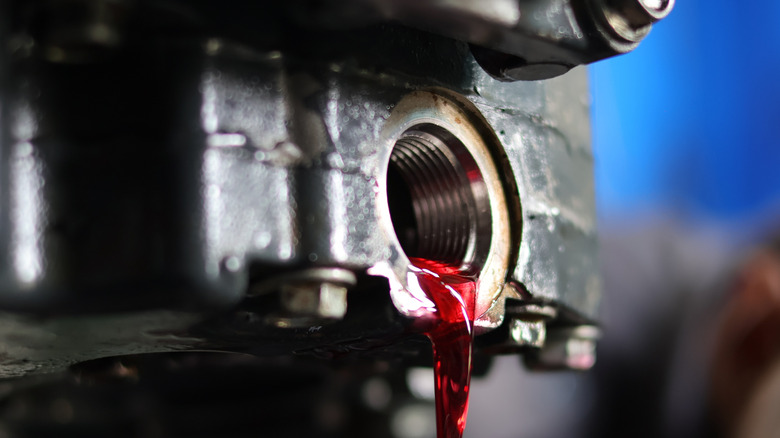
It’s a common myth that you shouldn’t change your transmission fluid, but that couldn’t be further from the truth. Automatic transmission fluid has a service life, and not changing it can lead to serious problems. ATF changes are a regular part of vehicle maintenance, albeit at much longer intervals than engine oil changes. It’s about 60,000 miles for normal cars, and half that (or even less) if you’re frequently abusing the transmission with heavy towing or driving hard.
Improper maintenance is one point of failure, as is simply having a higher-mileage vehicle. The fact is, nothing lasts forever; seals will go bad, internal components will wear out or otherwise get damaged, and so on. Contaminated fluid is another given, which is why you should replace it regularly and periodically check the transmission dipstick if your car has one. Then you have electronic failures, such as a solenoid or a fault with the signals being interpreted by your car’s ECU.
All that said, torque converters and automatic transmissions in general are generally robust components. Unlike a manual transmission with a flywheel and clutch, an automatic marries the torque converter to a flex plate, meaning there’s far less mechanical contact between engine and transmission. Typically, these units last well beyond 100,000 miles with good maintenance. That number will drop drastically if you put significant strain on the parts, but as long as you adjust your maintenance intervals accordingly and watch for those symptoms, you should be good to go.

Stephan is the sports journalist for the Maple Grove Report.