WASHINGTON — The roar of three jets in close formation diving toward the surf broke the tranquility of a secluded beach on the Chesapeake Bay in southern Maryland a couple of weeks ago.
The powerful military planes turned sharply skyward in a synchronized loop-de-loop. Other aerial acrobatics followed for nearly two hours.
It was the Navy’s Blue Angels practicing at a nearby Naval Air Station on the Patuxent River for their show over the National Mall to usher in the celebrations of the nation’s 250 birthday.
The Blue Angel’s “Wings over Washington” aimed to showcase what promoters said is “the thunder of American airpower.” It was also a part of the “Freedom 250” celebrations, the Trump-led commemoration of the semiquincentennial.
The main Freedom 250 event opened last week at the National Mall. It was the Great American State Fair that billed itself as “a world-class exposition and modern-day World’s Fair” aimed at extolling the nation’s greatness.
It features a Ferris wheel, booths promoting most of the nation’s states (10 states, including Illinois, Massachusetts and Vermont, skipped the event) and a wooden replica of a controversial arch President Donald Trump wants to build on a roundabout across from Arlington National Cemetery.
Official planning for the celebrations of the nation’s 250th birthday began in 2016 with the congressional, non-partisan United States Semiquincentennial Commission, called America250.
But after the America250 leadership resisted White House demands to shift the focus toward partisan, campaign-style spectacles, the Trump administration diverted nearly $80 million in congressionally appropriated funds to the National Park Foundation to create Freedom 250 and asked private funders to give to that group instead of the semiquincentennial commission.
The White House’s celebration had problems from the start. Most musicians who agreed to perform at the national fair on the mall — including Martina McBride, The Commodores and Morris Day & The Time — backed out, saying they were misled into believing the celebration was a nonpartisan celebration of America’s 250th birthday.
So, Trump scrapped the opening day concert and announced on Truth Social that it would be replaced by “the Number One Attraction anywhere in the World, the man who gets much larger audiences than Elvis in his prime” — himself.
He gave a 25-minute campaign-style speech and postponed Saturday’s traditional July 4th fireworks display over the National Mall by two hours — so it now begins at 11 p.m. — to give another speech.
There is also controversy over the “Freedom Trucks” — a federally funded fleet of mobile museums that will travel the nation and contain content from the conservative Prager University and Hillsdale College. The exhibits in the trucks portray the founding of the United States as an exclusively religious, Christian project and contain other falsehoods.
Scrapping the loon game
The Great American State Fair has been plagued by poor attendance and intermittent power failures.
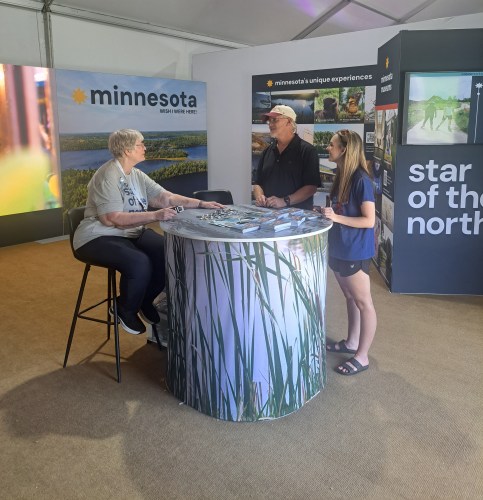
But despite record-high temperatures, Julie Ramer, who ran Minnesota’s booth at the fair on the National Mall this week, said she’s had visitors from all over the United States and overseas.
So many visitors, in fact, that Ramer was unable to hold the “loon game” that was supposed to be featured in the booth. In that game, a visitor would pick one of several small rubber loonlets and receive the small prize described on a sticker at the bottom of the baby bird.

But Ramer said she was too busy providing information about Minnesota to fairgoers to hold the game and put the rubber birds away. Instead, Ramer put the prizes — postcards, buttons and packets of green bean seeds — on a table for visitors to take home.
The manager of the welcome centers run by Explore Minnesota, a state agency that promotes tourism, Ramer said she volunteered to work at the booth and considers it a very positive experience, despite an air conditioner that kept breaking down.
“You can tell that people love being Americans,” she said.
She said most visitors to the booth were eager to learn about Minnesota and many had ties to the state. But there were a few rude individuals.
“They would say something like, ‘I don’t like your state’s politics’ or ‘I’m not going to your state until it changes its ways,’” Ramer said. “When people make those comments, I just don’t engage.”
She also said others in the booth would often chide those hostile fairgoers, telling them that we all have to celebrate the nation’s birthday.
A main reason Ramer volunteered to promote Minnesota in the nation’s Capital was that she had been a part of the bicentennial celebrations in the city in 1976 as a member of her high school band.
She said the band played at venues all over the Washington, D.C., area, including the White House and the Pentagon. “The bicentennial was very celebratory,” Ramer said.
The mood in Washington is different from what it was during the celebration of the nation’s 200th birthday.
Putting Watergate and the Vietnam War behind it, the United States was unified and hopeful, said Ross Baker, a political science professor at Rutgers University.
Planners of that celebration encouraged locally sponsored events. And every day Americans found ways to celebrate in their own special ways; for instance, residents of Washington, D.C., and towns and cities across the nation spontaneously painted fire hydrants as Revolutionary War soldiers, American flags and heroes of the revolution, including Betsy Ross and George Washington.
And instead of a Great American State Fair and its political speeches, there was a 12-week Festival of American Folklife, a collaboration of the Smithsonian with thousands of national and international scholars, folk artisans, and performers.
“What we were celebrating in 1976 was genuine,” Baker said. “This seems trivial and contrived.”
In 1976, the nation had a sense of limited possibility and a sense that the celebration was a significant occasion, Baker said. “Everybody wanted into it; this was a time to really come together,” he said.
But 50 years later, the nation is again at war and politically divided and many are pessimistic about the future. The nation’s political institutions, like Congress, are dysfunctional, Baker said.
And a celebration of a 250th birthday simply does not have the impact of the celebration of the nation’s 200th birthday, he said. “I would bet there will be a lot more enthusiasm for 2076,” Baker said.
In other news:
▪️Matthew Blake writes that the end of enhanced federal premium subsidies — abolished in President Donald Trump’s “big beautiful bill” — continued medical inflation and other factors have led to a sharp drop in the number of Minnesotans receiving health care coverage from MNsure.
▪️The acceptance of free trips from special interests, often to exotic locales, by members of Congress and their staffers continues unabated, even after reforms have sought to curb the practice. Since Jan. 1 of last year, Minnesota’s members of Congress have accepted 74 of these trips, to Israel, Ireland, Greece, Thailand, Japan and other foreign and domestic destinations.
▪️Meanwhile, Metro reporter Trevor Mitchell wrote that from arts centers to environmentally friendly housing, Hennepin County has handed out millions of dollars to encourage building near trains and buses.
▪️And Greater Minnesota reporter Brian Arola had a story this week about how under the Trump administration’s new regulations, exemptions to Medicaid work requirements will be harder to secure, even for cancer patients.
Please keep your comments, and any questions, coming. I’ll try my best to respond. Please contact me at aradelat@minnpost.com.
Related