5 Experiences Every Traveler Needs To Have At Least Once In Their Lives


Share The Article

Most bucket lists are entirely focused on geography. Go here, take a picture of this famous monument, eat at this wildly popular restaurant, and check a box ✅.

But real travel isn’t about collecting passport stamps or standing in an endless line for a highly filtered photo op.

The most profound moments on the road have nothing to do with coordinates on a map. They are deeply psychological. It is about how a specific experience rewires your brain, shifts your perspective, and forces you to grow. These are the ones you remember forever.

If you want to truly experience the world, you have to chase the feelings, not just the destinations. Here are five raw, transformative experiences every traveler needs to have at least once in their lives.

The Solo Mission

Traveling entirely by yourself for the first time is equal parts terrifying and intoxicating. When you travel with friends, family, or a partner, your trip is an endless series of compromises. You eat where the group agrees to eat, you wake up when everyone is ready, and your mood is constantly tied to the collective energy of the people around you. Going solo completely shatters that dynamic. It is the ultimate, unfiltered freedom. You can wake up at dawn to hike, or sleep until noon and eat cheap street food for breakfast without justifying it to a single soul.

Seoul-solo-traveler

But the real psychological shift happens when things go wrong and there is no one else to turn to. You miss a train, you get completely turned around in a new neighborhood, and you alone have to figure it out. That realization—that you are fully capable of navigating the world on your own two feet—builds a quiet, unbreakable confidence that changes how you carry yourself forever.

A solo female traveler by a lake in Switzerland

The True Off-Grid Disconnect

Forget the overpriced wellness retreats that force you to hand over your phone at the door. You need to willingly travel to a place where a cellular signal simply does not exist. We are so incredibly addicted to our screens, the constant dopamine hits of notifications, and the comforting safety net of Google Maps that the first twenty-four hours completely off the grid feel like literal withdrawal. You will instinctively reach for your pocket a hundred times just out of muscle memory.

But once that initial panic fades, something beautiful happens. Your brain finally goes quiet. The constant, low-level anxiety of the digital world evaporates. You start noticing the intricate details in the architecture, the way the wind sounds, and the actual taste of your food. It is a harsh, necessary reminder of what it actually feels like to be completely present in your own life without a glowing rectangle demanding your attention.

alone traveler woman seats with her back at stone and looks at colorful Hawaiian waterfall. hawaii. Kauai

The Zero-Plan Arrival

Human beings crave control. We love detailed spreadsheets, perfectly timed itineraries, and reading fifty reviews before booking a basic dinner reservation. For just one trip, you need to throw all of that out the window. Book your flight, maybe book your very first night in a hotel, and leave the rest of the week completely blank.

The psychological thrill of arriving in a foreign country with zero plans is unmatched. It forces you to actually talk to locals, ask the bartender where they eat on their day off, and follow the natural rhythm of the city instead of a strict schedule. You trade the stress of sticking to a rigid itinerary for the absolute freedom of spontaneity. Some of the best nights of your life will happen simply because you had no place to be and let the destination guide you.

Tourist walking through old San Juan

The Physical Crucible

There is a very specific type of euphoria that comes from earning a view through pure, unadulterated grit. You can easily swipe a credit card to get a helicopter ride to the top of a mountain, but it will never feel the same as pushing your body to its absolute breaking point to stand on that exact same peak. You need to take on a physical challenge that makes your lungs burn and your legs shake.

Whether it is a brutal multi-day jungle trek, hiking a steep volcano in the pitch black for sunrise, or navigating rugged terrain, the experience is deeply psychological. Halfway up, your brain will scream at you to quit. Pushing past that mental wall and finally reaching the summit releases a flood of endorphins and pride that completely rewires your limits. You realize you are so much tougher than you ever gave yourself credit for.

Tyler Fox and father Tim Fox on the Inca Trail in Peru

The Complete Language Barrier

English is an incredibly privileged safety net. In most major tourist hubs around the globe, you can easily find someone who speaks enough English to point you in the right direction. To truly grow as a traveler, you need to get off the beaten path and drop yourself into a town or region where absolutely no one speaks your language.

The feeling of extreme vulnerability hits you instantly. You are completely stripped of your ability to use charm, humor, or deep conversation to get by. Instead, you are forced to rely on raw human connection. You will find yourself communicating through wild hand gestures, pointing, awful drawings, and shared laughter over the sheer absurdity of the situation. It teaches you profound humility and shows you that kindness and hospitality do not require a shared vocabulary to be deeply felt.

Before you completely throw out your itinerary and chase these experiences, make sure you actually know what you are walking into. Always check the latest travel alerts and specific customs rules for your destination before you head to the airport. The world is out there waiting to challenge you, so get the basic planning out of the way first and let the real adventure begin.


Source link

Leave a Reply

Subscribe to Our Newsletter

Get our latest articles delivered straight to your inbox. No spam, we promise.

Recent Reviews


Google Drive Organize My Files

Elyse Betters Picaro / ZDNET

Follow ZDNET: Add us as a preferred source on Google.


ZDNET’s key takeaways

  • Gemini can suggest Drive file moves and new folders.
  • Organize My Files requires Workspace or Google AI access.
  • The tool is useful but still feels limited and unfinished.

I’m an Apple person. I’ve owned an iPhone since 2007 and a Mac since before that, so of course I’m also a longtime user of iCloud Photos and iCloud Drive. I pay $10 a month for the 2TB iCloud+ plan because I have 488GB of data sitting there, including nearly 40,000 photos. Don’t judge me. The real problem is that I’m also a heavy Google user, specifically Workspace apps.

Also: I tested ChatGPT Plus vs. Gemini Pro to see which is better

After 14 years of using Google Drive, I have 340GB of data stored there from all the Google Docs, Sheets, Slides, and Gmail messages I’ve created, not to mention file uploads. So I pay $20 a month for Google AI Pro, which gives me 5TB of storage and access to Gemini AI. And because, apparently, I need all the subscriptions, I also pay $20 a month for ChatGPT Plus.

I need to cut subscriptions

I know… I need to cut subscription costs somewhere. I’ve wondered whether I should cancel ChatGPT or somehow, some way, reduce my Google usage enough to stop paying for extra Drive storage. Realistically, I do not think I could ever get my data down to the 15GB Google gives me for free. My Drive has become so daunting that I’ve mostly stopped trying to manage it.

The funny part is that I am hyper-organized. My pantry has coordinated glass jars with labels. My daughter’s toy room has a place for everything. My Google Drive, though? A dumping ground. What can I say? Pre-parenthood Elyse was not so organized.

Also: Tired of AI Overviews? I found 9 Google Search alternatives

Because my Drive has never been in a good place, I have let files, photos, screenshots, PDFs, tax documents, drafts, downloads, and random digital debris accumulate with no real oversight for years. I keep putting off cleaning it.

Recently, I had the idea that some AI service could connect to my Drive and help me quickly organize it with a few clicks. Then I remembered my Drive includes things like my house deed, a copy of my will, and my LLC business details, and suddenly giving a random third-party company broad access to my personal data felt like too much to bear.

So here we are. My Drive is still messy, and my subscriptions are still multiplying. Joy. I sure do love that in this economy.

Can ‘Organize My Files’ declutter my Drive?

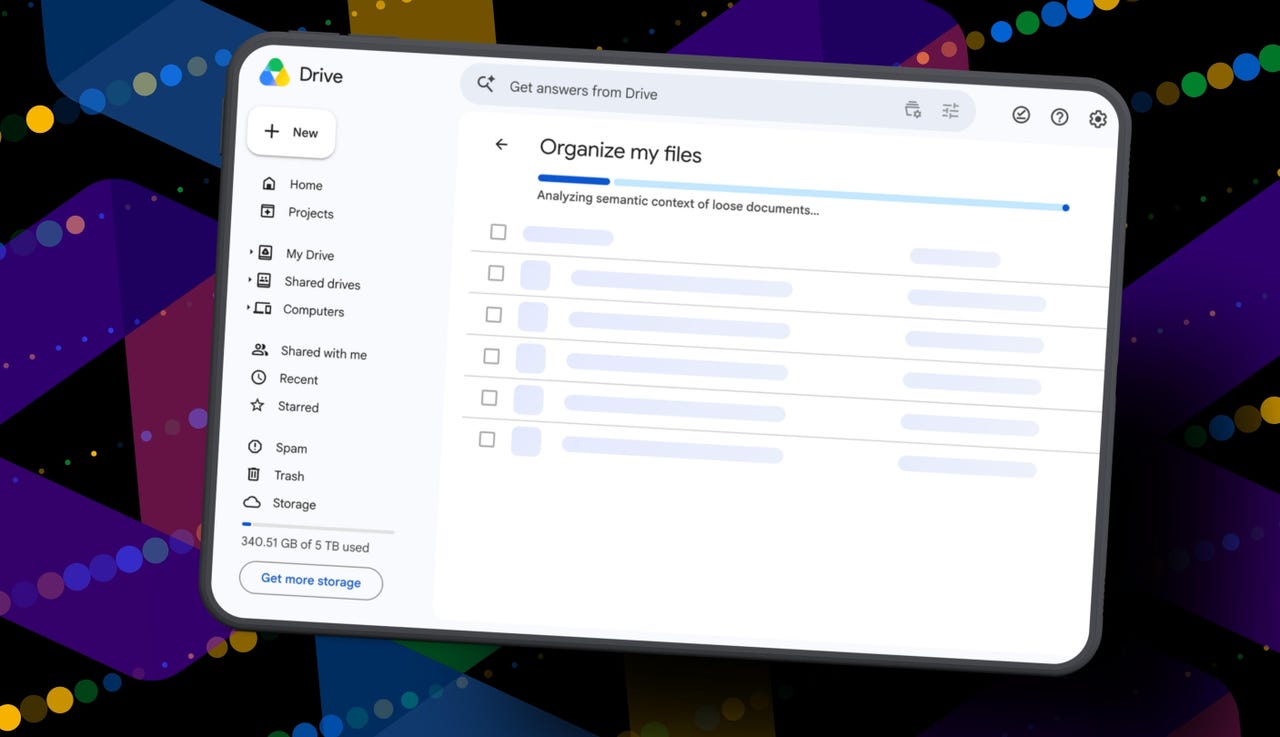
But today I spotted a quiet little launch from Google: its “Organize My Files” feature is now available. Can Gemini actually, truly help me declutter, organize, and simplify my Drive now? Apparently, it uses Gemini AI to suggest moving loose files in Drive into existing folders or creating new folders for related files. And I get to review everything before anything moves.

Also: I tried Gmail’s new Gemini AI features, and I want to unsubscribe

If this works, maybe one day I can move my data out of Drive and cancel my Google AI Pro plan for good. Maybe. One day.

How Organize My Files works

What you’ll need: A Google account with a messy-as-hell Drive. Oh, and Google’s “Organize My Files” feature is currently limited to Google Workspace and Google AI subscribers. Workspace smart features must also be enabled for it to appear in Drive.

Open Google Drive

Elyse Betters Picaro / ZDNET

Look toward the top of the file and folder list in My Drive for a new button called “Suggest File Moves.” Google said it will appear in My Drive as well as in parent folders in Drive. 

Clicking Suggest File Moves opens a new Organize My Files window, where Gemini will begin analyzing loose files and suggesting ways to clean them up.

Also: This Gemini setting made my AI results way more personal


Show more

Click Suggest File Moves

Elyse Betters Picaro / ZDNET

After a minute or so, Gemini serves up recommendations to review. They’re divided into two main types:

  • Gemini may suggest moving files into existing folders in Drive.
  • Gemini may suggest creating new folders for related groups of files.

All files and folders can be previewed through hovercards or opened in a new tab for a closer look.

Also: Is Google’s AI Ultra plan worth $100/month?


Show more

Review Gemini's suggestions

Elyse Betters Picaro / ZDNET

It’s time to use the checkboxes to select or deselect any file or folder that Gemini served up. 

Also, if a suggested folder name is weird, just rename it. Check destinations for folders, too. If they aren’t right, change the target. Once the suggestions do look right and you’re happy, approve the changes.

Gemini will then perform the file or folder moves in one batch and return to My Drive.

Also: I used Nano Banana 2 to make perfect sketchnotes: 5 lessons


Show more

Approve the changes

Elyse Betters Picaro / ZDNET

My result

After all that, Gemini suggested 19 moves for me. Nineteen. And it mostly surfaced recent files I had created or uploaded.

Some of the suggestions made sense. Gemini wanted to move my resume and a couple of resumes I had helped family members create into an existing resume folder. It also suggested creating a new Family and Real Estate folder for house deed documents, plus a Travel Planning folder for upcoming summer trip itineraries I have stored in Drive. But one of the files it grouped under Travel Planning was literally called “Delete,” because it’s a doc I want to delete. Gemini did not realize that, nor did it suggest deleting it.

To be clear, I have hundreds of gigabytes of data and years of clutter sitting in Google Drive.

Also: How I unlocked another 15GB of Gmail storage for free

Still, I approved the changes Gemini recommended. For the heck of it, I ran the tool again. In about 30 seconds, it suggested the same thing: the same file moves, the same new folders, and the same changes it had just made. This feels half-baked.

It’s not at all the sweeping cleanup assistant for Drive that I was hoping for and need. Maybe it will get better over time. It did just come out of beta, and it’s possible Google will improve how Gemini scans Drive, prioritizes older files, recognizes obvious trash, and surfaces deeper organization suggestions. I just don’t want to have to click it 500 times, hoping it finds something new each time.

Looks like I’m still stuck with a messy Drive and a $20 AI Pro subscription… for now.


Source link