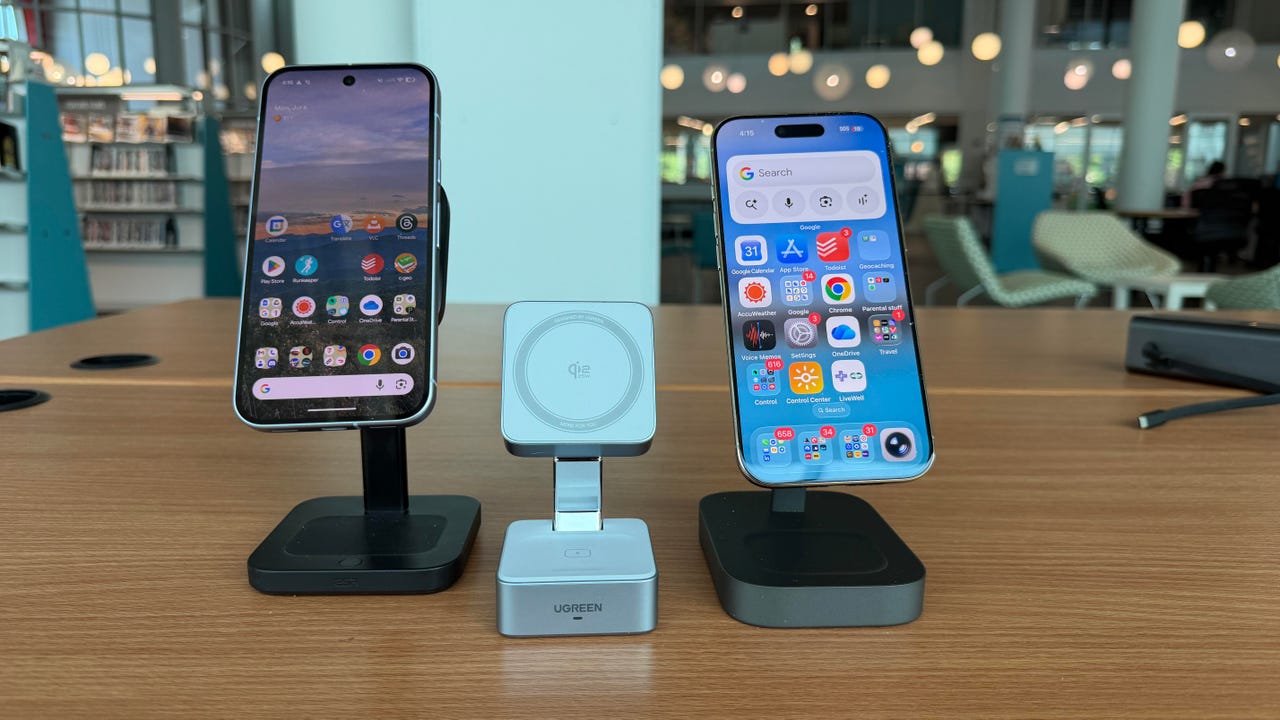
I tested 3 wireless chargers to see which keeps my phones cool – what I learned surprised me


charging-leader

Adam Doud/ZDNET

Follow ZDNET: Add us as a preferred source on Google.


ZDNET’s key takeaways

  • Magnetic wireless chargers use different methods to fight heat.
  • I tested three different stations to see which works best.
  • The results were surprising.

To those of us who have been longtime fans of wireless charging — even going back to the days of the Palm Pre — one thing has remained certain: When you pick up your phone, it’s going to be warm. 

As it turns out, transmitting electricity through the air is going to heat things up, and that can be not ideal for your battery. When I got on the phone with the folks at Mophie, they were excited to tell me about its new charging stand.

Also: I cracked open a ‘1,000W’ portable charger after it failed me in minutes – and wished I hadn’t

According to CMO Brian Oleska, the 4-in-1 charger features StealthCharge Technology, which is Qi2.2-certified for 25W of wireless charging. But it passively keeps your phone cooler by positioning most of the charging components away from the charging pad and in the base of the stand. The metal of the stand acts as a heat sink, keeping your phone cooler. 

As for the charging coil, it comes with its own heat sink. In theory, this keeps your phone and its battery cooler overall, and it’s also silent — there’s no fan cooling the charger.

Testing with Apple and Google

So, I wanted to test it out. 

Mophie sent the 4-in-1 charging stand, which includes a watch charger, an additional Qi pad for AirPods, and a retractable wired cable as well. I tested this charger against a Ugreen Qi2 25W Magflow wireless charger, which monitors the temperature of the phone to prevent overheating, and an ESR Qi2.2 3-in-1 charging stationwith its CryoBoost fan-cooling technology.

To conduct the test, I used an iPhone Air and a Google Pixel 10, both of which have integrated magnets in the back of the phone to support Qi2.2 charging. The iPhone Air supports up to 20W of wireless charging, and the Pixel 10 supports up to 15W. Of course, we’ve learned that the wattage advertised by phone companies isn’t necessarily what you’re getting.

img-6595

Adam Doud / ZDNET

For testing, I discharged the phone to somewhere below 20%, and I charged the phone for 30 minutes using each stand. 

Then, I measured the heat of the charging pad on the charger itself, the back of the phone (on the logo), and the camera bump with a thermometer gun. I measured the camera island on each phone for different reasons. 

The iPhone Air famously keeps its processor (and basically everything else) in the camera pill, while the visor on the back of the Pixel 10 is the only metal component on the back of the phone, so if there’s a good place to find heat, it’s there.

Here’s what happened

Of the three chargers, the ESR kept both phones cooler, with temperature increases of 13.1 and 14.8 degrees Fahrenheit for the iPhone Air and the Pixel 10, respectively. That’s not surprising, since it uses an active cooling mechanism (read: a fan). According to Mophie, the benefit of using its charger is that it’s silent since there is no fan. 

Practically speaking, the fan in the ESR charger is basically a non-issue. Yes, there is noise, but it’s incredibly faint.

screenshot-2026-06-30-204221.png

Adam Doud / ZDNET

The Mophie charger kept the charging pad and the iPhone Air cooler, but the Pixel 10 and charging pad were cooler on the Ugreen charger than on the Mophie charger. The Ugreen charger doesn’t have a cooling mechanism except for an internal heat monitor that can adjust charging levels on the fly. Then again, that’s with an Android phone, and the Mophie charger is designed for the iPhone. 

From an engineering standpoint, I’m not 100% positive what difference that makes.

Also: I cracked open cheap charging gadgets from Temu – and it was worse than I expected

Finally, just for fun, I plugged in the iPhone Air to a wired charger for 30 minutes. 

It charged 44% of the battery, and it increased the temperature of the battery by 17.1 degrees — about the same as the Ugreen wireless charger — and it increased the camera island temperature by 23.9 degrees. So, overall, wired charging heated up the iPhone more than any of the wireless chargers, which makes sense, but I never really thought about it before.

Overall, it makes me wonder if heat is really the problem. Now, I’m not so sure. 

But what I have learned is that the method by which your wireless charging stand tries to dissipate heat isn’t as important as other things, such as whether it can charge other devices and how portable it is overall. At the end of the day, a charging phone is going to get warm, and there’s not a heck of a lot you can do about it.





Source link

Leave a Reply

Subscribe to Our Newsletter

Get our latest articles delivered straight to your inbox. No spam, we promise.

Recent Reviews


What Is Invoice Factoring in Plain English?

At its core, invoice factoring (also known as accounts receivable financing) is about selling your invoices to a factoring company in exchange for immediate cash. You’ll usually get 70–90% upfront, then the remainder (minus fees) once your customer pays.

This is not a loan. You’re not creating new debt or taking on monthly repayments. You’re simply trading tomorrow’s receivables for today’s working capital.

👉 Forbes Advisor explains invoice factoring as one of the most practical ways small businesses improve liquidity.


How Does Invoice Factoring Work?

Here’s the play-by-play:

  1. You invoice your customer for goods or services.

  2. Instead of waiting for them to pay, you sell that invoice to a factoring company.

  3. The factoring company advances you 70–90% of the invoice value.

  4. They collect directly from your customer.

  5. When the customer pays, you receive the remaining balance, minus factoring fees.

Example: You invoice a client for $50,000. A factor gives you 85% upfront ($42,500). Your client pays in 45 days. After collecting their fee (say 2%), the factor pays you the rest ($6,500). End result: You didn’t wait 45 days to get paid.

đź’ˇ Pro Tip: Pair invoice factoring with a revolving line of credit for maximum flexibility in managing cash flow gaps.


Invoice Factoring vs. Invoice Financing

They sound similar, but there’s a big difference:

Invoice Factoring Invoice Financing
Sell invoices outright Borrow against invoices
Factor collects payment You still collect
Not treated as debt Loan repayment required
Transparent but higher cost Often cheaper but more responsibility

👉 If you prefer to stay in control of collections, invoice financing might work better. But if you just want fast cash and less admin, factoring is the way to go.


Pros and Cons of Invoice Factoring

Pros Cons
✅ Immediate access to working capital ❌ More expensive than bank loans
✅ Based on customer creditworthiness ❌ Customers know factoring is in place
✅ No new debt or repayments ❌ Limited to B2B invoices
✅ Supports cash flow management ❌ Recourse factoring = you take the risk

💡 Pro Tip: If you’re worried about non-paying customers, look for non-recourse factoring. It costs more, but the factor—not you—takes the hit if your client defaults.


Who Uses Invoice Factoring?

Certain industries rely heavily on factoring because slow-paying customers are the norm. Top sectors include:

  • Trucking & logistics: Carriers often wait 30–90 days for brokers or shippers to pay. Factoring ensures they cover fuel and payroll immediately.

  • Staffing agencies: Weekly payroll but client invoices that pay monthly? Factoring bridges that gap.

  • Construction & subcontracting: Payment delays are common due to project milestones. Receivables financing through construction business loans keep crews running.

  • Wholesale & manufacturing: Large-volume orders often come with long terms. Factoring maintains liquidity.

  • Marketing & creative agencies: Agencies billing retainers or project-based fees often use factoring to smooth out revenue cycles.

👉 Fun fact: Staffing and trucking together account for the majority of factoring volume in the U.S.


How to Choose the Right Factoring Company

Not all factoring companies are created equal. Before signing a deal, compare:

  • Fees & transparency: Is it a flat fee or tiered by days outstanding?

  • Advance rates: Some offer 70%, others 95%.

  • Contract length: Month-to-month is flexible; year-long contracts can trap you.

  • Industry expertise: A factor that knows trucking ≠ one that specializes in creative agencies.

  • Non-recourse vs. recourse: Decide how much risk you want to carry.

For a deeper look, read Wolters Kluwer’s guide on factoring and cash flow.


Costs & Fees of Factoring Receivables

Typical fees run 1–5% per month depending on invoice size, industry, and risk. The longer your client takes to pay, the higher the fee.

Two key costs to look for:

  1. Factoring Fee (Discount Rate): Percentage of the invoice charged.

  2. Reserve Hold: Portion of the invoice held back until payment clears.

đź’ˇ Pro Tip: Always check if the factor files a UCC-1 lien. This filing can block you from getting other types of financing until the lien is released.


Real Case: Startup Scales With Invoice Factoring

A small tech startup wanted to grow but didn’t want to take on venture capital or debt. By factoring their invoices, they accessed quick cash, hired aggressively, and scaled operations. Within three years, they sold for $35 million—without giving up equity.

That’s the power of cash flow management through factoring.


Alternatives to Invoice Factoring

Invoice factoring is great—but it’s not the only way to fund your business. Alternatives include:

  • SBA 7a loans: Lower cost, but longer approval timelines. 

  • Business credit cards: Fast but can carry high interest.

  • Lines of credit: Flexible but harder to qualify for.

  • Revenue-based financing: Funding based on your sales.

đź’ˇ Pro Tip: Use factoring for short-term cash flow gaps, but consider long-term financing for expansion projects.


Source link